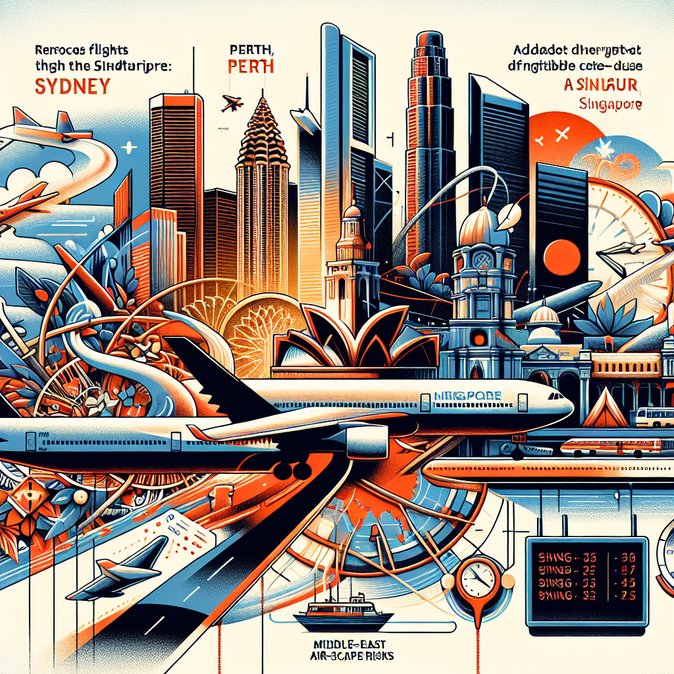
Qantas Airways is once again having to re-draw its long-haul route map as the security crisis in the Middle East spills over into commercial aviation. In an advisory circulated to industry partners and confirmed by the Centre for Aviation (CAPA), the airline said it will temporarily route its Sydney–Perth–Paris Charles-de-Gaulle service through Singapore from 20 April until at least 26 July 2026. North- and south-bound sectors will alternate between a technical stop and full passenger change-over in Singapore depending on the week of operation. The change is a direct response to restricted airspace and higher insurance premiums triggered by Iranian missile activity around the Strait of Hormuz and the Gulf region. Qantas has already been operating its flagship Perth–London “Kangaroo Route” through Singapore instead of the shorter over-Iran track since February; the Paris service is the latest casualty. The airline says it is “closely monitoring the evolving situation” and will restore non-stop services as soon as over-flight corridors are deemed safe and commercially viable. For corporate travel managers the detour means longer block times—up to two extra hours each way—and fresh connection risks for onward itineraries into continental Europe. Travellers booked on the affected flights are being re-issued e-tickets with updated times, and Qantas is allowing fee-free date changes or refunds for those who can no longer meet business commitments.
![Qantas reroutes Australia–France flights via Singapore amid Middle-East conflict]()
Before setting out, passengers should also double-check visa requirements, especially if their itinerary now involves a transit or stopover in Singapore. VisaHQ can simplify this process for both individuals and corporate travel departments by providing real-time guidance and expedited visa processing through its Australian portal (https://www.visahq.com/australia/), ensuring travel plans stay compliant despite last-minute route changes.
Cargo capacity is also tighter because of Singapore’s weight-restricted runway slots, prompting forwarders to warn exporters of possible delays for high-value perishables. More broadly, the episode underscores how geopolitical flashpoints continue to disrupt carefully calibrated ultra-long-haul networks. Airlines operating across Eurasia now face a patchwork of closed skies—from Russia and Ukraine in the north to Yemen and Iran in the south—leaving only a handful of narrow corridors. Until a sustained de-escalation materialises, Australian companies should build extra lead-time into travel schedules and re-confirm critical meetings in Europe.
Before setting out, passengers should also double-check visa requirements, especially if their itinerary now involves a transit or stopover in Singapore. VisaHQ can simplify this process for both individuals and corporate travel departments by providing real-time guidance and expedited visa processing through its Australian portal (https://www.visahq.com/australia/), ensuring travel plans stay compliant despite last-minute route changes.
Cargo capacity is also tighter because of Singapore’s weight-restricted runway slots, prompting forwarders to warn exporters of possible delays for high-value perishables. More broadly, the episode underscores how geopolitical flashpoints continue to disrupt carefully calibrated ultra-long-haul networks. Airlines operating across Eurasia now face a patchwork of closed skies—from Russia and Ukraine in the north to Yemen and Iran in the south—leaving only a handful of narrow corridors. Until a sustained de-escalation materialises, Australian companies should build extra lead-time into travel schedules and re-confirm critical meetings in Europe.