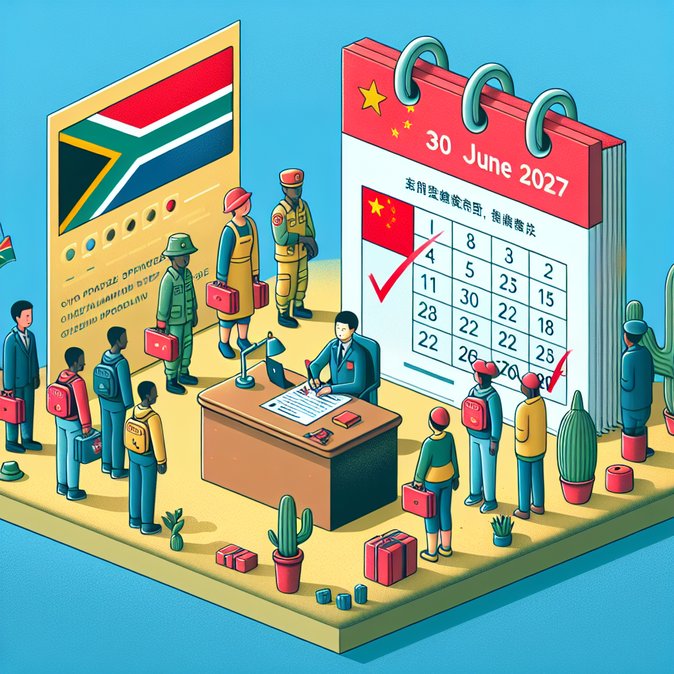
South Africa’s Department of Home Affairs has issued Immigration Directive No. 7 of 2026, giving foreign nationals whose visa-extension or status-change applications are still pending an automatic grace period until 30 June 2027. The concession—announced on 6 April by industry publication Travel and Tour World—explicitly covers Chinese tourists, students and assignees caught in the country’s long-running processing delays. Under the directive, applicants who lodged in-country requests before their previous visas expired may remain, work or study lawfully while waiting for outcomes, without facing overstay penalties at departure. They must, however, keep proof of submission and update contact details with Home Affairs.
![South Africa Grants Chinese Visitors Legal Stay Until June 2027 Amid Visa Backlog]()
For travelers who prefer expert assistance rather than navigating Home Affairs’ requirements alone, VisaHQ offers a streamlined service that can pre-screen documentation, book appointments and monitor application progress; its China portal (https://www.visahq.com/china/) also pushes real-time alerts on South African immigration updates, giving Chinese students, tourists and corporate mobility teams a single hub for staying compliant.
The policy is a pragmatic response to a backlog estimated at more than 66,000 cases, caused by staff shortages and an IT overhaul at South Africa’s Visa & Permit Services. Chinese business councils had warned that uncertainty was discouraging investment projects, particularly in mining, automotive assembly and special-economic-zone developments reliant on Chinese engineers. For mobility teams, the directive buys crucial time. Employers can maintain payroll and medical-aid cover for China-origin assignees without resorting to costly “visa-run” flights to neighbouring states. Travel managers should nevertheless diarise 30 June 2027 as the new hard stop and begin filing renewal packets at least six months in advance, because Home Affairs says no further blanket extensions are planned. The move also signals Pretoria’s broader charm offensive toward the Chinese market. Officials confirmed they are studying a five-year, multiple-entry business visa for South Africans travelling to China, aiming for reciprocal facilitation ahead of the BRICS Tourism Ministers’ meeting in August.

For travelers who prefer expert assistance rather than navigating Home Affairs’ requirements alone, VisaHQ offers a streamlined service that can pre-screen documentation, book appointments and monitor application progress; its China portal (https://www.visahq.com/china/) also pushes real-time alerts on South African immigration updates, giving Chinese students, tourists and corporate mobility teams a single hub for staying compliant.
The policy is a pragmatic response to a backlog estimated at more than 66,000 cases, caused by staff shortages and an IT overhaul at South Africa’s Visa & Permit Services. Chinese business councils had warned that uncertainty was discouraging investment projects, particularly in mining, automotive assembly and special-economic-zone developments reliant on Chinese engineers. For mobility teams, the directive buys crucial time. Employers can maintain payroll and medical-aid cover for China-origin assignees without resorting to costly “visa-run” flights to neighbouring states. Travel managers should nevertheless diarise 30 June 2027 as the new hard stop and begin filing renewal packets at least six months in advance, because Home Affairs says no further blanket extensions are planned. The move also signals Pretoria’s broader charm offensive toward the Chinese market. Officials confirmed they are studying a five-year, multiple-entry business visa for South Africans travelling to China, aiming for reciprocal facilitation ahead of the BRICS Tourism Ministers’ meeting in August.