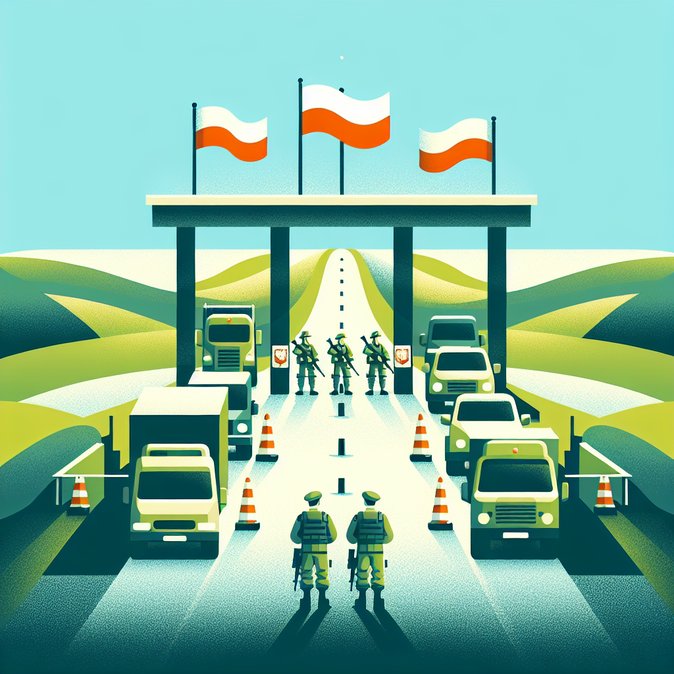
President Karol Nawrocki signed a decree on 3 April authorising the deployment of Polish Armed Forces units to reinforce Border Guard patrols on the frontiers with Germany and Lithuania from 5 April until 1 October 2026. The move follows the government’s decision to prolong temporary Schengen-internal controls on both borders, first introduced in July 2025, amid concerns over migrant smuggling networks using the so-called eastern route. According to the National Security Bureau (BBN), soldiers will help screen vehicles, secure crossing points and maintain public order in a swathe up to 15 km inside the border zone. A pilot introduced in October 2025 saw military engineers install mobile surveillance towers and unmanned ground sensors along key transit corridors such as the A2 and Via Baltica highways.
![President orders Polish troops to support extended border checks with Germany and Lithuania]()
For those preparing trips that may now involve added documentation checks at these internal Schengen borders, VisaHQ’s Poland platform (https://www.visahq.com/poland/) provides real-time entry guidance, streamlined online application tools and expert customer support, helping individual travelers and corporate mobility managers stay compliant and minimize potential delays.
The upgraded operation will now add infantry units and military police to quick-reaction teams. For cross-border commuters, freight hauliers and business travellers, the presence of uniformed troops means more frequent stop-and-search procedures and random vehicle inspections at previously open crossing points, including secondary rural roads. Although delays have so far averaged only 10–15 minutes, logistics firms shipping just-in-time components from German suppliers to Polish plants should factor in possible tailbacks during peak hours or bad weather. Under the Schengen Borders Code, internal controls can be renewed for up to two years, after which Brussels must authorise any further extensions. Warsaw insists the measures are strictly targeted and proportionate; Berlin and Vilnius have so far accepted the justification but will review the security situation again in early autumn. Multinationals rotating staff through Polish subsidiaries are advised to inform employees of documentation checks and to carry company letters confirming purpose of travel.
For those preparing trips that may now involve added documentation checks at these internal Schengen borders, VisaHQ’s Poland platform (https://www.visahq.com/poland/) provides real-time entry guidance, streamlined online application tools and expert customer support, helping individual travelers and corporate mobility managers stay compliant and minimize potential delays.
The upgraded operation will now add infantry units and military police to quick-reaction teams. For cross-border commuters, freight hauliers and business travellers, the presence of uniformed troops means more frequent stop-and-search procedures and random vehicle inspections at previously open crossing points, including secondary rural roads. Although delays have so far averaged only 10–15 minutes, logistics firms shipping just-in-time components from German suppliers to Polish plants should factor in possible tailbacks during peak hours or bad weather. Under the Schengen Borders Code, internal controls can be renewed for up to two years, after which Brussels must authorise any further extensions. Warsaw insists the measures are strictly targeted and proportionate; Berlin and Vilnius have so far accepted the justification but will review the security situation again in early autumn. Multinationals rotating staff through Polish subsidiaries are advised to inform employees of documentation checks and to carry company letters confirming purpose of travel.