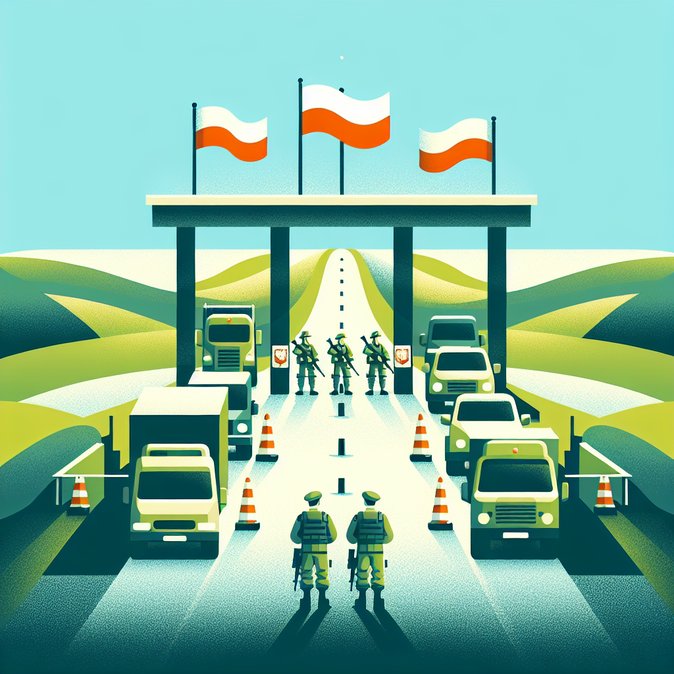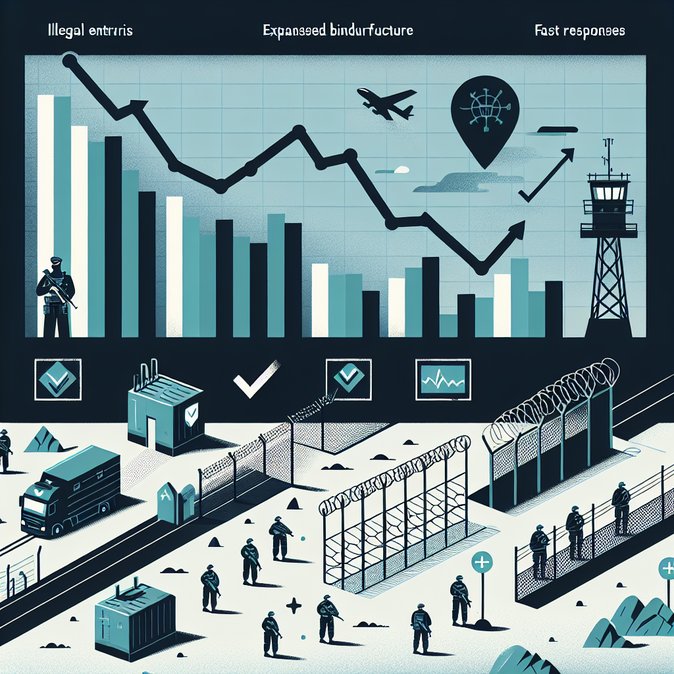
Poland’s Ministry of the Interior and Administration (MSWiA) reported on 4 April that the number of recorded attempts to cross the border from Belarus without authorization has fallen from 3,306 in the first quarter of 2022 to just 158 in the first quarter of 2026—a drop of almost 96 %. The ministry attributes the decline to a package of emergency regulations that temporarily suspend the right to lodge an asylum claim at the border and allow the Border Guard to turn back migrants intercepted on Polish soil. The rules, first introduced in March 2025, have already been renewed six times and remain in force until at least 22 May 2026. Behind the headline figures is the broader “zero-tolerance” strategy Warsaw adopted after Minsk and Moscow were accused of orchestrating migrant flows as a form of hybrid warfare. A five-metre steel fence, thermal-imaging cameras and motion sensors now line 186 km of the frontier, while a separate, PLN 10 billion (EUR 2.3 billion) East Shield programme is reinforcing the entire eastern border with both physical and digital barriers. According to officials, additional mobile patrols and biometric checks have also deterred would-be crossers.
![MSWiA claims 96 % fall in irregular crossings from Belarus after year of "zero-tolerance" measures]()
For travellers and employers who need to ensure their paperwork is in perfect order amid these evolving border controls, VisaHQ provides fast, reliable visa and travel-document assistance for Poland and over 200 other destinations. Its online portal (https://www.visahq.com/poland/) lets users check the latest requirements, submit applications digitally and track processing in real time, reducing the risk of delays when crossing into or out of the country.
The ministry stressed that “migration is under control, but we remain vigilant,” noting that temporary controls on Poland’s land borders with Germany and Lithuania—re-introduced last summer—will stay in place. Those internal-Schengen checks aim to intercept migrants who manage to leave Belarusian territory via Lithuania or Latvia and then try to reach western Europe through Poland. Business travellers crossing by car or train should therefore continue to plan for spot checks and possible delays at major crossings such as Budzisko and Świecko. Human-rights NGOs have criticised the blanket push-back policy, arguing it violates the 1951 Refugee Convention and EU asylum law. So far, Polish courts have largely sided with the government, citing national-security grounds. Companies moving staff across the eastern frontier should ensure employees carry complete documentation and, where possible, use official checkpoints that remain open 24 hours a day. Logistics operators moving goods from Belarus or Russia via Lithuania are advised to monitor wait-time apps provided by the Border Guard. Any resurgence in crossings could prompt Warsaw to extend the restrictions again or tighten carrier-liability rules for bus and coach operators.

For travellers and employers who need to ensure their paperwork is in perfect order amid these evolving border controls, VisaHQ provides fast, reliable visa and travel-document assistance for Poland and over 200 other destinations. Its online portal (https://www.visahq.com/poland/) lets users check the latest requirements, submit applications digitally and track processing in real time, reducing the risk of delays when crossing into or out of the country.
The ministry stressed that “migration is under control, but we remain vigilant,” noting that temporary controls on Poland’s land borders with Germany and Lithuania—re-introduced last summer—will stay in place. Those internal-Schengen checks aim to intercept migrants who manage to leave Belarusian territory via Lithuania or Latvia and then try to reach western Europe through Poland. Business travellers crossing by car or train should therefore continue to plan for spot checks and possible delays at major crossings such as Budzisko and Świecko. Human-rights NGOs have criticised the blanket push-back policy, arguing it violates the 1951 Refugee Convention and EU asylum law. So far, Polish courts have largely sided with the government, citing national-security grounds. Companies moving staff across the eastern frontier should ensure employees carry complete documentation and, where possible, use official checkpoints that remain open 24 hours a day. Logistics operators moving goods from Belarus or Russia via Lithuania are advised to monitor wait-time apps provided by the Border Guard. Any resurgence in crossings could prompt Warsaw to extend the restrictions again or tighten carrier-liability rules for bus and coach operators.