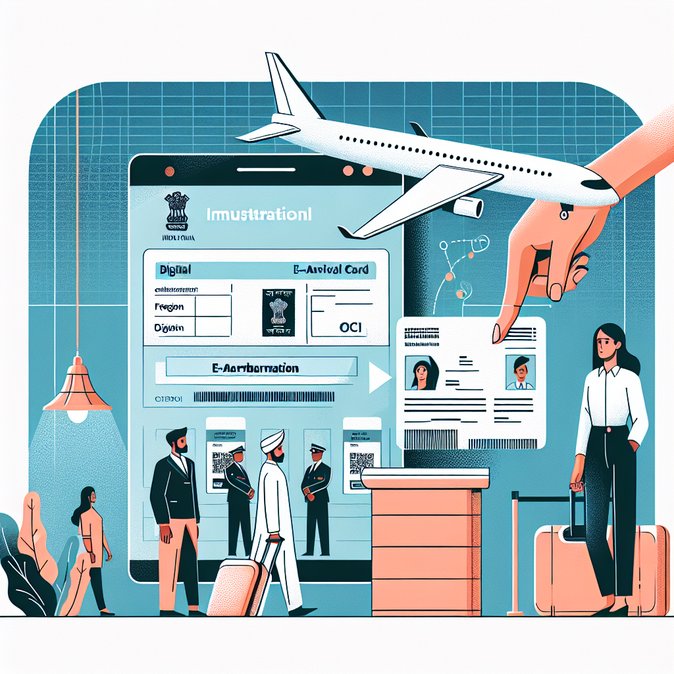
India’s experiment with digitised arrival declarations has moved from pilot to permanent policy. From 1 April 2026, every foreign traveller and Overseas Citizen of India (OCI) card-holder entering the country must complete an electronic Arrival Card (e-AC) no later than 72 hours before landing. The Bureau of Immigration switched off paper disembarkation forms at all airports after a six-month transition that began in October 2025. The e-AC is not a visa; instead it captures key data—flight details, port of entry, purpose of visit, length and place of stay—that border-control algorithms cross-reference with visa records and security watch-lists. Officials say the shift has already trimmed average immigration processing times by up to 40 per cent at Delhi, Mumbai and Bengaluru airports, freeing border‐control staff to focus on higher-risk secondary inspections. Families of up to five can file a single consolidated form, and travellers receive a QR code that is scanned alongside their passports at automated counters.
![India Finalises Full Roll-Out of Mandatory e-Arrival Card for All International Passengers]()
For travellers who would rather not navigate the new rules alone, VisaHQ’s India portal (https://www.visahq.com/india/) streamlines the process by combining visa application services with step-by-step e-AC guidance, deadline reminders and live support, ensuring paperwork is filed correctly and on time.
For corporate mobility managers the stakes are clear. Airlines are enforcing a “no form, no boarding” rule similar to many destination countries’ electronic travel declarations. Multinationals have begun embedding e-AC reminders in their travel-approval workflows; failure to file can mean long queues and missed onward connections. Frequent-traveller programmes are also being updated so that profiles pre-populate the form, reducing friction for executives who shuttle in and out of India’s tech and manufacturing hubs. The requirement dovetails with India’s broader Immigration, Visa, Foreigners Registration & Tracking (IVFRT) overhaul, a ₹1,800-crore initiative that is upgrading everything from trusted-traveller e-gates to predictive analytics. Ultimately, authorities hope the data lake created by the e-AC will power real-time risk modelling similar to systems used in Singapore and Australia—an essential capability as India targets 100 million annual international arrivals by 2030. Travellers should bookmark the Bureau of Immigration portal, indianvisaonline.gov.in, or download the Su-Swagatam mobile app. While a grace period is in effect this week, immigration officers have warned that manual, on-arrival data entry will be allowed only in exceptional cases such as medical emergencies.

For travellers who would rather not navigate the new rules alone, VisaHQ’s India portal (https://www.visahq.com/india/) streamlines the process by combining visa application services with step-by-step e-AC guidance, deadline reminders and live support, ensuring paperwork is filed correctly and on time.
For corporate mobility managers the stakes are clear. Airlines are enforcing a “no form, no boarding” rule similar to many destination countries’ electronic travel declarations. Multinationals have begun embedding e-AC reminders in their travel-approval workflows; failure to file can mean long queues and missed onward connections. Frequent-traveller programmes are also being updated so that profiles pre-populate the form, reducing friction for executives who shuttle in and out of India’s tech and manufacturing hubs. The requirement dovetails with India’s broader Immigration, Visa, Foreigners Registration & Tracking (IVFRT) overhaul, a ₹1,800-crore initiative that is upgrading everything from trusted-traveller e-gates to predictive analytics. Ultimately, authorities hope the data lake created by the e-AC will power real-time risk modelling similar to systems used in Singapore and Australia—an essential capability as India targets 100 million annual international arrivals by 2030. Travellers should bookmark the Bureau of Immigration portal, indianvisaonline.gov.in, or download the Su-Swagatam mobile app. While a grace period is in effect this week, immigration officers have warned that manual, on-arrival data entry will be allowed only in exceptional cases such as medical emergencies.