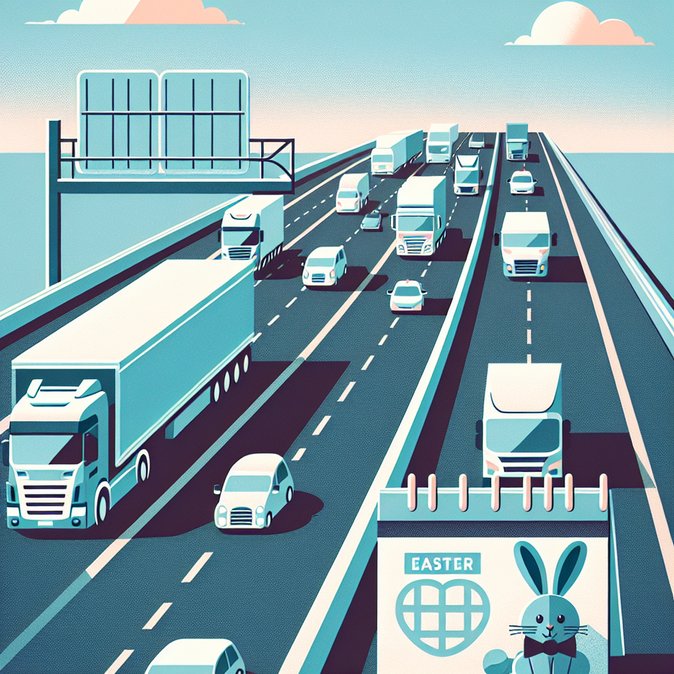
Logistics planners are bracing for one of the toughest weeks of the year as France joins 14 other European countries in imposing heavy-goods-vehicle (HGV) driving bans over the Easter period. According to border-monitor Nakordoni’s 4 April bulletin, France will prohibit trucks over 7.5 t from 22:00 Saturday to 22:00 Monday, with a full 24-hour stop on Easter Sunday. The French ban applies to the entire national road network, although exemptions exist for perishable food, fuel tankers and livestock.
![France Enforces 24-Hour Easter Truck Ban, Part of Europe-Wide Heavy-Goods Restrictions]()
For international drivers and logistics managers who also need to coordinate last-minute travel documentation for crew rotations or troubleshoot visa renewals while rerouting around the Easter shutdown, VisaHQ offers a fast, online solution. Its France portal (https://www.visahq.com/france/) provides streamlined applications, document checklists and live status updates, allowing teams to stay focused on load planning instead of embassy queues.
Violations attract on-the-spot fines of €135–€750 and possible immobilisation of the vehicle. The restriction dovetails with similar blockades in Germany, Italy and Austria, effectively shutting the main north-south freight corridors. Manufacturers operating just-in-time pipelines—especially the automotive and aerospace clusters around Toulouse and Lyon—have advanced shipments or rerouted via Spanish ports. Express consignments and critical spare parts are being shifted to smaller 3.5-t vans, which fall below the ban threshold, or to air-freight via Paris-CDG. Global mobility teams should note that household-goods consignments for relocating staff may also be delayed if they are moved by standard 40-t artics. Forwarders recommend scheduling load-outs either before noon on Saturday or after 22:00 on Monday, and allowing at least 24 hours’ slack in tenancy start-dates. Looking ahead, EU ministers are debating a proposal to harmonise public-holiday truck bans to improve supply-chain predictability; France supports the idea but only if derogations for perishables remain.

For international drivers and logistics managers who also need to coordinate last-minute travel documentation for crew rotations or troubleshoot visa renewals while rerouting around the Easter shutdown, VisaHQ offers a fast, online solution. Its France portal (https://www.visahq.com/france/) provides streamlined applications, document checklists and live status updates, allowing teams to stay focused on load planning instead of embassy queues.
Violations attract on-the-spot fines of €135–€750 and possible immobilisation of the vehicle. The restriction dovetails with similar blockades in Germany, Italy and Austria, effectively shutting the main north-south freight corridors. Manufacturers operating just-in-time pipelines—especially the automotive and aerospace clusters around Toulouse and Lyon—have advanced shipments or rerouted via Spanish ports. Express consignments and critical spare parts are being shifted to smaller 3.5-t vans, which fall below the ban threshold, or to air-freight via Paris-CDG. Global mobility teams should note that household-goods consignments for relocating staff may also be delayed if they are moved by standard 40-t artics. Forwarders recommend scheduling load-outs either before noon on Saturday or after 22:00 on Monday, and allowing at least 24 hours’ slack in tenancy start-dates. Looking ahead, EU ministers are debating a proposal to harmonise public-holiday truck bans to improve supply-chain predictability; France supports the idea but only if derogations for perishables remain.