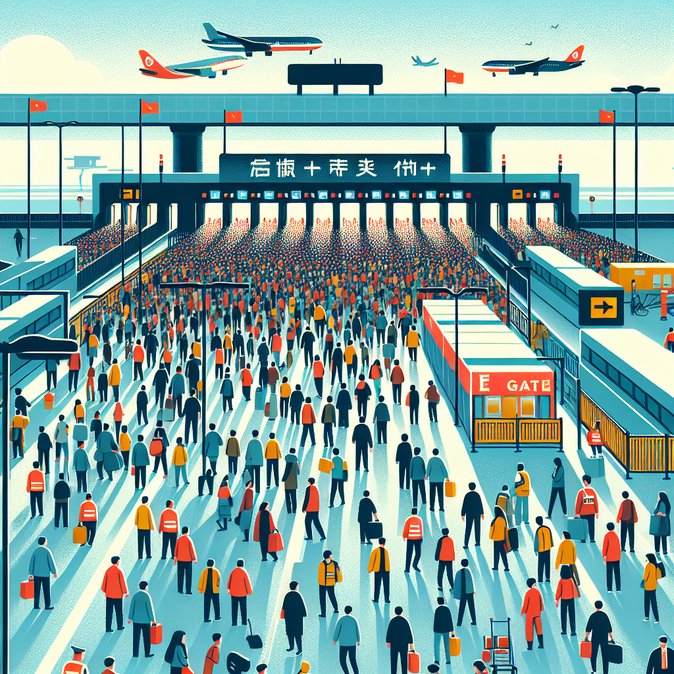
China’s National Immigration Administration (NIA) expects daily inbound and outbound passenger volumes to exceed 2.3 million during the Qingming Festival period (4–6 April 2026), representing an 11.1 % jump on last year’s holiday window. The busiest hubs—Shanghai Pudong, Guangzhou Baiyun, Beijing Capital, Chengdu Tianfu and Shenzhen Bao’an—are gearing up for round-the-clock peak operations, with Pudong alone forecast to handle 95,000 border clearances per day. To manage the surge, the NIA has deployed 1,200 additional officers and activated ‘smart channel’ e-gates at secondary airports such as Changsha and Xiamen. Land checkpoints at Shenzhen’s Futian Port and the Hong Kong-Zhuhai-Macau Bridge are adding temporary lanes for Macao tour coaches and cross-border trucking.
![Immigration Authority Projects 11 % Rise in Cross-Border Trips During Qingming Holiday]()
Travelers who still need to secure visas, entry permits or invitation letters can save time by using VisaHQ’s end-to-end online service (https://www.visahq.com/china/), which aggregates the latest consular requirements and submits applications on your behalf—an especially handy option for companies coordinating last-minute Qingming travel.
Ferry operators between Xiamen and Kinmen and cruise terminals in Shanghai and Tianjin have likewise extended operating hours. For corporates scheduling expatriate travel, authorities recommend arriving at airports at least three hours before departure and pre-completing digital health-declaration forms in the China Immigration mini-program. Logistic providers have been told to stagger cargo-vehicle departures to avoid bottlenecks in Horgos and Manzhouli, where fresh-produce consignments historically face clearance delays around public holidays. The expected spike underscores the rapid rebound of outbound Chinese tourism; Ctrip data show flight and hotel bookings for the three-day weekend up 37 % on 2025. Destinations within four hours’ flying time—Japan, South Korea and Singapore—are the top beneficiaries, but long-haul routes to the UAE and France are also back to 90 % of pre-pandemic capacity. Businesses should anticipate tighter hotel availability in tier-one cities and consider flexible-working arrangements for employees travelling home to tend ancestral graves, the core tradition of Qingming.

Travelers who still need to secure visas, entry permits or invitation letters can save time by using VisaHQ’s end-to-end online service (https://www.visahq.com/china/), which aggregates the latest consular requirements and submits applications on your behalf—an especially handy option for companies coordinating last-minute Qingming travel.
Ferry operators between Xiamen and Kinmen and cruise terminals in Shanghai and Tianjin have likewise extended operating hours. For corporates scheduling expatriate travel, authorities recommend arriving at airports at least three hours before departure and pre-completing digital health-declaration forms in the China Immigration mini-program. Logistic providers have been told to stagger cargo-vehicle departures to avoid bottlenecks in Horgos and Manzhouli, where fresh-produce consignments historically face clearance delays around public holidays. The expected spike underscores the rapid rebound of outbound Chinese tourism; Ctrip data show flight and hotel bookings for the three-day weekend up 37 % on 2025. Destinations within four hours’ flying time—Japan, South Korea and Singapore—are the top beneficiaries, but long-haul routes to the UAE and France are also back to 90 % of pre-pandemic capacity. Businesses should anticipate tighter hotel availability in tier-one cities and consider flexible-working arrangements for employees travelling home to tend ancestral graves, the core tradition of Qingming.