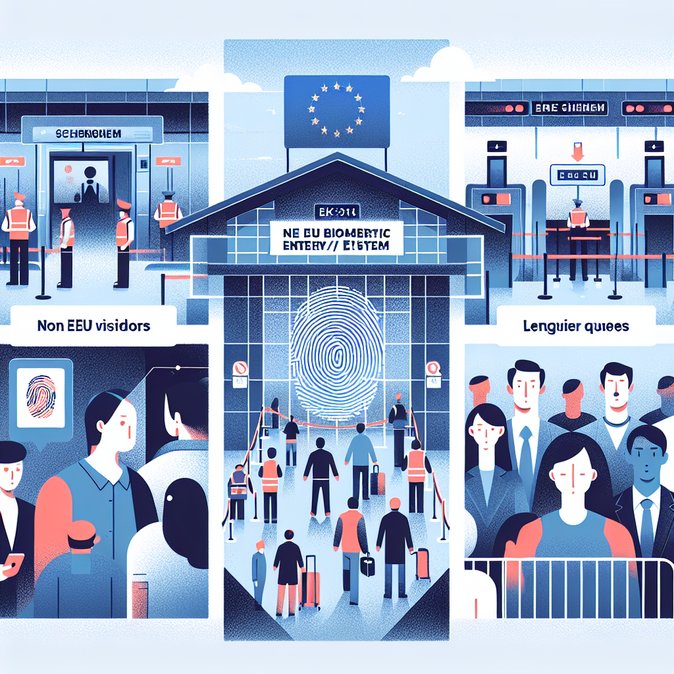
Schengen border control just became biometric. As of 31 March the European Union’s new Entry/Exit System (EES) is operational at all external air, land and sea checkpoints, replacing passport stamps with a digital record of each non-EU traveller’s name, facial image, fingerprints and travel-document data. Full implementation is slated for 10 April, but airports are already enrolling up to half of arrivals. For Chinese passport-holders the change is procedural—not a new visa—but it carries practical implications. First-time entrants after 31 March will be asked to scan their passport at an EES kiosk or desk and provide four fingerprints and a live photo; subsequent crossings merely verify that profile.
![EU Entry/Exit System goes live—what Chinese business travellers need to know]()
Need help navigating these shifting requirements? VisaHQ’s China portal (https://www.visahq.com/china/) offers step-by-step guidance on Schengen visas, real-time updates on EES roll-outs and handy tools for tracking stay calculations, so travellers and mobility managers can stay compliant without the guesswork.
Border agencies say the process averages 45–60 seconds, yet airlines warn peak queues could hit two hours until travellers familiarise themselves with kiosks. The system automatically calculates the 90/180-day Schengen allowance and flags overstays. Mobility managers must therefore tighten day-count tracking for staff who shuttle between EU clients. Employees transiting multiple Schengen states on the same trip will no longer receive physical stamps, so HR should rely on flight or hotel records—and eventually the EES portal (not yet open to travellers)—for audit trails. Data privacy is a secondary concern. The EU stores biometric data for three years; overstayers’ data are kept for five. Chinese firms with EU-based teams should brief travellers on consent requirements and advise them to leave extra time at immigration, particularly at Paris CDG, Frankfurt and Madrid, where bottlenecks during trial phases were most acute. Children as young as six must enrol, so family-accompanied assignees should prepare accordingly. Looking ahead, the EU’s ETIAS pre-travel authorisation is due in Q4 2026. The Commission insists that ETIAS and EES will be interoperable, meaning Chinese visa-exempt travellers (e.g., holders of Schengen visas issued in Hong Kong) will complete ETIAS online before departure and then clear EES on arrival—adding one more layer to global mobility planning.

Need help navigating these shifting requirements? VisaHQ’s China portal (https://www.visahq.com/china/) offers step-by-step guidance on Schengen visas, real-time updates on EES roll-outs and handy tools for tracking stay calculations, so travellers and mobility managers can stay compliant without the guesswork.
Border agencies say the process averages 45–60 seconds, yet airlines warn peak queues could hit two hours until travellers familiarise themselves with kiosks. The system automatically calculates the 90/180-day Schengen allowance and flags overstays. Mobility managers must therefore tighten day-count tracking for staff who shuttle between EU clients. Employees transiting multiple Schengen states on the same trip will no longer receive physical stamps, so HR should rely on flight or hotel records—and eventually the EES portal (not yet open to travellers)—for audit trails. Data privacy is a secondary concern. The EU stores biometric data for three years; overstayers’ data are kept for five. Chinese firms with EU-based teams should brief travellers on consent requirements and advise them to leave extra time at immigration, particularly at Paris CDG, Frankfurt and Madrid, where bottlenecks during trial phases were most acute. Children as young as six must enrol, so family-accompanied assignees should prepare accordingly. Looking ahead, the EU’s ETIAS pre-travel authorisation is due in Q4 2026. The Commission insists that ETIAS and EES will be interoperable, meaning Chinese visa-exempt travellers (e.g., holders of Schengen visas issued in Hong Kong) will complete ETIAS online before departure and then clear EES on arrival—adding one more layer to global mobility planning.