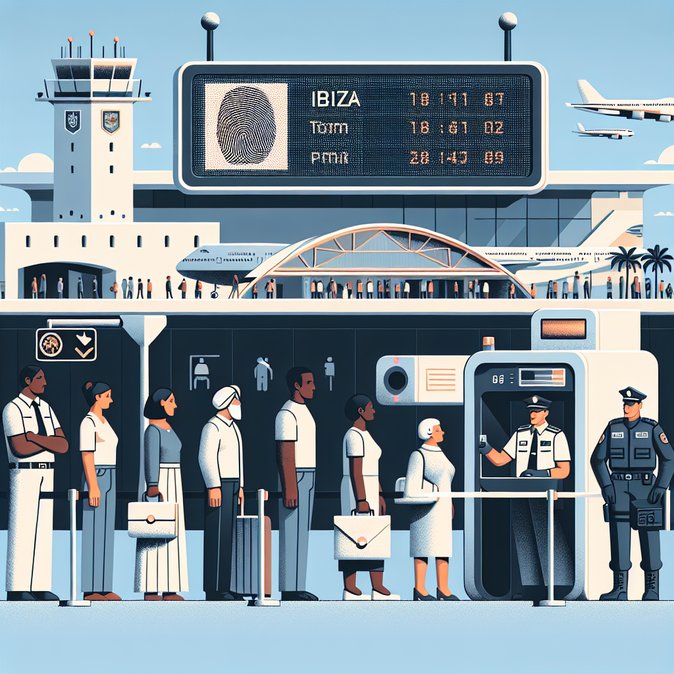
Ibiza’s international gateway is sprinting to finish one of the most complex technology upgrades ever undertaken at a Spanish regional airport: full-scale deployment of the European Union’s new Entry/Exit System (EES). The automated border-management platform, already in pilot use at several continental hubs, will register the biometric data and travel history of every non-EU visitor, replacing the manual passport stamps still familiar to millions of United Kingdom holiday-makers. Airport director Marta Torres confirmed this week that construction crews are working double shifts to embed e-gates, biometric kiosks and secure server rooms before the first Easter charter flights touch down in early April. Once live, the system will scan passport chips, capture four fingerprints and a facial image, and instantly cross-check stay limits across the 26-nation Schengen Area. Authorities hope the digital ledger will curb document fraud and visa over-stays, but Torres acknowledged that the learning curve could create visible queues. To blunt the impact, Aena and Spain’s National Police will deploy extra staff on arrival peaks and position roving “blue-vest” teams to guide travellers through the new process.
Business-travel managers are already recalibrating itineraries.
![Ibiza Airport accelerates installation of EU Entry/Exit System ahead of summer rush]()
To ensure the paperwork keeps pace with these new biometric checks, online visa specialist VisaHQ can streamline Spain-bound applications, provide real-time status updates, and offer expert support for corporate travel planners and holiday-goers alike—visit https://www.visahq.com/spain/ for details.
Consulting firm CWT predicts average dwell time at Ibiza’s non-EU booths could initially double from three to six minutes per passenger, a risk for tight connections to mainland meetings. Airlines serving the UK market are adjusting block times by 5-10 minutes and warning corporate clients to build additional buffers into day-return schedules. Although EES is an EU-wide mandate, airports can stagger the roll-out. Ibiza volunteered to be an early adopter to avoid a “big-bang” switch during the peak July–August corridor, when the island can process more than 50,000 passengers a day. The Balearic government also sees long-term upside: granular flow data will help justify infrastructure grants and fine-tune policing rosters during the music-festival season, when night-time charter arrivals spike. For companies moving staff in and out of Spain this summer, the advice is clear: 1) ensure British and other third-country nationals have passports with NFC chips that still read reliably; 2) brief employees on the fingerprint and face-scan requirement, which includes minors from age six; and 3) schedule the first post-EES trips as “soft landings,” avoiding meetings within two hours of landing. Torres says the airport will publish real-time queue estimates in its app once the system goes live, giving travel managers a last-mile tool to keep projects—and holiday plans—on track.
Business-travel managers are already recalibrating itineraries.

To ensure the paperwork keeps pace with these new biometric checks, online visa specialist VisaHQ can streamline Spain-bound applications, provide real-time status updates, and offer expert support for corporate travel planners and holiday-goers alike—visit https://www.visahq.com/spain/ for details.
Consulting firm CWT predicts average dwell time at Ibiza’s non-EU booths could initially double from three to six minutes per passenger, a risk for tight connections to mainland meetings. Airlines serving the UK market are adjusting block times by 5-10 minutes and warning corporate clients to build additional buffers into day-return schedules. Although EES is an EU-wide mandate, airports can stagger the roll-out. Ibiza volunteered to be an early adopter to avoid a “big-bang” switch during the peak July–August corridor, when the island can process more than 50,000 passengers a day. The Balearic government also sees long-term upside: granular flow data will help justify infrastructure grants and fine-tune policing rosters during the music-festival season, when night-time charter arrivals spike. For companies moving staff in and out of Spain this summer, the advice is clear: 1) ensure British and other third-country nationals have passports with NFC chips that still read reliably; 2) brief employees on the fingerprint and face-scan requirement, which includes minors from age six; and 3) schedule the first post-EES trips as “soft landings,” avoiding meetings within two hours of landing. Torres says the airport will publish real-time queue estimates in its app once the system goes live, giving travel managers a last-mile tool to keep projects—and holiday plans—on track.