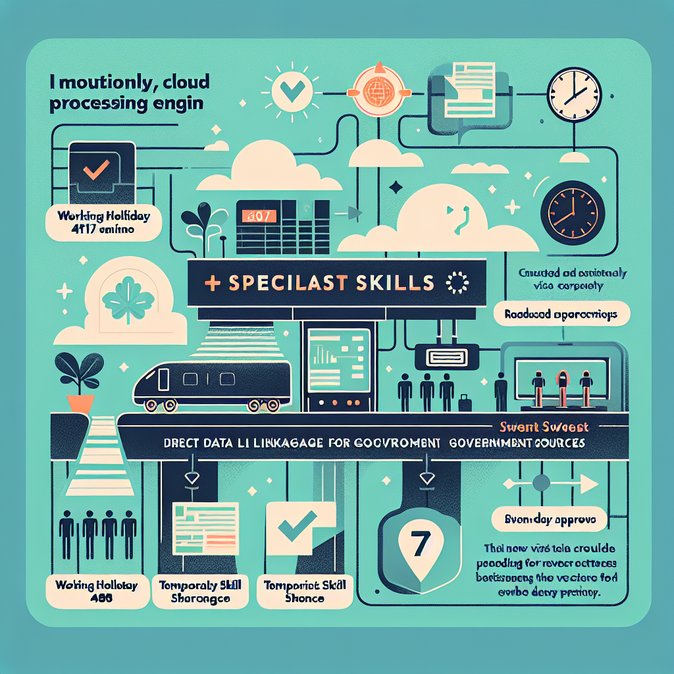
At 00:01 AEST on 28 March 2026, the Department of Home Affairs silently flipped the switch on what officials call the biggest back-end reform of Australian immigration since ImmiAccount launched a decade ago. The cloud-based “Unified Digital Processing Environment” (UDPE) automatically triages applications, runs risk analytics against more than 200 government and commercial data sets, and— crucially for business— can grant low-risk short-term visas in minutes. Early user reports shared by migration agents show two immediate winners: the long-criticised Working Holiday 417 stream and the Temporary Skill Shortage 482 “Short-Term” stream. Applicants who lodged after 25 March are already receiving grants in under 48 hours, compared with published medians of 13 and 28 days respectively only a fortnight ago. A high-priority “Specialist Skills” lane promises a 7-business-day turnaround where the nominated base salary exceeds A$180,000, bringing Australia into line with Singapore’s ONE Pass and Canada’s Tech Talent Strategy. Behind the speed is a radical redesign of evidentiary rules. Instead of uploading every document, applicants consent to real-time data pulls— tax files, education records, boarding-pass scans and even facial-recognition matches from SmartGate kiosks. The system assigns a dynamic risk score; only higher-risk cases are pushed to human officers. Privacy groups have flagged concerns, but the department insists data is read-only and stored in government servers. For employers, the headline is certainty. “We can now fly a consultant in for an April project start and have the visa back before the flight is ticketed,” said the mobility lead of a Big-Four advisory firm. Universities are equally upbeat: PhD candidates stuck offshore during the pandemic backlog can finally arrive before winter semester.
![‘One-click visas’: Australia switches on new real-time processing platform, slashing wait times across key streams]()
For applicants who would prefer expert help navigating these new fast-track channels, VisaHQ’s Australian platform (https://www.visahq.com/australia/) offers streamlined online filing, real-time UDPE status monitoring and proactive alerts if extra evidence is requested—making sure business travellers, students and holiday-makers can take full advantage of the department’s minute-level approvals.
The platform launch also prefigures a February-budget commitment to collapse Australia’s labyrinth of more than 100 temporary‐visa subclasses into 15 “outcome-based” categories by 2028. Officials say UDPE is built to switch off legacy classes at the flick of a toggle. In the shorter term, Home Affairs will monitor performance over Easter when daily arrival volumes typically spike; if the system holds, additional streams— including Student 500 and the popular ETA mobile app— will migrate in June. Practical tips for mobility managers: 1) submit complete digital consents to avoid manual kick-outs; 2) salary evidence for the Specialist Skills lane must be in an Australian dollar contract; 3) flag that any adverse immigration, tax or health matches will still divert an application to manual processing, so buffer time remains wise. Industry will watch closely whether speed comes at the expense of approval rates, but for now, Australia has signalled it intends to compete aggressively for global talent and tourists in an era where processing time is king.

For applicants who would prefer expert help navigating these new fast-track channels, VisaHQ’s Australian platform (https://www.visahq.com/australia/) offers streamlined online filing, real-time UDPE status monitoring and proactive alerts if extra evidence is requested—making sure business travellers, students and holiday-makers can take full advantage of the department’s minute-level approvals.
The platform launch also prefigures a February-budget commitment to collapse Australia’s labyrinth of more than 100 temporary‐visa subclasses into 15 “outcome-based” categories by 2028. Officials say UDPE is built to switch off legacy classes at the flick of a toggle. In the shorter term, Home Affairs will monitor performance over Easter when daily arrival volumes typically spike; if the system holds, additional streams— including Student 500 and the popular ETA mobile app— will migrate in June. Practical tips for mobility managers: 1) submit complete digital consents to avoid manual kick-outs; 2) salary evidence for the Specialist Skills lane must be in an Australian dollar contract; 3) flag that any adverse immigration, tax or health matches will still divert an application to manual processing, so buffer time remains wise. Industry will watch closely whether speed comes at the expense of approval rates, but for now, Australia has signalled it intends to compete aggressively for global talent and tourists in an era where processing time is king.