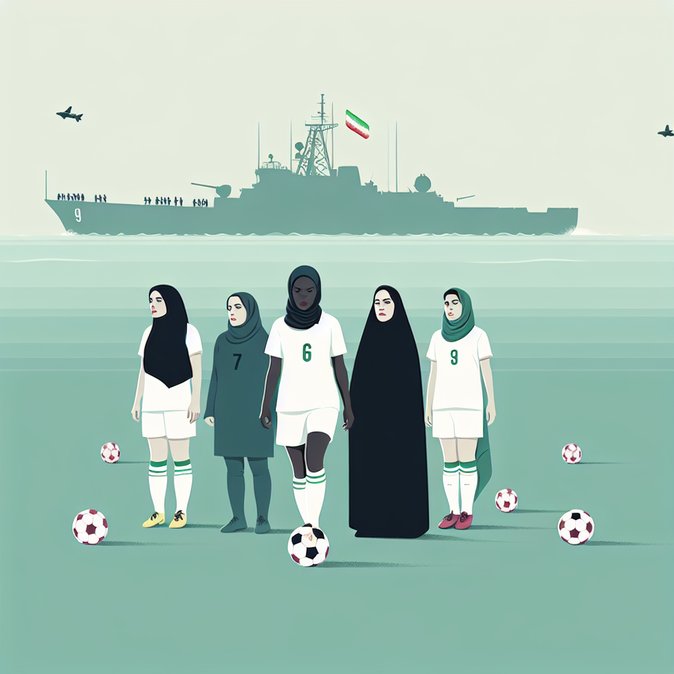
Australia’s decision to grant humanitarian visas to seven members of Iran’s women’s national football team has become the latest flash-point in the diplomatic fallout from the widening Iran war. In an interview broadcast on ABC’s flagship current-affairs program 7.30 late on Thursday, 20 March, Iranian foreign-ministry spokesman Esmaeil Baghaei accused Canberra of “coercing” the players into seeking asylum and warned that Australian military assets stationed in the Gulf are now regarded as “legitimate targets”. The comments came only hours after SBS News confirmed that five of the footballers had accepted Australia’s offer of protection visas following fears for their safety after they refused to sing the Iranian national anthem during the AFC Women’s Asian Cup group stage in Brisbane. Two team-mates later withdrew their applications and returned to Tehran, but the remaining five are now in community accommodation in Sydney while their claims are processed. Home Affairs Minister Tony Burke told reporters the women were interviewed individually on arrival to ensure they were free from intimidation and none were linked to Iran’s Islamic Revolutionary Guard Corps. The episode highlights how sport can collide with geopolitics in the global mobility space. Under Australia’s Migration Act, the minister may grant a fast-tracked subclass 202 Global Humanitarian visa to individuals who face a “well-founded fear of persecution” and are already onshore. Immigration lawyers say the use of the 202 pathway for high-profile athletes is unusual but lawful, mirroring the special intake offered to Afghan women athletes in 2021.
![Iran condemns Australia over humanitarian visas for women’s footballers who protested anthem]()
For organisations and individuals navigating these shifting visa landscapes, VisaHQ’s Australia portal (https://www.visahq.com/australia/) offers up-to-date guidance and application support not only for humanitarian pathways but also for business, tourist and work visas. Their specialists can triage documentation requirements, flag security-related pitfalls and streamline submissions, saving mobility teams valuable time.
For employers and mobility managers the case is a reminder that humanitarian protections can override normal labour-market testing and sponsorship rules, allowing immediate work rights once security checks are cleared. Baghaei’s broadside also underscores the growing security risks for Australian personnel and business travellers in the Middle East. On 10 March, the Albanese government deployed an E-7A Wedgetail surveillance aircraft and 85 ADF personnel to the United Arab Emirates to bolster air-defence coverage for allied bases. Tehran now says those assets could be targeted in retaliation for what it calls Australia’s “alignment with aggressors”. Corporate travel departments have already reported a spike in duty-of-care alerts for fly-in-fly-out contractors transiting through Dubai and Doha. From a political perspective, the visas have divided opinion at home. The Greens welcomed the move as “a modest but vital humanitarian gesture”, while opposition back-bencher James Paterson said it risked turning Australia into “a political football for propaganda”. A Resolve poll published Thursday shows 61 per cent of Australians want the country to stay out of the conflict, yet 35 per cent still support offering refuge to at-risk Iranian dissidents. Practical take-aways for mobility professionals: confirm that employees travelling on Iranian passports are carrying valid Australian visas and are not subject to UN or Australian autonomous sanctions; review crisis-response clauses in global assignment policies to ensure rapid extraction is possible if the security situation deteriorates; and monitor any further expansion of Australia’s humanitarian programme, which could create niche recruitment channels for skilled refugees in sectors with acute shortages such as health and IT.

For organisations and individuals navigating these shifting visa landscapes, VisaHQ’s Australia portal (https://www.visahq.com/australia/) offers up-to-date guidance and application support not only for humanitarian pathways but also for business, tourist and work visas. Their specialists can triage documentation requirements, flag security-related pitfalls and streamline submissions, saving mobility teams valuable time.
For employers and mobility managers the case is a reminder that humanitarian protections can override normal labour-market testing and sponsorship rules, allowing immediate work rights once security checks are cleared. Baghaei’s broadside also underscores the growing security risks for Australian personnel and business travellers in the Middle East. On 10 March, the Albanese government deployed an E-7A Wedgetail surveillance aircraft and 85 ADF personnel to the United Arab Emirates to bolster air-defence coverage for allied bases. Tehran now says those assets could be targeted in retaliation for what it calls Australia’s “alignment with aggressors”. Corporate travel departments have already reported a spike in duty-of-care alerts for fly-in-fly-out contractors transiting through Dubai and Doha. From a political perspective, the visas have divided opinion at home. The Greens welcomed the move as “a modest but vital humanitarian gesture”, while opposition back-bencher James Paterson said it risked turning Australia into “a political football for propaganda”. A Resolve poll published Thursday shows 61 per cent of Australians want the country to stay out of the conflict, yet 35 per cent still support offering refuge to at-risk Iranian dissidents. Practical take-aways for mobility professionals: confirm that employees travelling on Iranian passports are carrying valid Australian visas and are not subject to UN or Australian autonomous sanctions; review crisis-response clauses in global assignment policies to ensure rapid extraction is possible if the security situation deteriorates; and monitor any further expansion of Australia’s humanitarian programme, which could create niche recruitment channels for skilled refugees in sectors with acute shortages such as health and IT.
More From Australia
View all
Australia activates Section 84B ‘arrival-pause’ power, making visa grants conditional on real-time border controls

ImmiAccount rolls out real-time queue tracker and fixed decision timeframes for key visa classes