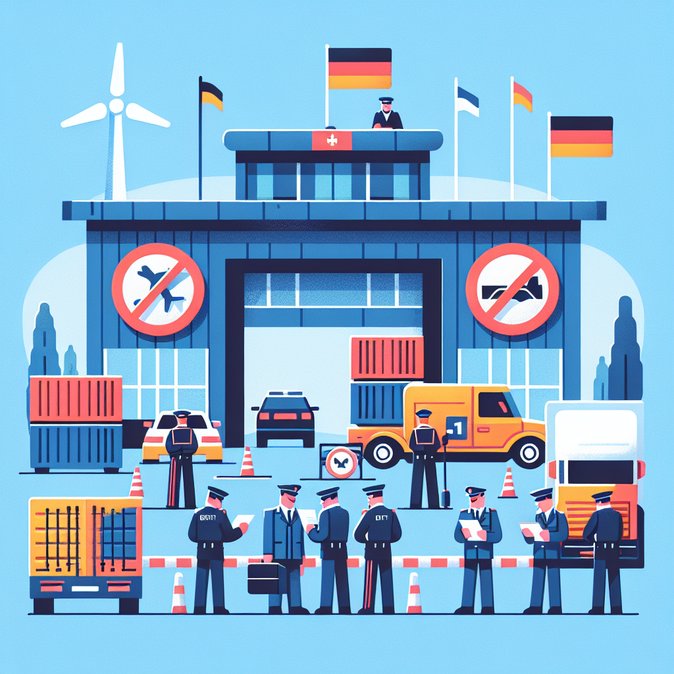
Poland’s Border Guard (Straż Graniczna) has released fresh statistics showing the scale of temporary internal-Schengen checks on its western and north-eastern frontiers, five months after Warsaw re-introduced controls to curb irregular migration routes into Germany and Lithuania. According to the report, dated 20:40 on 15 March 2026, officers have inspected more than 2.1 million travellers and just over 1 million vehicles since controls were reinstated on 7 July 2025.
The bulk of activity has focused on the German border, where the Nadodrzański and Morski Border Guard units screened 1.2 million people and nearly 570 000 vehicles across the Dolnośląskie, Lubuskie and Zachodniopomorskie provinces. Around 380 non-EU nationals—predominantly from Ukraine, Turkey, Russia, Syria, India and Vietnam—were refused entry for lacking the required travel documents.
On the Lithuanian frontier, the Podlaski unit checked almost 900 000 travellers and 470 000 means of transport. More than 460 people, most frequently citizens of India, Ukraine and Uzbekistan, were denied entry on similar documentation grounds.
Officers also arrested nearly 40 suspected facilitators believed to be involved in people-smuggling rings.
The figures underscore how internal border controls—allowed under the Schengen Borders Code only in exceptional circumstances—have become a semi-permanent fixture along Poland’s internal EU borders.
Warsaw argues the measure is necessary to stem secondary movements of irregular migrants who enter the Schengen Area via the Baltic route and to disrupt organised smuggling networks.
![Poland’s Border Guards report over 2 million checks in first five months of reinstated controls with Germany and Lithuania]()
VisaHQ can simplify the paperwork side of these heightened checks by helping travellers and corporate mobility teams verify visa requirements, secure Poland-related travel documents, and track application status online. Its dedicated portal (https://www.visahq.com/poland/) provides up-to-date guidance on Schengen rules, work permits, and courier submission options—giving companies an efficient one-stop solution while border formalities remain unpredictable.
Germany, which has maintained its own controls since October 2023, continues to press Poland to host joint checkpoints on the Polish side; the Polish government has so far rejected the idea on sovereignty grounds.
For multinational companies moving staff through Poland, the data translate into longer travel times on key road corridors such as the A2 (Świecko) and A4 (Jędrzychowice) and highlight the importance of carrying complete travel documentation—even for routine intra-Schengen trips.
Mobility managers should advise business travellers and shuttle-bus operators to budget extra border-crossing time and ensure passports or national ID cards are readily accessible.
Employers posting third-country nationals to projects in Poland must also double-check visa and work-permit validity, as border officials are clearly enforcing documentary compliance.
Looking ahead, the Ministry of the Interior is expected to decide in early April whether to request a further six-month extension of the controls, which could push the regime into the autumn tourist season. Companies should monitor forthcoming notices to carriers (NOTAMs) and any new Schengen Code proposals in Brussels that might formalise longer-term internal checks.
The bulk of activity has focused on the German border, where the Nadodrzański and Morski Border Guard units screened 1.2 million people and nearly 570 000 vehicles across the Dolnośląskie, Lubuskie and Zachodniopomorskie provinces. Around 380 non-EU nationals—predominantly from Ukraine, Turkey, Russia, Syria, India and Vietnam—were refused entry for lacking the required travel documents.
On the Lithuanian frontier, the Podlaski unit checked almost 900 000 travellers and 470 000 means of transport. More than 460 people, most frequently citizens of India, Ukraine and Uzbekistan, were denied entry on similar documentation grounds.
Officers also arrested nearly 40 suspected facilitators believed to be involved in people-smuggling rings.
The figures underscore how internal border controls—allowed under the Schengen Borders Code only in exceptional circumstances—have become a semi-permanent fixture along Poland’s internal EU borders.
Warsaw argues the measure is necessary to stem secondary movements of irregular migrants who enter the Schengen Area via the Baltic route and to disrupt organised smuggling networks.

VisaHQ can simplify the paperwork side of these heightened checks by helping travellers and corporate mobility teams verify visa requirements, secure Poland-related travel documents, and track application status online. Its dedicated portal (https://www.visahq.com/poland/) provides up-to-date guidance on Schengen rules, work permits, and courier submission options—giving companies an efficient one-stop solution while border formalities remain unpredictable.
Germany, which has maintained its own controls since October 2023, continues to press Poland to host joint checkpoints on the Polish side; the Polish government has so far rejected the idea on sovereignty grounds.
For multinational companies moving staff through Poland, the data translate into longer travel times on key road corridors such as the A2 (Świecko) and A4 (Jędrzychowice) and highlight the importance of carrying complete travel documentation—even for routine intra-Schengen trips.
Mobility managers should advise business travellers and shuttle-bus operators to budget extra border-crossing time and ensure passports or national ID cards are readily accessible.
Employers posting third-country nationals to projects in Poland must also double-check visa and work-permit validity, as border officials are clearly enforcing documentary compliance.
Looking ahead, the Ministry of the Interior is expected to decide in early April whether to request a further six-month extension of the controls, which could push the regime into the autumn tourist season. Companies should monitor forthcoming notices to carriers (NOTAMs) and any new Schengen Code proposals in Brussels that might formalise longer-term internal checks.