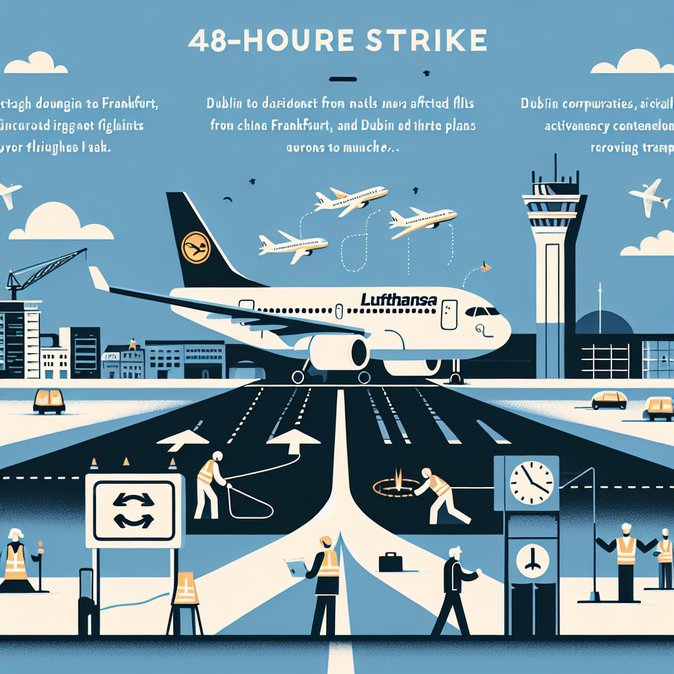
Irish business travellers heading to or connecting through Germany face a second consecutive day of schedule turbulence after the Vereinigung Cockpit (VC) pilots’ union pressed ahead with a 48-hour walk-out that began at 00:01 CET on Thursday, 12 March and continues through 23:59 CET Friday, 13 March 2026. Although Lufthansa has assembled a “special flight programme” that will see just over half of its normal network operate, the carrier confirmed on its live travel-information page that many rotations to and from Frankfurt and Munich have been cut. Dublin normally enjoys at least four daily services to the two hubs—vital for time-sensitive corporate itineraries and long-haul connections—but only two were expected to operate on Friday, according to the revised timetable.
![Lufthansa pilots’ strike extends into 13 March, disrupting Dublin–Germany traffic]()
In situations like this, ensuring that travel documents are in order can avert further headaches. VisaHQ’s Irish portal (https://www.visahq.com/ireland/) gives corporate travellers and mobility managers a quick way to double-check Schengen visa validity, secure emergency replacements and monitor entry rules, all through a single dashboard—particularly useful when last-minute rerouting through multiple EU countries becomes unavoidable.
Passengers whose flights were cancelled were proactively notified overnight, while those who have not received a message “can currently assume that their flight is not affected,” the airline said. Under the contingency policy published by Lufthansa, travellers holding tickets issued on or before 10 March for flights on 12 or 13 March may rebook once, free of charge, on any Lufthansa Group airline between 10 and 23 March 2026, or claim a full refund. Where seats permit, affected customers can also swap a cancelled domestic flight for a Deutsche Bahn rail ticket at no extra cost—a useful option for Ireland-based executives who can reposition via Amsterdam, Paris or Brussels and continue by train. While the walk-out is rooted in a long-running pay-and-pensions dispute, its knock-on impact underscores Ireland’s dependence on German hub connectivity for onward travel to Asia-Pacific and the Americas. HR and mobility managers are being advised to monitor bookings closely; employees who do not receive automated re-accommodation should use the carrier’s digital tools rather than call centres, which are experiencing “longer waiting times”. Lufthansa expects to “largely return to the regular flight schedule from Saturday, 14 March”, but industry analysts warn that further industrial action is possible if talks do not resume quickly. For companies with rotational assignees in Germany, the immediate priorities are duty-of-care messaging, checking Schengen visa validity if alternative routings involve land borders, and reminding staff that costs related to meals and hotels during the disruption should be retained for EU 261 compensation claims. Mobility teams should also note that Aer Lingus is offering same-day rescue fares on its Shannon–Heathrow and Dublin–Manchester services, which may provide alternative trans-Atlantic connections via Oneworld partners if German hubs remain congested.
In situations like this, ensuring that travel documents are in order can avert further headaches. VisaHQ’s Irish portal (https://www.visahq.com/ireland/) gives corporate travellers and mobility managers a quick way to double-check Schengen visa validity, secure emergency replacements and monitor entry rules, all through a single dashboard—particularly useful when last-minute rerouting through multiple EU countries becomes unavoidable.
Passengers whose flights were cancelled were proactively notified overnight, while those who have not received a message “can currently assume that their flight is not affected,” the airline said. Under the contingency policy published by Lufthansa, travellers holding tickets issued on or before 10 March for flights on 12 or 13 March may rebook once, free of charge, on any Lufthansa Group airline between 10 and 23 March 2026, or claim a full refund. Where seats permit, affected customers can also swap a cancelled domestic flight for a Deutsche Bahn rail ticket at no extra cost—a useful option for Ireland-based executives who can reposition via Amsterdam, Paris or Brussels and continue by train. While the walk-out is rooted in a long-running pay-and-pensions dispute, its knock-on impact underscores Ireland’s dependence on German hub connectivity for onward travel to Asia-Pacific and the Americas. HR and mobility managers are being advised to monitor bookings closely; employees who do not receive automated re-accommodation should use the carrier’s digital tools rather than call centres, which are experiencing “longer waiting times”. Lufthansa expects to “largely return to the regular flight schedule from Saturday, 14 March”, but industry analysts warn that further industrial action is possible if talks do not resume quickly. For companies with rotational assignees in Germany, the immediate priorities are duty-of-care messaging, checking Schengen visa validity if alternative routings involve land borders, and reminding staff that costs related to meals and hotels during the disruption should be retained for EU 261 compensation claims. Mobility teams should also note that Aer Lingus is offering same-day rescue fares on its Shannon–Heathrow and Dublin–Manchester services, which may provide alternative trans-Atlantic connections via Oneworld partners if German hubs remain congested.