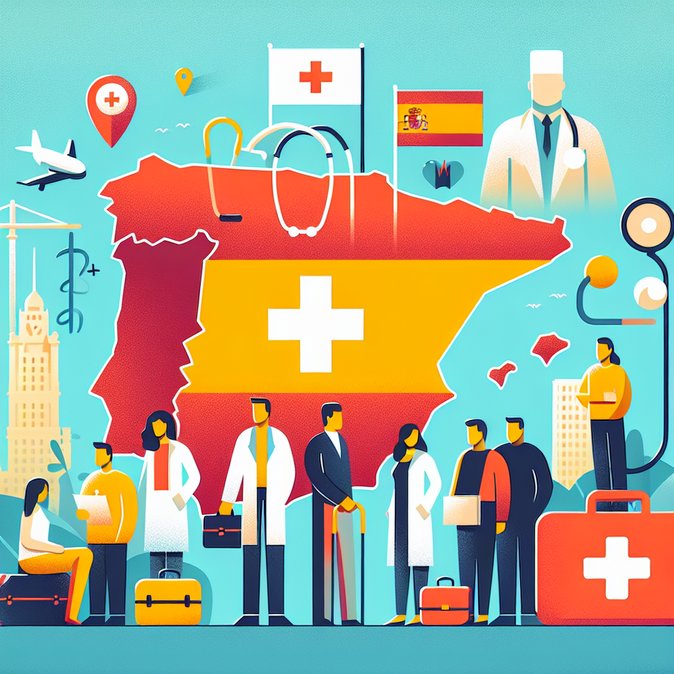
Spain’s coalition government has taken another step in its 2025-26 immigration reform programme by approving a royal decree that makes the public healthcare system universally available, irrespective of a person’s residence status. The measure – published in the Official State Gazette on 11 March and in force from the following day – removes the last administrative barriers that could prevent people without a Tarjeta de Identidad de Extranjero (TIE) from being treated by primary-care doctors, specialists or hospital services. Until now, rules differed from one autonomous community to another, forcing many undocumented migrants to rely on over-stretched emergency rooms or NGOs. Under the new system, anyone who can show that they live in Spain may file a simple application at their local health centre. A temporary certificate is issued immediately, and if the administration fails to respond within three months, entitlement is confirmed automatically.
![Spain guarantees free healthcare for undocumented migrants through new royal decree]()
For anyone who still needs help obtaining the right entry visas, residency permits or supporting documents before or after enrolling in the healthcare system, VisaHQ offers an easy-to-use platform with personalised assistance. Their Spain page (https://www.visahq.com/spain/) walks applicants through the forms, fees and appointment scheduling required for short- or long-term stays, making it simpler to line up immigration paperwork with the new health-care entitlements.
Vulnerable groups such as children, pregnant women, victims of gender-based violence and people with disabilities receive priority processing. The Ministry of Health argues that early access to primary care will lower overall expenditure by reducing preventable hospital admissions, while the Ministry of Inclusion and Migration says the change dovetails with the extraordinary regularisation process due later this year for an estimated 500,000 foreign nationals. Employers’ groups have broadly welcomed the decree, noting that companies operating duty-of-care policies for mobile staff now have legal clarity when seconding employees who have not yet finalised residence paperwork. Practical guidance circulated to regional health authorities outlines four steps for applicants: proof of presence (usually municipal padrón registration), submission of the new form, receipt of the temporary certificate and registration with a family doctor. NGOs that work with newcomers are already organising information clinics, while legal associations remind migrants that the decree does not grant residence rights – it merely guarantees healthcare while other immigration procedures are under way. Spain first introduced universal healthcare in 1986, limited it during the 2012 austerity period, and gradually restored coverage from 2018 onwards. The 2026 decree standardises the rules nationwide for the first time and is widely seen as the culmination of that decade-long policy reversal.

For anyone who still needs help obtaining the right entry visas, residency permits or supporting documents before or after enrolling in the healthcare system, VisaHQ offers an easy-to-use platform with personalised assistance. Their Spain page (https://www.visahq.com/spain/) walks applicants through the forms, fees and appointment scheduling required for short- or long-term stays, making it simpler to line up immigration paperwork with the new health-care entitlements.
Vulnerable groups such as children, pregnant women, victims of gender-based violence and people with disabilities receive priority processing. The Ministry of Health argues that early access to primary care will lower overall expenditure by reducing preventable hospital admissions, while the Ministry of Inclusion and Migration says the change dovetails with the extraordinary regularisation process due later this year for an estimated 500,000 foreign nationals. Employers’ groups have broadly welcomed the decree, noting that companies operating duty-of-care policies for mobile staff now have legal clarity when seconding employees who have not yet finalised residence paperwork. Practical guidance circulated to regional health authorities outlines four steps for applicants: proof of presence (usually municipal padrón registration), submission of the new form, receipt of the temporary certificate and registration with a family doctor. NGOs that work with newcomers are already organising information clinics, while legal associations remind migrants that the decree does not grant residence rights – it merely guarantees healthcare while other immigration procedures are under way. Spain first introduced universal healthcare in 1986, limited it during the 2012 austerity period, and gradually restored coverage from 2018 onwards. The 2026 decree standardises the rules nationwide for the first time and is widely seen as the culmination of that decade-long policy reversal.