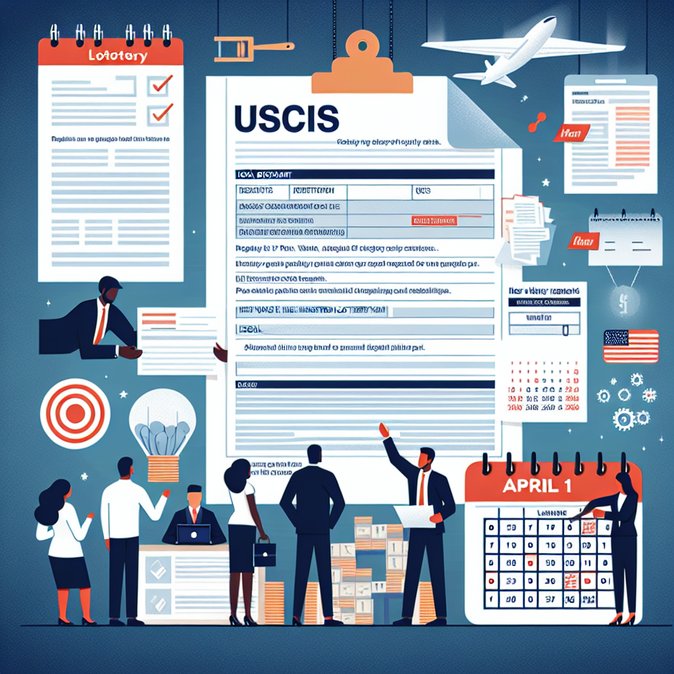
U.S. Citizenship and Immigration Services quietly dropped a new edition of Form I-129 on March 10, giving employers less than three weeks to learn the paperwork before cap-subject H-1B petitions may be filed on April 1. The form update dovetails with the agency’s most radical overhaul of H-1B selection in years: for FY 2027, each electronic registration will receive between one and four “chances” in the lottery based on the job’s wage level, effectively rewarding employers who pay at or above the prevailing wage. The revised I-129 forces petitioners to spell out a position’s minimum degree level, field of study, years of experience, specialised skills and supervisory duties in new, separately enumerated fields. Immigration lawyers warn that inconsistencies between those answers and the underlying Labor Condition Application could trigger Requests for Evidence or outright denials.
![USCIS Releases New Form I-129 Ahead of FY 2027 H-1B Wage-Weighted Lottery]()
Amid all this complexity, many employers and foreign professionals turn to third-party facilitators for help. VisaHQ’s U.S. portal (https://www.visahq.com/united-states/) offers streamlined tools to track changing government forms, generate compliant application packets and coordinate consular appointments worldwide, providing an extra layer of assurance when deadlines are tight and rules are in flux.
Companies that rely on high-volume filings—IT consulting, engineering and health-care staffing firms—have already begun redlining template job descriptions to satisfy the granular requirements. From a compliance standpoint, mobility teams must now track two ticking clocks: (1) the wage-weighted electronic-registration window that closes 19 March, and (2) the mandatory switch to the new I-129 edition for any petition post-marked on or after 1 April. Failure to use the correct version will result in automatic rejection and loss of the filing-fee receipts—potentially fatal where a candidate’s status is expiring. The broader business effect of the wage-weighted system remains to be seen. Modelling by several large immigration firms suggests Level IV (highest-paid) registrations could enjoy selection odds more than double those for Level I roles, putting pressure on employers to raise salary offers for early-career STEM talent. The rule also erects hurdles for universities and non-profits that typically pay below industry medians, although cap-exempt filings are not directly affected. USCIS has not committed to electronic filing of the new I-129 this season, meaning employers must still ship thick paper bundles to service centres. Nevertheless, the form’s structure—drop-down style sub-questions and embedded barcodes—signals that full online submission is on the horizon, likely in time for FY 2028 according to agency insiders.

Amid all this complexity, many employers and foreign professionals turn to third-party facilitators for help. VisaHQ’s U.S. portal (https://www.visahq.com/united-states/) offers streamlined tools to track changing government forms, generate compliant application packets and coordinate consular appointments worldwide, providing an extra layer of assurance when deadlines are tight and rules are in flux.
Companies that rely on high-volume filings—IT consulting, engineering and health-care staffing firms—have already begun redlining template job descriptions to satisfy the granular requirements. From a compliance standpoint, mobility teams must now track two ticking clocks: (1) the wage-weighted electronic-registration window that closes 19 March, and (2) the mandatory switch to the new I-129 edition for any petition post-marked on or after 1 April. Failure to use the correct version will result in automatic rejection and loss of the filing-fee receipts—potentially fatal where a candidate’s status is expiring. The broader business effect of the wage-weighted system remains to be seen. Modelling by several large immigration firms suggests Level IV (highest-paid) registrations could enjoy selection odds more than double those for Level I roles, putting pressure on employers to raise salary offers for early-career STEM talent. The rule also erects hurdles for universities and non-profits that typically pay below industry medians, although cap-exempt filings are not directly affected. USCIS has not committed to electronic filing of the new I-129 this season, meaning employers must still ship thick paper bundles to service centres. Nevertheless, the form’s structure—drop-down style sub-questions and embedded barcodes—signals that full online submission is on the horizon, likely in time for FY 2028 according to agency insiders.