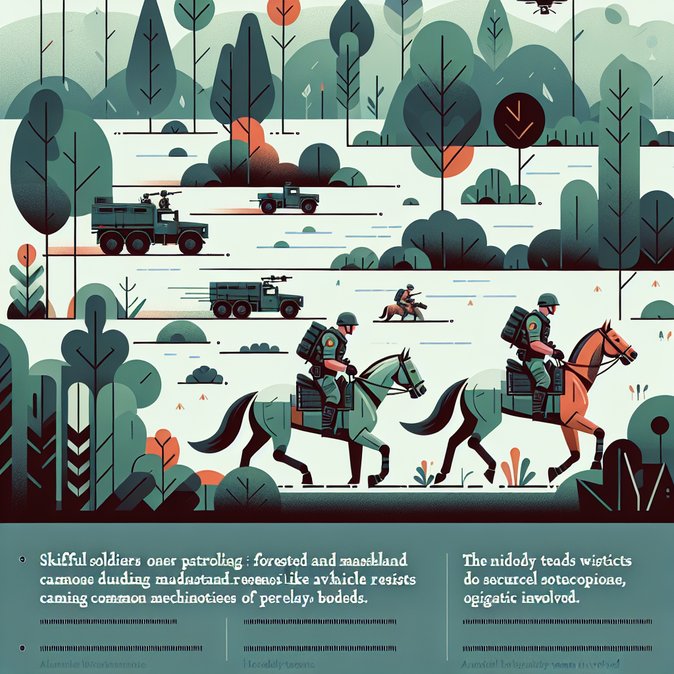
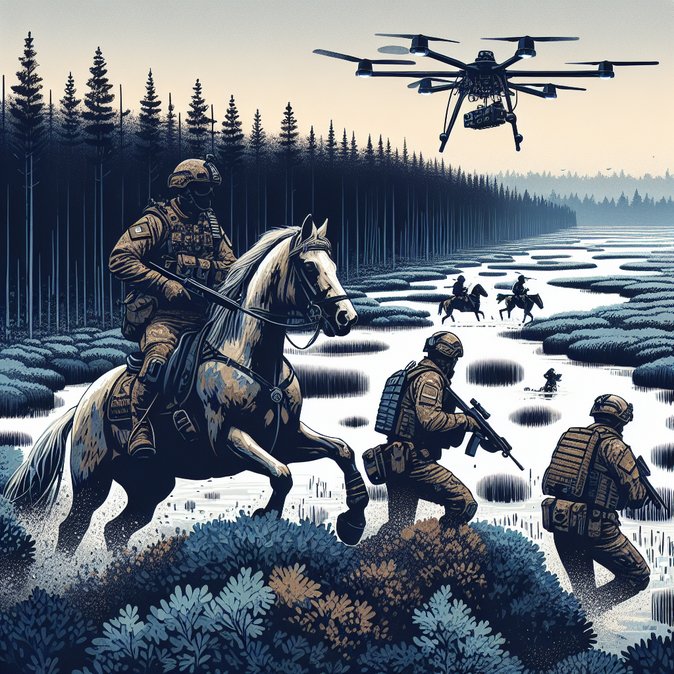
In a throwback to pre-mechanised border patrolling, Poland’s 2nd Lublin and 19th Nadbużańska Territorial-Defence Brigades have reintroduced horse patrols to police the most inaccessible swamp and forest sectors of the 418-kilometre frontier with Belarus. The first mixed platoons saddled-up at dawn on 10 March after a fortnight of intensive training at the Kleeberg Cavalry Centre near Chełm.
Commanders say the decision was driven by terrain realities: quads and armoured vehicles bog down in peatlands, while drones—now subject to new air-restriction zones—offer limited persistence under dense canopy. A mounted scout, by contrast, enjoys a three-metre eye-level vantage point and can carry radio repeaters or medical packs deep into the buffer zone without leaving a thermal signature easily picked up by adversary sensors.
Belarusian facilitators have recently shifted migrant-smuggling routes southward in an attempt to exploit wooded lowlands. Since January, Border Guard thermal cameras have logged more than 300 attempted crossings through these “green corridors”. The horse teams, paired with handheld FLIR units and backed by rapid-reaction jeeps on hard ground, are designed to close that loophole.
![Mounted Territorial Troops Deployed to Plug Forest Gaps on Belarus Border]()
For international contractors, NGO personnel or journalists planning assignments along the frontier, navigating Schengen paperwork can be as tricky as the terrain itself. VisaHQ’s online portal for Poland (https://www.visahq.com/poland/) gives real-time guidance on visa options, fees and processing times, allowing field teams to secure the right documents without detouring to consulates.
For companies that station technicians at the nearby LNG terminal in Świnoujście or maintain supply-chain routes through the ‘Via Carpatia’ corridor, the message is one of continued vigilance. Expect temporary roadblocks and document checks when patrols vector ground units to suspected crossings. Logistics managers should keep vehicle papers and crew manifests impeccable: anecdotal evidence suggests spot checks have already risen by 20 % in the affected counties.
Beyond the immediate security dividend, the initiative underlines Warsaw’s multi-layered approach to hybrid threats—a data point worth noting for multinational enterprises that may need to plan staff movements along Poland’s eastern flank in the months ahead.
Commanders say the decision was driven by terrain realities: quads and armoured vehicles bog down in peatlands, while drones—now subject to new air-restriction zones—offer limited persistence under dense canopy. A mounted scout, by contrast, enjoys a three-metre eye-level vantage point and can carry radio repeaters or medical packs deep into the buffer zone without leaving a thermal signature easily picked up by adversary sensors.
Belarusian facilitators have recently shifted migrant-smuggling routes southward in an attempt to exploit wooded lowlands. Since January, Border Guard thermal cameras have logged more than 300 attempted crossings through these “green corridors”. The horse teams, paired with handheld FLIR units and backed by rapid-reaction jeeps on hard ground, are designed to close that loophole.
For international contractors, NGO personnel or journalists planning assignments along the frontier, navigating Schengen paperwork can be as tricky as the terrain itself. VisaHQ’s online portal for Poland (https://www.visahq.com/poland/) gives real-time guidance on visa options, fees and processing times, allowing field teams to secure the right documents without detouring to consulates.
For companies that station technicians at the nearby LNG terminal in Świnoujście or maintain supply-chain routes through the ‘Via Carpatia’ corridor, the message is one of continued vigilance. Expect temporary roadblocks and document checks when patrols vector ground units to suspected crossings. Logistics managers should keep vehicle papers and crew manifests impeccable: anecdotal evidence suggests spot checks have already risen by 20 % in the affected counties.
Beyond the immediate security dividend, the initiative underlines Warsaw’s multi-layered approach to hybrid threats—a data point worth noting for multinational enterprises that may need to plan staff movements along Poland’s eastern flank in the months ahead.