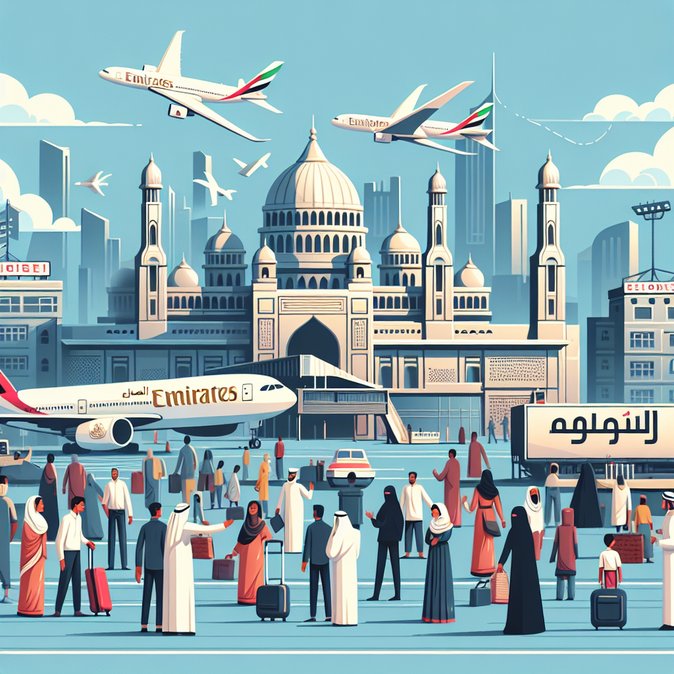
Kolkata’s Netaji Subhas Chandra Bose International Airport recorded its busiest international day of 2026 on 8 March when three Emirates wide-bodies—EK 572, EK 570 and a second EK 572 rotation—landed with 814 passengers evacuated from Dubai, Abu Dhabi and Sharjah.
The services, cleared after Dubai International Airport reopened a single runway hit by a drone strike the previous night, arrived almost five hours behind schedule. Travel agents accompanying the groups said most passengers were senior citizens on package tours who had left India on 27 February, just hours before the first missiles were fired in the Iran-Israel conflict.
Emirates positioned the aircraft into Kolkata nearly empty, underscoring how evacuation flights are operating on one-way economics. The airline flew back with only 232 outbound passengers across the three departures, reflecting travellers’ reluctance to head into an uncertain region.
![Three Emirates flights bring 814 stranded Indians to Kolkata after drone strike closure]()
Meanwhile, for passengers suddenly re-routing through alternate hubs, VisaHQ’s India portal (https://www.visahq.com/india/) can expedite visa processing and provide real-time entry guidance for dozens of countries, helping travellers secure the paperwork they need amid fluid schedules.
Officials at Kolkata airport cautioned that full normalisation is unlikely until trans-Gulf traffic to Europe and North America resumes, because the same long-haul feed underpins viability of Middle-East–Kolkata flights. Nevertheless, the arrivals lifted local morale: family members lined kerbside walls waving tricolours as exhausted tourists emerged.
With FlyDubai already having operated two rescue flights earlier in the week, attention now turns to Etihad, Qatar Airways and Air Arabia, which have yet to re-activate their Kolkata schedules. Mobility planners with companies based in eastern India should therefore treat Kolkata as an ‘arrival-only’ port for the time being and route outbound staff via Mumbai or Delhi.
The services, cleared after Dubai International Airport reopened a single runway hit by a drone strike the previous night, arrived almost five hours behind schedule. Travel agents accompanying the groups said most passengers were senior citizens on package tours who had left India on 27 February, just hours before the first missiles were fired in the Iran-Israel conflict.
Emirates positioned the aircraft into Kolkata nearly empty, underscoring how evacuation flights are operating on one-way economics. The airline flew back with only 232 outbound passengers across the three departures, reflecting travellers’ reluctance to head into an uncertain region.

Meanwhile, for passengers suddenly re-routing through alternate hubs, VisaHQ’s India portal (https://www.visahq.com/india/) can expedite visa processing and provide real-time entry guidance for dozens of countries, helping travellers secure the paperwork they need amid fluid schedules.
Officials at Kolkata airport cautioned that full normalisation is unlikely until trans-Gulf traffic to Europe and North America resumes, because the same long-haul feed underpins viability of Middle-East–Kolkata flights. Nevertheless, the arrivals lifted local morale: family members lined kerbside walls waving tricolours as exhausted tourists emerged.
With FlyDubai already having operated two rescue flights earlier in the week, attention now turns to Etihad, Qatar Airways and Air Arabia, which have yet to re-activate their Kolkata schedules. Mobility planners with companies based in eastern India should therefore treat Kolkata as an ‘arrival-only’ port for the time being and route outbound staff via Mumbai or Delhi.