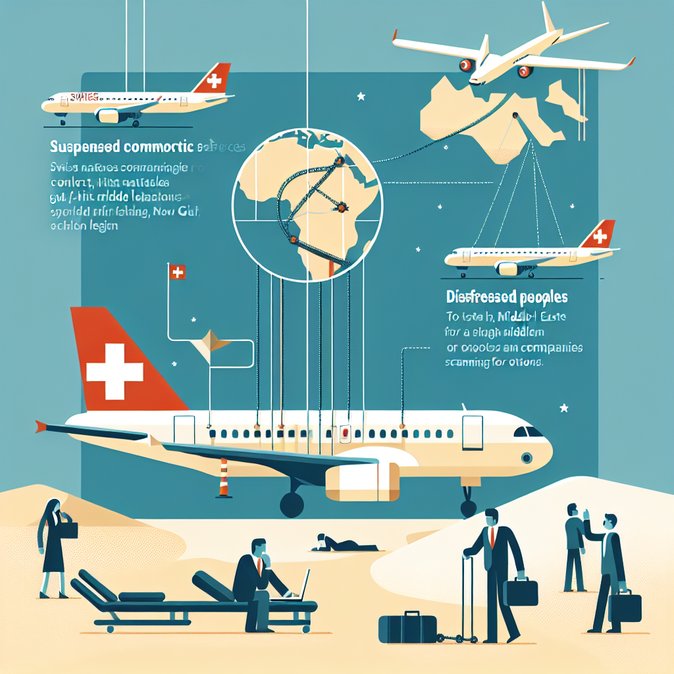
Airlines worldwide began the new week with a fresh round of route suspensions as the Middle-East security crisis entered its second week. An aviation bulletin compiled by The National on 8 March shows **SWISS maintaining a blanket suspension of its Dubai, Abu Dhabi and Dammam flights until 10 March, Amman and Erbil until 15 March, Tel Aviv until 22 March and Beirut until 28 March. Services to Tehran remain on hold until at least 30 April.** The Lufthansa Group carrier re-started Larnaca on 7 March after Cyprus re-opened its flight-information region.
The Swiss flag-carrier’s caution mirrors decisions by Air France, Finnair, Cathay Pacific, United and Royal Jordanian, all of which issued waivers and cancelled multiple rotations. Insurance underwriters have raised war-risk premiums for carriers flying within 250 nautical miles of Iranian or Israeli airspace, driving up operating costs. Airport coordinators in Zurich and Geneva report slot cancellations running at roughly 15 % of scheduled Middle-East traffic for the coming week.
For Swiss corporates with production sites in the Gulf, the network shake-up is more than an inconvenience: sea-freight alternatives add 10–14 days of lead-time and raise inventory costs. Mobility managers are advising essential travellers to route via Muscat, Doha or Cairo, but warn that seats are scarce and re-prices frequent. HR departments must also track visa validity—particularly for assignees on multiple-entry visit visas that may expire while holders await the resumption of flights.
![Global carriers extend Middle-East cancellations; SWISS keeps Dubai, Tel Aviv and Tehran off network]()
At times like these, many travellers and mobility teams turn to specialist visa services for timely guidance. VisaHQ’s Swiss portal (https://www.visahq.com/switzerland/) consolidates the latest entry requirements, helps process emergency extensions and can even courier passport renewals worldwide, offering companies a single point of contact when local consulates are overwhelmed.
Immigration practitioners note that some host countries will grant grace periods or emergency extensions when commercial air links collapse, but these are discretionary. Travellers should keep digital copies of entry stamps and check with local border-police websites daily. Swiss travel insurers, meanwhile, say policyholders whose trips were purchased before the escalation retain cancellation cover under the “war or terrorism” clauses, provided the journey falls within the affected time window.
The protracted closure is a reminder that **airspace disruptions can reverberate through corporate mobility chains**, affecting not only passenger flows but also the movement of time-critical spare parts and specialist technicians. Firms are urged to stress-test contingency budgets and revisit their emergency-travel authorisation thresholds.
The Swiss flag-carrier’s caution mirrors decisions by Air France, Finnair, Cathay Pacific, United and Royal Jordanian, all of which issued waivers and cancelled multiple rotations. Insurance underwriters have raised war-risk premiums for carriers flying within 250 nautical miles of Iranian or Israeli airspace, driving up operating costs. Airport coordinators in Zurich and Geneva report slot cancellations running at roughly 15 % of scheduled Middle-East traffic for the coming week.
For Swiss corporates with production sites in the Gulf, the network shake-up is more than an inconvenience: sea-freight alternatives add 10–14 days of lead-time and raise inventory costs. Mobility managers are advising essential travellers to route via Muscat, Doha or Cairo, but warn that seats are scarce and re-prices frequent. HR departments must also track visa validity—particularly for assignees on multiple-entry visit visas that may expire while holders await the resumption of flights.
At times like these, many travellers and mobility teams turn to specialist visa services for timely guidance. VisaHQ’s Swiss portal (https://www.visahq.com/switzerland/) consolidates the latest entry requirements, helps process emergency extensions and can even courier passport renewals worldwide, offering companies a single point of contact when local consulates are overwhelmed.
Immigration practitioners note that some host countries will grant grace periods or emergency extensions when commercial air links collapse, but these are discretionary. Travellers should keep digital copies of entry stamps and check with local border-police websites daily. Swiss travel insurers, meanwhile, say policyholders whose trips were purchased before the escalation retain cancellation cover under the “war or terrorism” clauses, provided the journey falls within the affected time window.
The protracted closure is a reminder that **airspace disruptions can reverberate through corporate mobility chains**, affecting not only passenger flows but also the movement of time-critical spare parts and specialist technicians. Firms are urged to stress-test contingency budgets and revisit their emergency-travel authorisation thresholds.