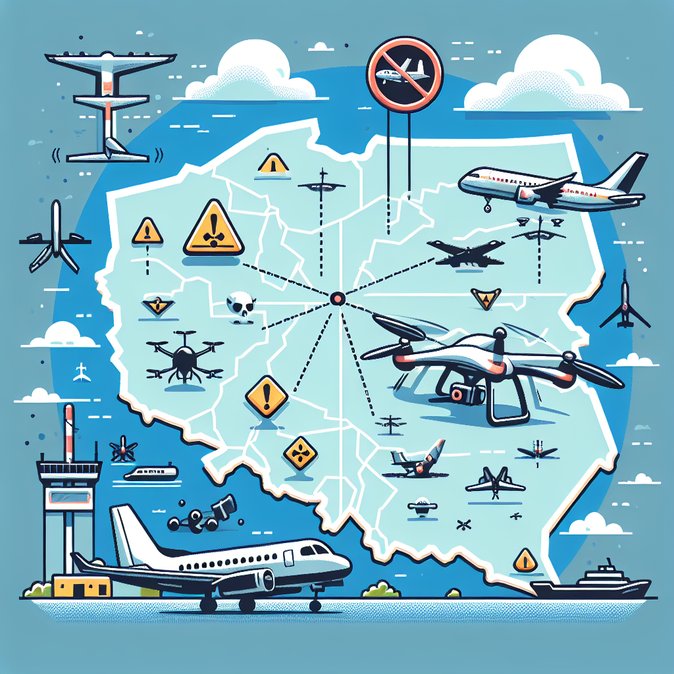
Poland’s Air Navigation Services Agency (PANSA) has issued a NOTAM establishing temporary restricted zone EP R130 over the country’s entire land frontier with Ukraine and Belarus. The measure, published on 6 March 2026 and effective from 10 March through 9 June 2026, closes the airspace from the surface to 3,000 metres (FL100) for most civilian operations. Night-time flights are banned outright; day-time flights will be permitted only if pilots file flight plans, keep transponders switched on and maintain continuous radio contact with Polish air-traffic control. Drones and light aircraft—which normally operate at low altitudes—are effectively grounded. Scheduled passenger jets cruising at higher levels remain unaffected.
The Ministry of the Interior requested the restriction after a February incident in which a commercial drone crashed inside a military base in Leźnica Wielka. Defence officials say the zone is needed to create an “air buffer” while Russia’s war against Ukraine continues to spill across borders in the form of drone overflights and missile debris. Although Warsaw stresses that the measure is preventative, the three-month duration signals that the government now treats the eastern flank as a semi-permanent security frontier.
For airlines the practical impact is limited to general-aviation and point-to-point air-taxi services within Podlaskie and Lublin voivodeships; carriers such as LOT Polish Airlines, Wizz Air and Ryanair do not need to reroute high-altitude international services. Corporate flight departments, however, must review any drone or helicopter work near the exclusion belt and pre-clear survey or utility missions with PANSA. Logistics companies using small UAVs to inspect pipelines or rail tracks in the border counties will have to suspend operations or apply for special military waivers.
![Poland creates 90-day low-altitude exclusion zone along the Ukrainian and Belarusian borders]()
For companies and individual travellers adjusting itineraries or deployment plans because of the new restriction, VisaHQ’s Poland service (https://www.visahq.com/poland/) can streamline visa, work-permit and residence-card applications, providing up-to-date documentation requirements and courier support even when in-person visits to consulates are curtailed.
Mobility managers moving assignees to eastern Poland should alert staff that recreational drone use is prohibited and that enforcement will be strict—the NOTAM references Poland’s Aviation Law articles that carry fines up to PLN 120,000 and the possibility of criminal proceedings. Organisations with critical infrastructure close to the frontier (wind farms, telecom towers) are advised to factor in delays to maintenance flights.
The zone also serves as a template for NATO neighbours. If Lithuania, Latvia or Romania replicate the Polish model, a contiguous low-altitude denial corridor could stretch from the Baltic to the Black Sea, further complicating cross-border drone operations and creating new compliance checkpoints for industrial UAV fleets.
The Ministry of the Interior requested the restriction after a February incident in which a commercial drone crashed inside a military base in Leźnica Wielka. Defence officials say the zone is needed to create an “air buffer” while Russia’s war against Ukraine continues to spill across borders in the form of drone overflights and missile debris. Although Warsaw stresses that the measure is preventative, the three-month duration signals that the government now treats the eastern flank as a semi-permanent security frontier.
For airlines the practical impact is limited to general-aviation and point-to-point air-taxi services within Podlaskie and Lublin voivodeships; carriers such as LOT Polish Airlines, Wizz Air and Ryanair do not need to reroute high-altitude international services. Corporate flight departments, however, must review any drone or helicopter work near the exclusion belt and pre-clear survey or utility missions with PANSA. Logistics companies using small UAVs to inspect pipelines or rail tracks in the border counties will have to suspend operations or apply for special military waivers.
For companies and individual travellers adjusting itineraries or deployment plans because of the new restriction, VisaHQ’s Poland service (https://www.visahq.com/poland/) can streamline visa, work-permit and residence-card applications, providing up-to-date documentation requirements and courier support even when in-person visits to consulates are curtailed.
Mobility managers moving assignees to eastern Poland should alert staff that recreational drone use is prohibited and that enforcement will be strict—the NOTAM references Poland’s Aviation Law articles that carry fines up to PLN 120,000 and the possibility of criminal proceedings. Organisations with critical infrastructure close to the frontier (wind farms, telecom towers) are advised to factor in delays to maintenance flights.
The zone also serves as a template for NATO neighbours. If Lithuania, Latvia or Romania replicate the Polish model, a contiguous low-altitude denial corridor could stretch from the Baltic to the Black Sea, further complicating cross-border drone operations and creating new compliance checkpoints for industrial UAV fleets.