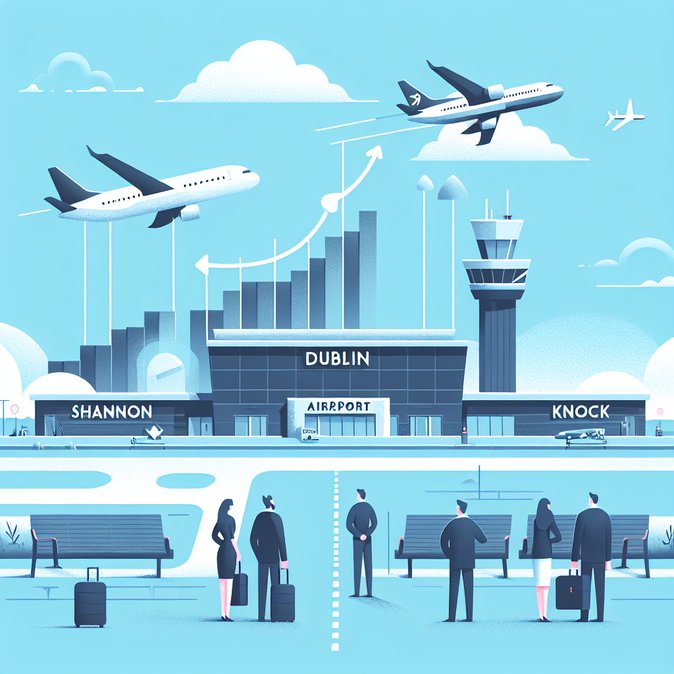
The Irish Government’s decision to accelerate the Dublin Airport (Passenger Capacity) Bill 2026—designed to scrap the 32-million-passenger cap and pave the way for annual throughput of 55 million—has sparked a sharp response from the Galway Chamber of Commerce. In a paper submitted on 6 March, the Chamber argues the move risks locking Ireland into one of Europe’s most centralised aviation models, with 83 % of international traffic already funneled through the capital.
Regional airports Shannon and Ireland West Knock both operate well below their existing capacity yet struggle to attract major carriers. Business leaders in the West fear further concentration will lengthen door-to-door journey times, raise travel costs for export-oriented SMEs, and weaken the region’s appeal for inward investors who prize direct international links.
Amid this evolving aviation landscape, travellers and companies may also face changing visa requirements as new routes emerge or existing ones are reshuffled. VisaHQ’s Ireland portal (https://www.visahq.com/ireland/) lets users quickly check entry rules, apply for electronic authorisations, and secure embassy appointments worldwide—helping ensure that itineraries via Dublin, Shannon, Knock or any other gateway remain hassle-free.
![Galway Chamber Warns Fast-Tracked Dublin Airport Expansion Could Skew National Connectivity]()
The Chamber also highlights infrastructure asymmetry: while the airport bill is being prioritised, essential road and water projects in the West remain in planning limbo. From a sustainability perspective, opponents note that additional flights into Dublin will exacerbate congestion on the M50 and inflate housing demand in the already stretched Greater Dublin Area.
Proponents of the bill—including daa plc—contend that hub expansion is vital to secure new long-haul routes and maintain competitiveness against European rivals. They argue that Shannon’s US pre-clearance niche and Knock’s low-cost model position them for complementary growth.
For global-mobility planners, the debate signals that flight-availability gains at Dublin may come at the expense of route diversity elsewhere. Companies with operations in Galway, Limerick or Mayo should engage early with travel suppliers to monitor potential changes in regional schedule frequency and consider ground-transport allowances if routing via Dublin becomes unavoidable.
Regional airports Shannon and Ireland West Knock both operate well below their existing capacity yet struggle to attract major carriers. Business leaders in the West fear further concentration will lengthen door-to-door journey times, raise travel costs for export-oriented SMEs, and weaken the region’s appeal for inward investors who prize direct international links.
Amid this evolving aviation landscape, travellers and companies may also face changing visa requirements as new routes emerge or existing ones are reshuffled. VisaHQ’s Ireland portal (https://www.visahq.com/ireland/) lets users quickly check entry rules, apply for electronic authorisations, and secure embassy appointments worldwide—helping ensure that itineraries via Dublin, Shannon, Knock or any other gateway remain hassle-free.
The Chamber also highlights infrastructure asymmetry: while the airport bill is being prioritised, essential road and water projects in the West remain in planning limbo. From a sustainability perspective, opponents note that additional flights into Dublin will exacerbate congestion on the M50 and inflate housing demand in the already stretched Greater Dublin Area.
Proponents of the bill—including daa plc—contend that hub expansion is vital to secure new long-haul routes and maintain competitiveness against European rivals. They argue that Shannon’s US pre-clearance niche and Knock’s low-cost model position them for complementary growth.
For global-mobility planners, the debate signals that flight-availability gains at Dublin may come at the expense of route diversity elsewhere. Companies with operations in Galway, Limerick or Mayo should engage early with travel suppliers to monitor potential changes in regional schedule frequency and consider ground-transport allowances if routing via Dublin becomes unavoidable.