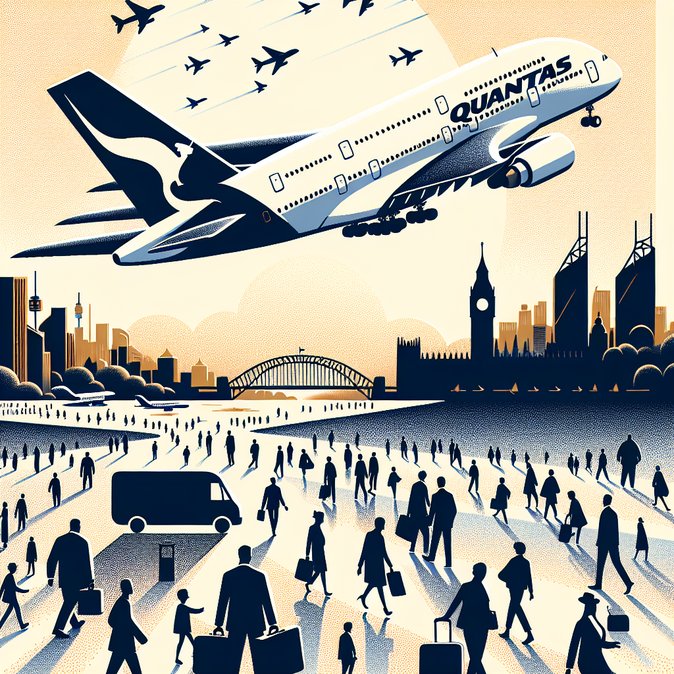
In an unusual manoeuvre, Qantas will operate a second Airbus A380 departure from Sydney to London on 7 March under flight number QF331. Unlike the carrier’s regular QF1, the extra service runs one-way only—there is no return leg from Heathrow. Industry observers believe the super-jumbo is being ferried to Europe for heavy maintenance and that Qantas has chosen to sell seats rather than fly empty.
The aircraft will follow the Sydney–Singapore–London routing, with a four-hour transit at Changi. Qantas says priority was given to passengers needing re-accommodation after this week’s Gulf airspace shutdown, which has snarled the international schedules of Emirates, Etihad, Qatar Airways and their Australian codeshare partners. Seats that remained were released to the public and sold within hours.
![One-off Qantas A380 flight to London clears backlog as Middle-East chaos deepens]()
Travellers caught up in these last-minute schedule changes may also need to review their visa or transit requirements. VisaHQ’s Australia portal (https://www.visahq.com/australia/) provides a quick way to confirm documentation needs for Singapore stopovers, onward journeys to the UK, and dozens of other destinations, helping corporate mobility teams keep staff compliant and on the move.
For mobility teams the additional capacity, albeit temporary, is welcome. Dozens of Australian executives and project teams were left scrambling when QF9 Perth–London went via Singapore and rival Gulf carriers cancelled or capped bookings. The one-off A380 flight provides 450 extra seats in peak demand week—enough to clear some of the backlog and avoid expensive multi-stop routings via Asia or North America.
The episode underlines how airlines can repurpose positioning flights to support disrupted corporate travel programmes, a tactic mobility managers may seek to leverage through their TMCs when future crises hit. It also hints at the flexibility Qantas gains from retaining a reduced but still operational A380 fleet even as newer A350-1000s prepare to enter service.
The aircraft will follow the Sydney–Singapore–London routing, with a four-hour transit at Changi. Qantas says priority was given to passengers needing re-accommodation after this week’s Gulf airspace shutdown, which has snarled the international schedules of Emirates, Etihad, Qatar Airways and their Australian codeshare partners. Seats that remained were released to the public and sold within hours.

Travellers caught up in these last-minute schedule changes may also need to review their visa or transit requirements. VisaHQ’s Australia portal (https://www.visahq.com/australia/) provides a quick way to confirm documentation needs for Singapore stopovers, onward journeys to the UK, and dozens of other destinations, helping corporate mobility teams keep staff compliant and on the move.
For mobility teams the additional capacity, albeit temporary, is welcome. Dozens of Australian executives and project teams were left scrambling when QF9 Perth–London went via Singapore and rival Gulf carriers cancelled or capped bookings. The one-off A380 flight provides 450 extra seats in peak demand week—enough to clear some of the backlog and avoid expensive multi-stop routings via Asia or North America.
The episode underlines how airlines can repurpose positioning flights to support disrupted corporate travel programmes, a tactic mobility managers may seek to leverage through their TMCs when future crises hit. It also hints at the flexibility Qantas gains from retaining a reduced but still operational A380 fleet even as newer A350-1000s prepare to enter service.