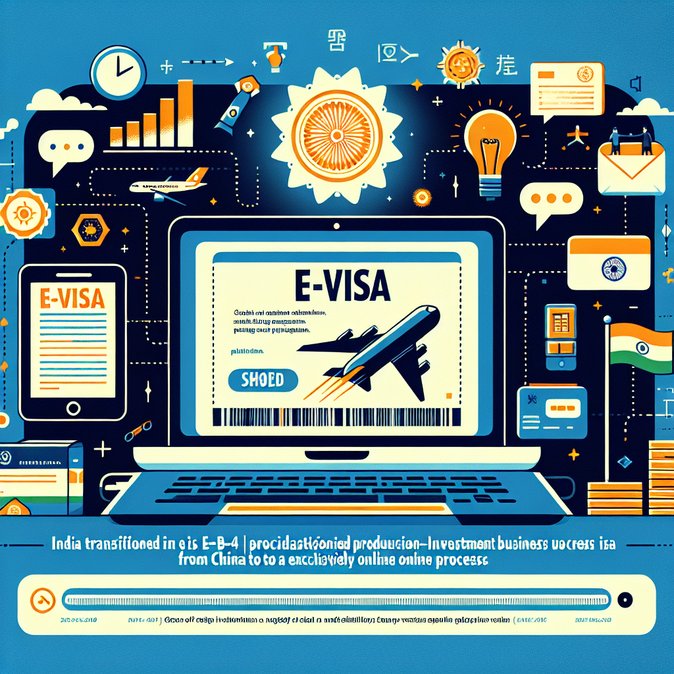
On 6 March 2026 the Indian Embassy in Beijing confirmed that, effective 1 January, it has stopped issuing paper visas for the Production-Investment Business category (e-B-4). Chinese applicants must now use India’s online e-Visa portal; paper submissions are no longer accepted. The e-B-4 visa—introduced in 2025 to fast-track technicians setting up manufacturing lines, installing equipment or training local staff—initially operated in parallel with a consular-sticker option. According to embassy data, duplicative workflows delayed approvals by up to two weeks.
![India makes e-B-4 business visa mandatory for Chinese investors, ends paper applications]()
For companies that would rather not gamble with photo specifications or sponsor-letter formatting, VisaHQ offers a turnkey filing service for India’s e-B-4 and other e-Visa classes. Through its India-focused platform (https://www.visahq.com/india/) the firm pre-screens documents, fixes common upload errors and liaises with Indian authorities, helping mobility managers secure approvals in a single pass.
Moving fully digital should cut processing to 72 hours, important for companies racing to meet production-linked-incentive (PLI) deadlines in sectors such as EV batteries and consumer electronics. It also dovetails with India’s IVFRT modernisation programme, which aims to digitise 100 % of arrival and visa processes by 2027. Chinese firms welcome the speed gains but caution that India’s portal rejects passports without ICAO-compliant photos, causing a spike in error messages. Mobility managers are advised to test uploads in advance and maintain a backup India-based sponsor letter in case the portal flags incomplete address data. The embassy says it will expand the e-B-4 model to Japan and South Korea later in 2026, signalling a broader shift away from paper business visas.

For companies that would rather not gamble with photo specifications or sponsor-letter formatting, VisaHQ offers a turnkey filing service for India’s e-B-4 and other e-Visa classes. Through its India-focused platform (https://www.visahq.com/india/) the firm pre-screens documents, fixes common upload errors and liaises with Indian authorities, helping mobility managers secure approvals in a single pass.
Moving fully digital should cut processing to 72 hours, important for companies racing to meet production-linked-incentive (PLI) deadlines in sectors such as EV batteries and consumer electronics. It also dovetails with India’s IVFRT modernisation programme, which aims to digitise 100 % of arrival and visa processes by 2027. Chinese firms welcome the speed gains but caution that India’s portal rejects passports without ICAO-compliant photos, causing a spike in error messages. Mobility managers are advised to test uploads in advance and maintain a backup India-based sponsor letter in case the portal flags incomplete address data. The embassy says it will expand the e-B-4 model to Japan and South Korea later in 2026, signalling a broader shift away from paper business visas.