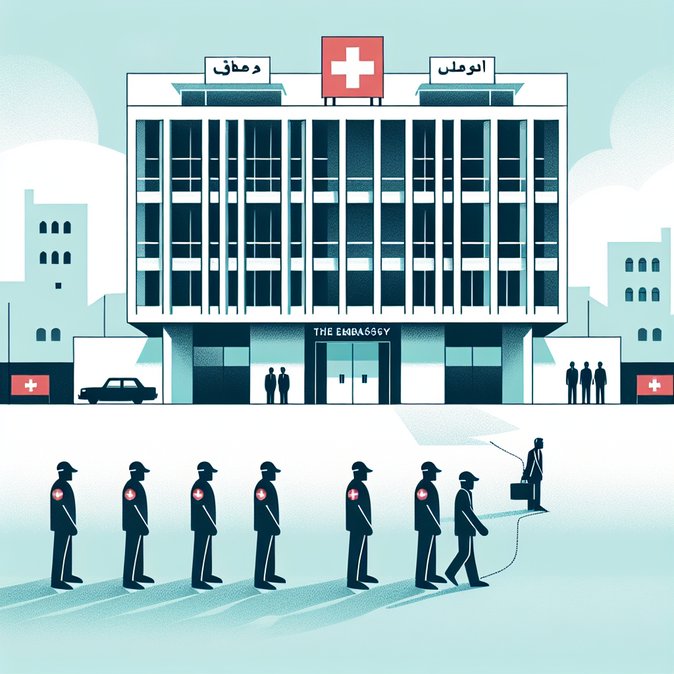
Even as several Western missions shuttered on 28 February, Switzerland opted for a calibrated approach: the embassy in Tehran will remain operational but with a reduced complement—ten diplomats instead of fourteen—after non-essential personnel were evacuated overland. The foreign ministry said the downsizing balances staff safety with Switzerland’s unique ‘protecting-power’ mandate, under which it represents US interests in Iran. The embassy is a critical mobility node. Besides issuing emergency documents and coordinating with Swiss airlines, it safeguards some 1,200 Swiss citizens resident in Iran and thousands transiting on business or humanitarian work. With airspace over Iran still closed to most commercial traffic, consular officers are organising alternative exit routes via Turkey and Armenia for nationals seeking to leave. A 24/7 hotline has been reinforced in Bern to field inquiries after callers reported long waits earlier in the day.
![Swiss Embassy in Tehran Cuts Staff but Keeps Doors Open for Consular Aid]()
For multinational companies the partial draw-down poses operational headaches. Legalisations, work-permit attestations and visa facilitation for Iranian staff seconded to Swiss HQs could slow, adding friction to supply-chain or R&D collaborations. To help mitigate such bureaucratic friction, VisaHQ offers an online platform where individuals and corporate travel departments can arrange Swiss visas, document legalisations and passport services without having to rely solely on the constrained embassy network. Its dedicated Switzerland page (https://www.visahq.com/switzerland/) provides real-time requirements, downloadable forms and secure courier options that keep critical paperwork moving despite the current staffing reductions. Firms are being advised to file paperwork via courier to the embassy in Ankara where possible, or to shift meetings to Dubai once flights resume. Diplomatic analysts say Switzerland’s decision underscores the importance it attributes to its protecting-power role, a centre-piece of its foreign-policy brand. Closing the mission would strain Swiss-US relations and leave Washington without a trusted channel to Tehran. Yet security experts caution that further escalation could force a full evacuation, which would have cascading effects on consular services for Swiss and US citizens alike. Companies with expatriate staff in Iran should therefore activate tier-two contingency plans, including remote work or relocation of key personnel to safer hubs. Crisis-management specialists recommend ensuring that employees carry both hard-copy and digital copies of Swiss passports, residence permits and Iranian visas to expedite potential land exits through bordering states.

For multinational companies the partial draw-down poses operational headaches. Legalisations, work-permit attestations and visa facilitation for Iranian staff seconded to Swiss HQs could slow, adding friction to supply-chain or R&D collaborations. To help mitigate such bureaucratic friction, VisaHQ offers an online platform where individuals and corporate travel departments can arrange Swiss visas, document legalisations and passport services without having to rely solely on the constrained embassy network. Its dedicated Switzerland page (https://www.visahq.com/switzerland/) provides real-time requirements, downloadable forms and secure courier options that keep critical paperwork moving despite the current staffing reductions. Firms are being advised to file paperwork via courier to the embassy in Ankara where possible, or to shift meetings to Dubai once flights resume. Diplomatic analysts say Switzerland’s decision underscores the importance it attributes to its protecting-power role, a centre-piece of its foreign-policy brand. Closing the mission would strain Swiss-US relations and leave Washington without a trusted channel to Tehran. Yet security experts caution that further escalation could force a full evacuation, which would have cascading effects on consular services for Swiss and US citizens alike. Companies with expatriate staff in Iran should therefore activate tier-two contingency plans, including remote work or relocation of key personnel to safer hubs. Crisis-management specialists recommend ensuring that employees carry both hard-copy and digital copies of Swiss passports, residence permits and Iranian visas to expedite potential land exits through bordering states.