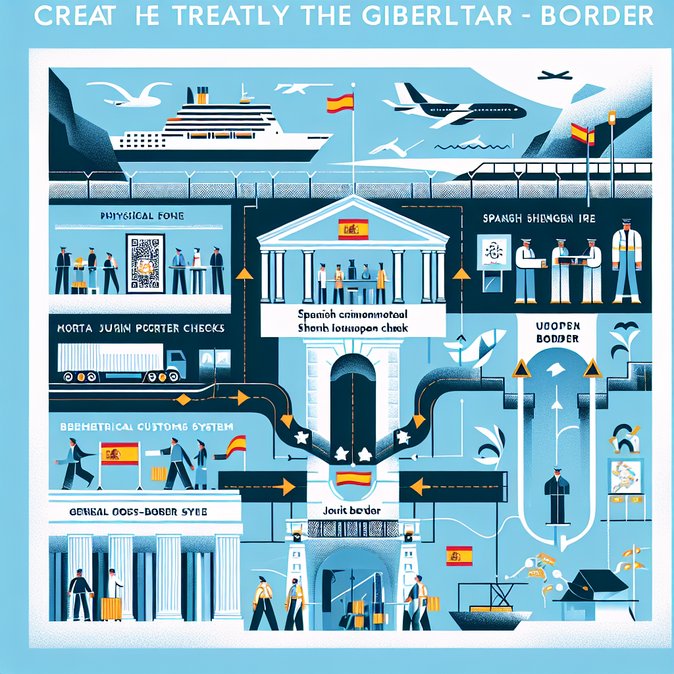
Spain, the United Kingdom and Gibraltar released the long-awaited draft post-Brexit treaty on February 27 2026, ending months of speculation about how the 1.2-kilometre land crossing at La Línea de la Concepción will work once the European Union’s Entry/Exit System (EES) becomes fully operational in April. Under the 1,000-page text, the physical fence (“la Verja”) that has separated the Rock from mainland Andalucía since the Franco era will be dismantled in favour of a joint control zone. Spanish Policía Nacional officers will carry out Schengen checks on travellers entering Gibraltar by air or sea, replicating the juxtaposed-control model used by French police at London’s St Pancras. For the 15,000 frontier workers who cross daily—half of Gibraltar’s workforce—the change means swipe-and-walk passage with no passport stamping, eliminating queues that regularly stretch for hours. The treaty also creates a bespoke customs union designed to slash paperwork for perishables, pharmaceuticals and e-commerce parcels that currently face double inspections. A new “green lane” at the port of Algeciras will pre-clear goods headed to Gibraltar, mirroring arrangements at Eurotunnel freight terminals. Environmental provisions set up a joint committee to police land-reclamation projects and marine pollution—historic friction points between the two jurisdictions.
![Draft Gibraltar Treaty Published: Spain Gains Schengen Role While Border Stays ‘Fluid’]()
Travelers worried about navigating the new EES requirements can lean on VisaHQ’s expertise: the platform (https://www.visahq.com/spain/) simplifies Schengen visa processing, handles pre-registration formalities and offers real-time status updates, ensuring commuters, tourists and freight drivers cross the Gibraltar–Spain border with confidence.
Critically, sovereignty issues are placed outside the scope of the agreement. Article 2 states that nothing in the text can be interpreted as recognising or renouncing claims by either side. Spanish Foreign Minister José Manuel Albares hailed the accord as “an historic model of coexistence after 313 years,” while Gibraltar’s Chief Minister Fabian Picardo called it “safe and secure… safeguarding our way of life.” Ratification by the European Parliament and the British and Spanish legislatures is expected before the summer, with provisional application pencilled in for 10 April 2026—day-one of the EU’s biometric border rollout. For companies operating on both sides of the border—from Spanish ship-repair yards in Algeciras to British online-gaming firms headquartered on the Rock—the treaty promises friction-free commuting, simplified VAT alignment and, ultimately, a larger cross-border labour pool. HR teams should start mapping new commuter allowances, while logistics managers can anticipate shorter door-to-door transit times once the green-lane customs model goes live.

Travelers worried about navigating the new EES requirements can lean on VisaHQ’s expertise: the platform (https://www.visahq.com/spain/) simplifies Schengen visa processing, handles pre-registration formalities and offers real-time status updates, ensuring commuters, tourists and freight drivers cross the Gibraltar–Spain border with confidence.
Critically, sovereignty issues are placed outside the scope of the agreement. Article 2 states that nothing in the text can be interpreted as recognising or renouncing claims by either side. Spanish Foreign Minister José Manuel Albares hailed the accord as “an historic model of coexistence after 313 years,” while Gibraltar’s Chief Minister Fabian Picardo called it “safe and secure… safeguarding our way of life.” Ratification by the European Parliament and the British and Spanish legislatures is expected before the summer, with provisional application pencilled in for 10 April 2026—day-one of the EU’s biometric border rollout. For companies operating on both sides of the border—from Spanish ship-repair yards in Algeciras to British online-gaming firms headquartered on the Rock—the treaty promises friction-free commuting, simplified VAT alignment and, ultimately, a larger cross-border labour pool. HR teams should start mapping new commuter allowances, while logistics managers can anticipate shorter door-to-door transit times once the green-lane customs model goes live.