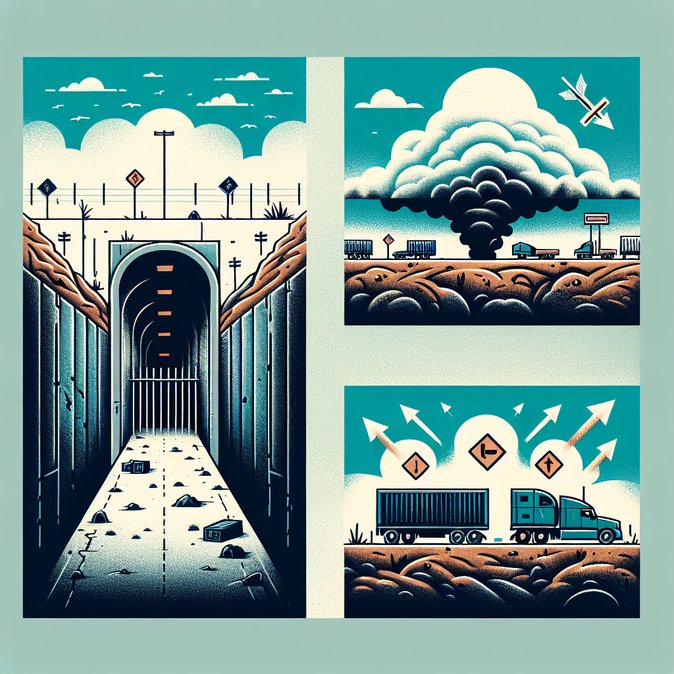
In the latest sign of escalating ‘hybrid’ pressure on the European Union’s eastern flank, Polish border guards on 25 February 2026 revealed the discovery of a reinforced tunnel running beneath the border with Belarus in Podlaskie Voivodeship. The passageway—roughly 60 metres long and 1.5 metres high—was equipped with concrete supports and concealed entrances, enabling smugglers to move groups of migrants undetected beneath the multi-billion-złoty border fence constructed in 2022.
![Polish Border Guards Expose Underground Migrant Tunnel on Belarus Frontier]()
Companies and travellers who suddenly find themselves navigating tightened Polish border rules may benefit from external support: VisaHQ, for example, offers up-to-date guidance on Poland’s visa requirements, expedited application services, and corporate compliance solutions that can reduce administrative delays for cross-border staff movements (see https://www.visahq.com/poland/ for details).
According to officials, at least 180 people, primarily from Afghanistan and Pakistan, traversed the tunnel before a thermal-imaging drone detected anomalous heat signatures. Engineers from Poland’s Territorial Defence Force have since filled the structure with expanding foam and seismic sensors have been installed to alert troops to further digging. Deputy Interior Minister Czesław Mroczek characterised the find as evidence that Belarus, with Russian backing, is ‘weaponising migration’ against Poland—a charge Minsk denies. The incident intensifies diplomatic friction just weeks after Warsaw extended temporary border controls with Germany and Lithuania, arguing that human-trafficking networks are rerouting flows westward. EU Home Affairs Commissioner Ylva Johansson expressed ‘grave concern’ and pledged additional Frontex surveillance resources. For businesses the development has two immediate implications. First, trucking operators that rely on the Kuźnica and Bobrowniki crossings should expect continued spot-checks, adding hours to delivery lead times in the automotive and FMCG supply chains. Second, expatriate staff based near the frontier face a heightened security posture, including ID checks and restricted access zones that may complicate housing and schooling arrangements. Longer term, Poland is accelerating plans for an underground sensor grid similar to systems on the US-Mexico border, funded in part by EU Integrated Border Management instruments. The government is also drafting legislation to make the facilitation of illegal entry via subterranean routes a distinct criminal offence carrying up to 15 years’ imprisonment.
Companies and travellers who suddenly find themselves navigating tightened Polish border rules may benefit from external support: VisaHQ, for example, offers up-to-date guidance on Poland’s visa requirements, expedited application services, and corporate compliance solutions that can reduce administrative delays for cross-border staff movements (see https://www.visahq.com/poland/ for details).
According to officials, at least 180 people, primarily from Afghanistan and Pakistan, traversed the tunnel before a thermal-imaging drone detected anomalous heat signatures. Engineers from Poland’s Territorial Defence Force have since filled the structure with expanding foam and seismic sensors have been installed to alert troops to further digging. Deputy Interior Minister Czesław Mroczek characterised the find as evidence that Belarus, with Russian backing, is ‘weaponising migration’ against Poland—a charge Minsk denies. The incident intensifies diplomatic friction just weeks after Warsaw extended temporary border controls with Germany and Lithuania, arguing that human-trafficking networks are rerouting flows westward. EU Home Affairs Commissioner Ylva Johansson expressed ‘grave concern’ and pledged additional Frontex surveillance resources. For businesses the development has two immediate implications. First, trucking operators that rely on the Kuźnica and Bobrowniki crossings should expect continued spot-checks, adding hours to delivery lead times in the automotive and FMCG supply chains. Second, expatriate staff based near the frontier face a heightened security posture, including ID checks and restricted access zones that may complicate housing and schooling arrangements. Longer term, Poland is accelerating plans for an underground sensor grid similar to systems on the US-Mexico border, funded in part by EU Integrated Border Management instruments. The government is also drafting legislation to make the facilitation of illegal entry via subterranean routes a distinct criminal offence carrying up to 15 years’ imprisonment.