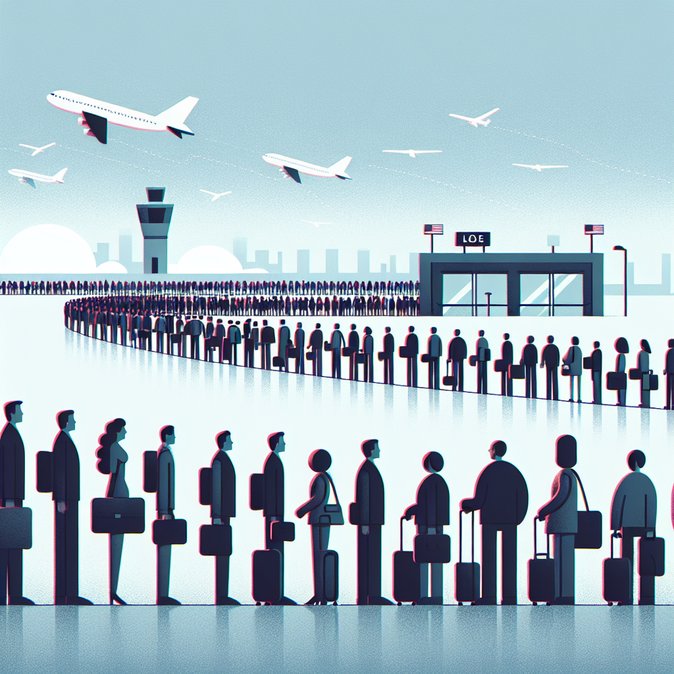
Business travelers arriving in the United States on February 24 were greeted by an unwelcome surprise: Global Entry kiosks at all 77 participating airports were dark after the Department of Homeland Security (DHS) halted the trusted-traveler program two days earlier as a cost-saving move during the ongoing partial government shutdown. The agency insisted that keeping TSA PreCheck open while pausing Global Entry would “maximize security resources,” yet industry groups argued the decision does the opposite, pushing 13 million pre-vetted travelers back into standard passport-control lines and lengthening queues for everyone. U.S. Travel Association president Geoff Freeman called the suspension “illogical,” noting that Global Entry’s $120 application fee funds most of the program’s operating costs.
![U.S. Travel Industry Blasts DHS Suspension of Global Entry Amid Shutdown]()
Amid the uncertainty, travelers can at least remove another layer of complexity by arranging their visa and travel-document needs in advance through VisaHQ. The platform (https://www.visahq.com/united-states/) offers step-by-step guidance, real-time status tracking, and expert support for U.S. visas and countless other destinations, helping to ensure that paperwork—not to mention sudden program suspensions—never becomes a trip-ruining surprise.
According to CBP data, automated kiosks trimmed arrival wait times by 70 percent and freed 300,000 officer hours in 2025—capacity that now must be absorbed by regular inspection booths already short-staffed because 60 percent of CBP officers are working without pay. Airlines for America warned that the abrupt halt could trigger a cascade of missed connections at major hubs such as ATL, JFK and LAX, where evening arrival “banks” funnel thousands of passengers through immigration in tight windows. Corporate travel managers have begun revising connection-time guidelines upward by 30-45 minutes and urging employees to download Mobile Passport Control (MPC) as a partial workaround. Policy analysts note that Global Entry has survived previous shutdowns precisely because it is fee-funded. The move therefore appears to be political leverage rather than a budget necessity—an impression reinforced when DHS backtracked on an earlier plan to close TSA PreCheck after fierce airline and congressional pushback. Lawmakers on both sides of the aisle have introduced bills to classify Global Entry as an “excepted” activity during funding lapses, but none has reached the floor. For now, companies are advising international travelers to: (1) schedule longer layovers when connecting in the United States, (2) avoid last-flight-of-the-day domestic legs, and (3) pre-enroll in MPC where available. The practical takeaway, says one Fortune 100 mobility manager, is that “trusted-traveler benefits can vanish overnight, so contingency planning has to be baked into every itinerary while the shutdown drags on.”

Amid the uncertainty, travelers can at least remove another layer of complexity by arranging their visa and travel-document needs in advance through VisaHQ. The platform (https://www.visahq.com/united-states/) offers step-by-step guidance, real-time status tracking, and expert support for U.S. visas and countless other destinations, helping to ensure that paperwork—not to mention sudden program suspensions—never becomes a trip-ruining surprise.
According to CBP data, automated kiosks trimmed arrival wait times by 70 percent and freed 300,000 officer hours in 2025—capacity that now must be absorbed by regular inspection booths already short-staffed because 60 percent of CBP officers are working without pay. Airlines for America warned that the abrupt halt could trigger a cascade of missed connections at major hubs such as ATL, JFK and LAX, where evening arrival “banks” funnel thousands of passengers through immigration in tight windows. Corporate travel managers have begun revising connection-time guidelines upward by 30-45 minutes and urging employees to download Mobile Passport Control (MPC) as a partial workaround. Policy analysts note that Global Entry has survived previous shutdowns precisely because it is fee-funded. The move therefore appears to be political leverage rather than a budget necessity—an impression reinforced when DHS backtracked on an earlier plan to close TSA PreCheck after fierce airline and congressional pushback. Lawmakers on both sides of the aisle have introduced bills to classify Global Entry as an “excepted” activity during funding lapses, but none has reached the floor. For now, companies are advising international travelers to: (1) schedule longer layovers when connecting in the United States, (2) avoid last-flight-of-the-day domestic legs, and (3) pre-enroll in MPC where available. The practical takeaway, says one Fortune 100 mobility manager, is that “trusted-traveler benefits can vanish overnight, so contingency planning has to be baked into every itinerary while the shutdown drags on.”