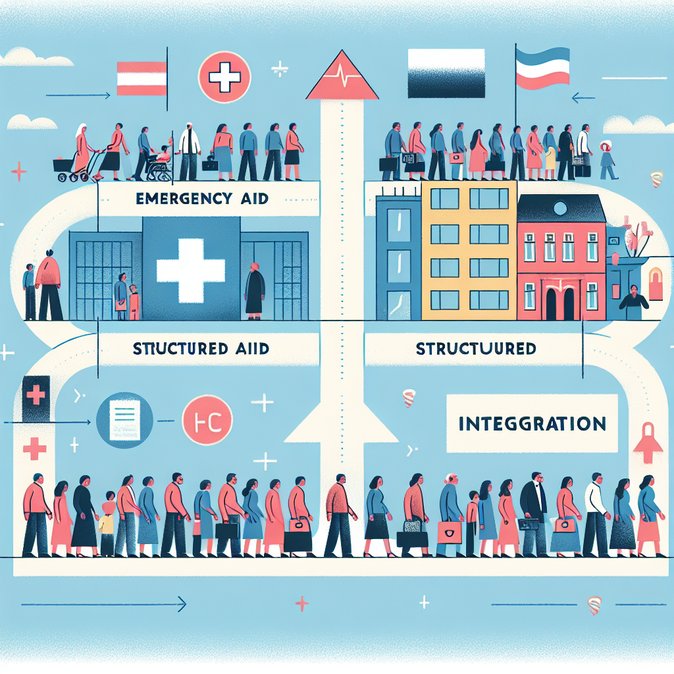
On 24 February 2026 the Polish government published in the Journal of Laws (Dz.U. poz. 203) a 42-page statute that fundamentally rewrites the legal basis for almost one million Ukrainians who fled Russia’s full-scale invasion four years ago. The “Act on the Expiry of Measures under the Ukraine Assistance Law” repeals most emergency provisions adopted in March 2022 and stitches many of them into the mainstream Law on Foreigners, social-security and tax codes. The step signals Warsaw’s confidence that the acute phase of the humanitarian crisis has passed and that long-term integration can now be managed through standard migration channels. From 5 March 2026 newly arriving Ukrainian citizens will have 30 days to register for a PESEL number with the “UKR” status. Those who already hold that status keep lawful stay until 4 March 2027 but must present a valid travel document by 31 August 2026. Employers can continue to hire them without labour-market testing, yet simplified on-line notifications will replace the blanket work authorisation that existed under the Special Act.
![Poland publishes landmark law phasing-out the 2022 “Special Act” for Ukrainian refugees]()
VisaHQ, a global visa and passport services platform, can help both individuals and corporate mobility teams navigate these changes. Its Poland desk (https://www.visahq.com/poland/) offers tailored document checklists, pre-screening of applications and appointment-booking assistance, reducing the risk of last-minute rejections or missed deadlines.
The Ministry of the Interior is promising a dedicated web portal in April to funnel refugees into the three-year temporary-residence permit available under Article 106 of the Foreigners’ Act – a procedure that includes standard fingerprints and fee payments. The law also narrows access to publicly funded healthcare, housing and family benefits. Free medical care will henceforth be limited to minors, pregnant women, victims of torture or sexual violence and residents of collective accommodation centres; all other adults must pay health-insurance contributions or rely on employers to do so. Local authorities warn of near-term bottlenecks as tens of thousands of Ukrainians scramble to update paperwork; corporate HR teams with large Ukrainian workforces are advising staff to book civic-office appointments well in advance and to budget half-a-day for biometric capture. Tax rules are also tightening. Under a new Article 52zr of the Personal Income-Tax Act, Ukrainians who meet the centre-of-life-interests test between 2024 and 2026 may confirm it by a simple written statement, but only until 31 December 2026. After that date, standard residence-based taxation will apply. Schools are affected too: pupils covered by the old rules must now meet the same graduation and exam criteria as other foreign students, or repeat the final grade. For global-mobility managers the message is clear: the era of automatic extensions is ending. Companies should audit their Ukrainian assignee populations, prepare information campaigns in plain Ukrainian and allocate budget for government fees that were previously waived. Early movers will avoid blocked bank accounts and ensure continued access to Poland’s burgeoning e-Government platforms, including the Diia.pl digital ID that remains valid for border crossings within the EU.

VisaHQ, a global visa and passport services platform, can help both individuals and corporate mobility teams navigate these changes. Its Poland desk (https://www.visahq.com/poland/) offers tailored document checklists, pre-screening of applications and appointment-booking assistance, reducing the risk of last-minute rejections or missed deadlines.
The Ministry of the Interior is promising a dedicated web portal in April to funnel refugees into the three-year temporary-residence permit available under Article 106 of the Foreigners’ Act – a procedure that includes standard fingerprints and fee payments. The law also narrows access to publicly funded healthcare, housing and family benefits. Free medical care will henceforth be limited to minors, pregnant women, victims of torture or sexual violence and residents of collective accommodation centres; all other adults must pay health-insurance contributions or rely on employers to do so. Local authorities warn of near-term bottlenecks as tens of thousands of Ukrainians scramble to update paperwork; corporate HR teams with large Ukrainian workforces are advising staff to book civic-office appointments well in advance and to budget half-a-day for biometric capture. Tax rules are also tightening. Under a new Article 52zr of the Personal Income-Tax Act, Ukrainians who meet the centre-of-life-interests test between 2024 and 2026 may confirm it by a simple written statement, but only until 31 December 2026. After that date, standard residence-based taxation will apply. Schools are affected too: pupils covered by the old rules must now meet the same graduation and exam criteria as other foreign students, or repeat the final grade. For global-mobility managers the message is clear: the era of automatic extensions is ending. Companies should audit their Ukrainian assignee populations, prepare information campaigns in plain Ukrainian and allocate budget for government fees that were previously waived. Early movers will avoid blocked bank accounts and ensure continued access to Poland’s burgeoning e-Government platforms, including the Diia.pl digital ID that remains valid for border crossings within the EU.