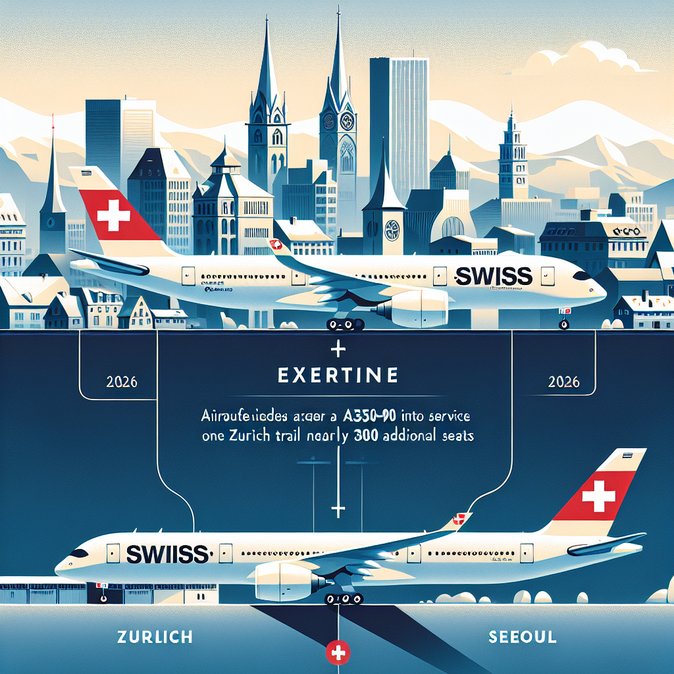
Swiss International Air Lines (SWISS) quietly reached a fleet milestone on 24 February when flight data confirmed that its second Airbus A350-900, christened “Delémont,” has joined scheduled service on the carrier’s Zurich–Montreal rotation. The inaugural commercial flight departed Kloten at 10:05 a.m. local time, adding almost 300 daily seats to one of SWISS’s most lucrative business-travel corridors.
![SWISS deploys second Airbus A350-900 on Zurich–Montreal, boosting transatlantic capacity]()
For passengers excited about the new connection, sorting out travel documentation can be just as important as choosing the right flight. VisaHQ’s Switzerland portal (https://www.visahq.com/switzerland/) offers an easy way to check visa requirements for Canada, South Korea, the United States and dozens of other destinations served by SWISS, guiding travellers through eTA applications, embassy appointments and courier services so that they can board the A350 with peace of mind.
The twin-engine wide-body completed acceptance checks in Toulouse earlier this month before operating a proving run to Boston. According to the airline’s LinkedIn statement, the aircraft features SWISS’s refreshed ‘warm minimalist’ cabin with enclosed business-class suites, a 40-seat premium-economy cabin and next-generation Panasonic in-flight connectivity—amenities targeted squarely at corporate flyers and high-yield leisure travellers. Deploying a second A350 enables SWISS to retire an ageing Airbus A340 on the route, cutting fuel burn by an estimated 25 % and slashing per-seat CO₂ emissions to just under 2.3 litres per 100 passenger-kilometres. The move dovetails with corporate sustainability targets: several Swiss multinationals, including Novartis and UBS, have pledged to halve aviation-related Scope 3 emissions by 2030 and rank aircraft type in their travel-policy decision matrices. Network-planning documents seen by industry analysts suggest both A350s will operate Boston and Seoul flights from the start of the summer timetable, while newcomer Montreal becomes a core “triangle” allowing same-aircraft utilisation across North America and Asia. That gives travel managers more daylight-hour options via Zurich hub connections and may help stabilise premium-cabin fares, which spiked by double digits after capacity was removed during winter runway-works. For Switzerland’s wider mobility ecosystem the up-gauge signals confidence in long-haul demand: Zurich Airport’s slot-co-ordination data show transatlantic frequencies will exceed pre-pandemic 2019 levels by Q3 2026, aided by SWISS’s eight remaining A350 deliveries scheduled through 2031.

For passengers excited about the new connection, sorting out travel documentation can be just as important as choosing the right flight. VisaHQ’s Switzerland portal (https://www.visahq.com/switzerland/) offers an easy way to check visa requirements for Canada, South Korea, the United States and dozens of other destinations served by SWISS, guiding travellers through eTA applications, embassy appointments and courier services so that they can board the A350 with peace of mind.
The twin-engine wide-body completed acceptance checks in Toulouse earlier this month before operating a proving run to Boston. According to the airline’s LinkedIn statement, the aircraft features SWISS’s refreshed ‘warm minimalist’ cabin with enclosed business-class suites, a 40-seat premium-economy cabin and next-generation Panasonic in-flight connectivity—amenities targeted squarely at corporate flyers and high-yield leisure travellers. Deploying a second A350 enables SWISS to retire an ageing Airbus A340 on the route, cutting fuel burn by an estimated 25 % and slashing per-seat CO₂ emissions to just under 2.3 litres per 100 passenger-kilometres. The move dovetails with corporate sustainability targets: several Swiss multinationals, including Novartis and UBS, have pledged to halve aviation-related Scope 3 emissions by 2030 and rank aircraft type in their travel-policy decision matrices. Network-planning documents seen by industry analysts suggest both A350s will operate Boston and Seoul flights from the start of the summer timetable, while newcomer Montreal becomes a core “triangle” allowing same-aircraft utilisation across North America and Asia. That gives travel managers more daylight-hour options via Zurich hub connections and may help stabilise premium-cabin fares, which spiked by double digits after capacity was removed during winter runway-works. For Switzerland’s wider mobility ecosystem the up-gauge signals confidence in long-haul demand: Zurich Airport’s slot-co-ordination data show transatlantic frequencies will exceed pre-pandemic 2019 levels by Q3 2026, aided by SWISS’s eight remaining A350 deliveries scheduled through 2031.