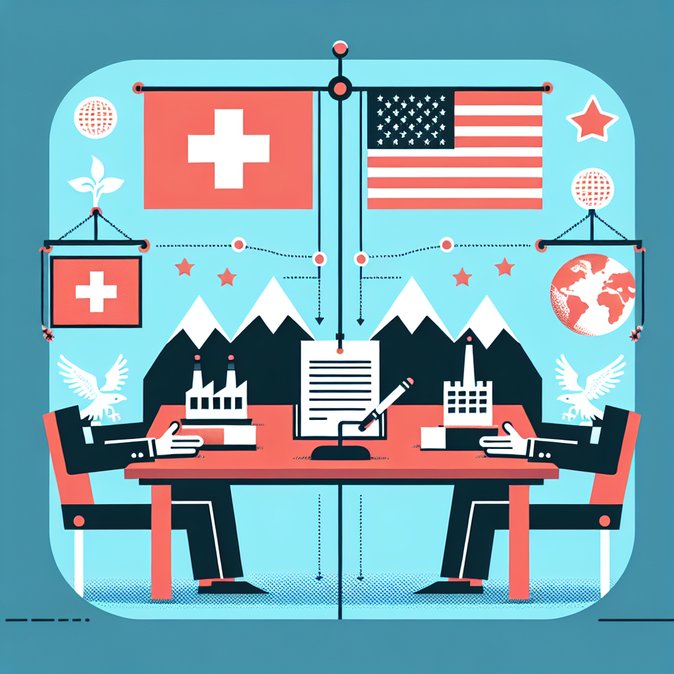
Hours after the U.S. Supreme Court struck down large parts of President Trump’s unilateral tariff regime, Switzerland’s Federal Council said on 22 February that it would not abandon ongoing negotiations for a comprehensive trade accord with Washington. Speaking to Keystone-SDA and quoted by news portal Nau.ch, officials at the State Secretariat for Economic Affairs (SECO) said the aim remained “maximum legal certainty for Swiss exporters,” even if a new U.S. executive order re-imposes 15 % duties from next week. The Court held that the administration had exceeded its powers by using emergency legislation (IEEPA 1977) to levy blanket “reciprocal” tariffs worth some 200 billion USD. Although the judgment opens the door to refund claims, SECO warns that most Swiss firms will still face the new 15 % tariff announced by the White House under a different legal basis. Business lobby economiesuisse estimates potential cash-flow hits of up to 500 million CHF for machinery and precision-instrument exporters. Political pressure mounted in Bern: left-wing parties demanded an immediate halt to talks, arguing that negotiating under tariff threat is untenable. Yet Economic Affairs Minister Guy Parmelin rejected calls for a walk-out, noting that Swiss pharmaceutical and aviation products are still exempt and that companies have pledged 200 billion CHF in future U.S. investments that hinge on a stable framework. For global-mobility managers the episode is an object lesson in how trade policy can ripple into people-mobility planning. Higher duties raise total assignment costs for U.S. projects, while uncertainty over refund timelines complicates budgeting. Relocation advisers say some firms are pausing U.S. expansion moves until tariff clarity returns; others are rushing to accelerate shipments and temporary assignments before the 15 % rate kicks in.
![Bern Sticks to U.S. Tariff Talks After Supreme Court Blow to Trump Duties]()
At times like these, navigating the procedural side of cross-border work becomes just as critical as understanding the tariff tables. VisaHQ’s Switzerland portal (https://www.visahq.com/switzerland/) offers corporate mobility teams a one-stop interface for U.S. and global visa processing, real-time regulatory alerts and document-tracking dashboards—services that can keep projects on schedule even when trade policy is in flux.
SECO confirmed that a multi-party parliamentary delegation will travel to Washington next week to press for durable tariff relief and to highlight Swiss investment in U.S. R&D hubs. Mobility stakeholders should watch whether negotiations deliver sector-specific carve-outs that could influence future site-selection and expatriate deployment decisions.

At times like these, navigating the procedural side of cross-border work becomes just as critical as understanding the tariff tables. VisaHQ’s Switzerland portal (https://www.visahq.com/switzerland/) offers corporate mobility teams a one-stop interface for U.S. and global visa processing, real-time regulatory alerts and document-tracking dashboards—services that can keep projects on schedule even when trade policy is in flux.
SECO confirmed that a multi-party parliamentary delegation will travel to Washington next week to press for durable tariff relief and to highlight Swiss investment in U.S. R&D hubs. Mobility stakeholders should watch whether negotiations deliver sector-specific carve-outs that could influence future site-selection and expatriate deployment decisions.