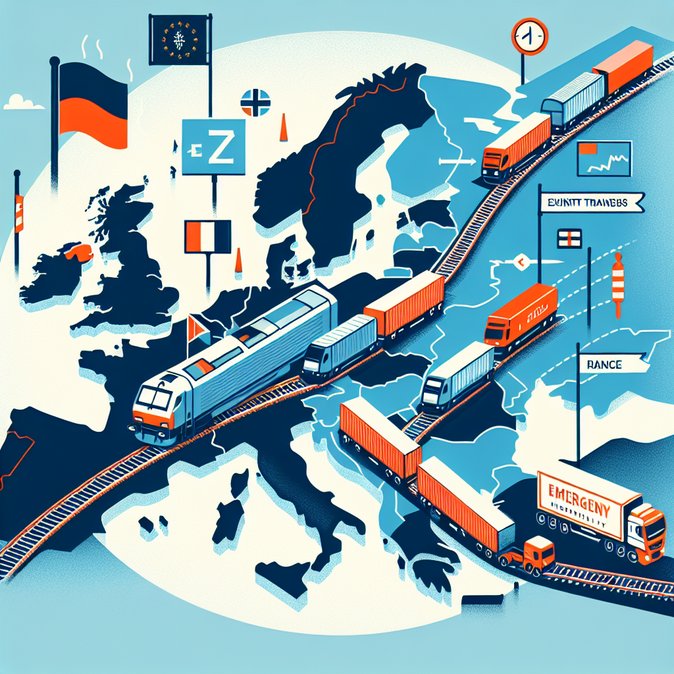
On 29 January the European Parliament’s Transport (TRAN) Committee approved a provisional regulation that obliges national infrastructure managers to plan and allocate rail capacity jointly on international corridors. Although technical, the measure could be a game-changer for French shippers that rely on time-critical freight flows through Luxembourg, Germany, Italy and Spain.
Under the agreement, infrastructure managers such as SNCF Réseau will have to publish standardised capacity “catalogues” 18 months ahead of each timetable, coordinate maintenance windows and create one-stop booking interfaces for train paths that cross at least one border. Today, operators often juggle a patchwork of national rules, leading to late-night path cancellations or bottlenecks at hand-over points like Modane and Hendaye.
The French government lobbied hard for the reform after a series of weekend engineering overruns on the Lyon–Turin line stranded automotive components en route to assembly plants in 2025. Industry group TLF estimates that predictable freight paths could shave €13 million a year off contingency warehousing costs for French exporters alone, while helping Paris meet its modal-shift targets ahead of the 2030 climate milestone.
![EU lawmakers endorse deal to coordinate cross-border rail capacity—welcome news for French exporters]()
For stakeholders who also have to manage the cross-border movement of personnel—whether drivers, technicians or auditors—VisaHQ can remove much of the administrative friction. The platform’s France hub (https://www.visahq.com/france/) consolidates constantly updated visa requirements and offers expedited processing for Schengen and third-country documents, allowing logistics teams to align travel paperwork with the new, more predictable rail schedules.
For mobility professionals overseeing expatriate assignments linked to pan-European manufacturing footprints, the deal matters in two ways. First, more reliable rail freight reduces pressure on just-in-time road haulage, potentially decreasing the need for emergency driver deployments and last-minute Schengen visa runs for non-EU technicians. Second, the regulation dovetails with France’s planned extension of internal border controls—a reminder that rail is becoming a strategic lever in both security and decarbonisation policy.
The text must still clear a plenary vote and gain Council approval, but lawmakers expect formal adoption before the summer recess, with phased implementation from 2028. Companies should map current rail-freight dependencies, engage with forwarders on preferred train paths and monitor how SNCF Réseau integrates the new rules into its digital path-request system.
Under the agreement, infrastructure managers such as SNCF Réseau will have to publish standardised capacity “catalogues” 18 months ahead of each timetable, coordinate maintenance windows and create one-stop booking interfaces for train paths that cross at least one border. Today, operators often juggle a patchwork of national rules, leading to late-night path cancellations or bottlenecks at hand-over points like Modane and Hendaye.
The French government lobbied hard for the reform after a series of weekend engineering overruns on the Lyon–Turin line stranded automotive components en route to assembly plants in 2025. Industry group TLF estimates that predictable freight paths could shave €13 million a year off contingency warehousing costs for French exporters alone, while helping Paris meet its modal-shift targets ahead of the 2030 climate milestone.

For stakeholders who also have to manage the cross-border movement of personnel—whether drivers, technicians or auditors—VisaHQ can remove much of the administrative friction. The platform’s France hub (https://www.visahq.com/france/) consolidates constantly updated visa requirements and offers expedited processing for Schengen and third-country documents, allowing logistics teams to align travel paperwork with the new, more predictable rail schedules.
For mobility professionals overseeing expatriate assignments linked to pan-European manufacturing footprints, the deal matters in two ways. First, more reliable rail freight reduces pressure on just-in-time road haulage, potentially decreasing the need for emergency driver deployments and last-minute Schengen visa runs for non-EU technicians. Second, the regulation dovetails with France’s planned extension of internal border controls—a reminder that rail is becoming a strategic lever in both security and decarbonisation policy.
The text must still clear a plenary vote and gain Council approval, but lawmakers expect formal adoption before the summer recess, with phased implementation from 2028. Companies should map current rail-freight dependencies, engage with forwarders on preferred train paths and monitor how SNCF Réseau integrates the new rules into its digital path-request system.