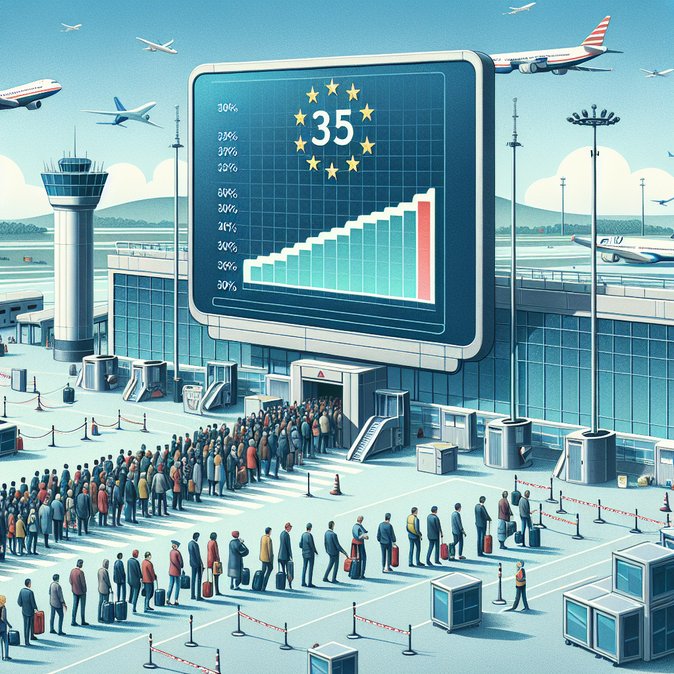
The EU’s biometric Entry/Exit System (EES) entered its second rollout phase on 9 January 2026, requiring border guards to register at least 35 percent of arriving and departing third-country nationals. Less than three weeks in, aviation bodies are warning that the scheme is choking passenger flows at key Spanish gateways. A Biometric Update report on 28 January quotes Airports Council International (ACI) Europe and Spanish hotel federation CEHAT describing the situation as “a mess” that risks escalating into full-blown summer chaos.
At Malaga-Costa del Sol, Tenerife South, Lanzarote and Barcelona-El Prat, travellers have faced queues exceeding two hours as understaffed police teams struggle with fingerprint scanners that routinely crash or time-out. Lisbon has temporarily suspended EES checks; industry analysts say Spanish authorities may need to do the same during Easter peaks. Airlines such as Ryanair and Vueling are already emailing passengers to arrive three hours before departure.
![Entry/Exit System phase-two snarls Spanish airports, industry calls for contingency plans]()
If you’re planning travel to Spain and want to minimize surprises at the border, VisaHQ can help. The service provides up-to-date guidance on Schengen visa requirements, passport validity rules and emerging EES procedures, allowing travellers to pre-clear many documentation hurdles online before they ever reach the airport. Check out the dedicated Spain page at https://www.visahq.com/spain/ to see how a few clicks can streamline your trip.
For mobility managers, the immediate impact is delay-risk and missed connections for business travellers. Companies should advise staff to build extra buffer time into Iberian itineraries and to ensure passports are machine-readable and free of smudged stamps. Carriers operating tight Madrid or Barcelona connections for long-haul flights may need to re-time schedules until full biometric throughput is achieved.
Spanish police unions argue that the problem is solvable if the Interior Ministry hires the 1,200 additional officers promised for EES implementation. Technology suppliers are also rolling out software patches to cut enrolment from 90 seconds to 45. The third and final phase—100 percent biometric capture—begins on 10 April 2026. Unless Spain accelerates staffing and kiosk deployment, analysts warn that peak-summer passenger volumes could trigger systemic disruption across the Schengen zone.
At Malaga-Costa del Sol, Tenerife South, Lanzarote and Barcelona-El Prat, travellers have faced queues exceeding two hours as understaffed police teams struggle with fingerprint scanners that routinely crash or time-out. Lisbon has temporarily suspended EES checks; industry analysts say Spanish authorities may need to do the same during Easter peaks. Airlines such as Ryanair and Vueling are already emailing passengers to arrive three hours before departure.
If you’re planning travel to Spain and want to minimize surprises at the border, VisaHQ can help. The service provides up-to-date guidance on Schengen visa requirements, passport validity rules and emerging EES procedures, allowing travellers to pre-clear many documentation hurdles online before they ever reach the airport. Check out the dedicated Spain page at https://www.visahq.com/spain/ to see how a few clicks can streamline your trip.
For mobility managers, the immediate impact is delay-risk and missed connections for business travellers. Companies should advise staff to build extra buffer time into Iberian itineraries and to ensure passports are machine-readable and free of smudged stamps. Carriers operating tight Madrid or Barcelona connections for long-haul flights may need to re-time schedules until full biometric throughput is achieved.
Spanish police unions argue that the problem is solvable if the Interior Ministry hires the 1,200 additional officers promised for EES implementation. Technology suppliers are also rolling out software patches to cut enrolment from 90 seconds to 45. The third and final phase—100 percent biometric capture—begins on 10 April 2026. Unless Spain accelerates staffing and kiosk deployment, analysts warn that peak-summer passenger volumes could trigger systemic disruption across the Schengen zone.