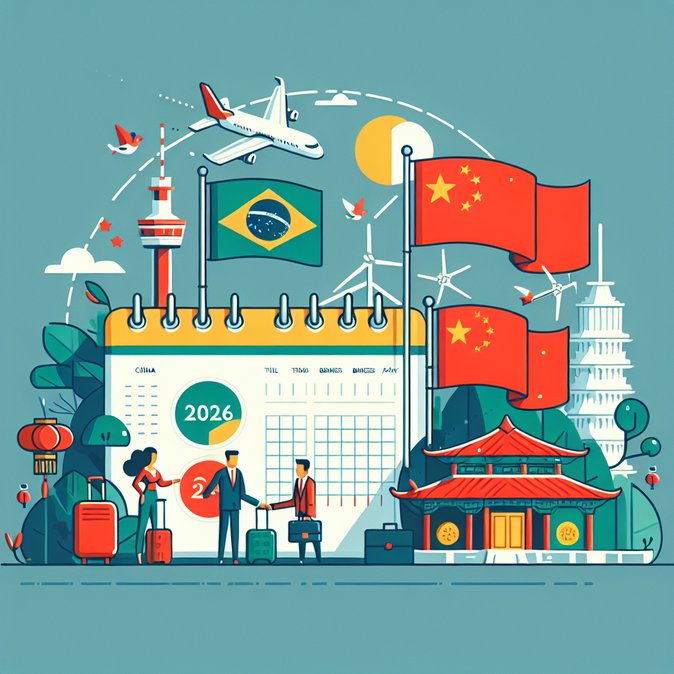
Brazilian President Luiz Inácio Lula da Silva has approved a unilateral visa-exemption regime for holders of Chinese ordinary passports, allowing stays of up to 30 days for tourism, business, family visits, academic exchanges and transit. Announced in Brasília on 26 January and confirmed by the travel trade press on 28 January, the measure mirrors China’s own visa-free access for Brazilians introduced last year and will apply at least until 31 December 2026. (travelandtourworld.com)
While no visa is needed for these short trips, Chinese travelers who intend to stay longer, work, or continue on to other Latin American countries may still need additional documentation. VisaHQ’s China portal (https://www.visahq.com/china/) streamlines the process for securing these secondary visas and travel permits, offering user-friendly online applications, document checklists, and live support—making it easier for individuals and corporate mobility managers to navigate any extra requirements beyond Brazil’s new waiver.
Implementation details—including the formal start date and permitted annual stay limits—will be set out by the Ministries of Foreign Affairs and Tourism in coming weeks, but officials say the framework will match the Chinese precedent. Travellers will still need a return or onward ticket, proof of accommodation and sufficient funds. Work, study or paid activities remain outside the waiver and will continue to require the appropriate visas.
![Brazil Grants Visa-Free Short-Stay Entry to Chinese Citizens Until End-2026]()
For Chinese multinationals, the policy eliminates a significant administrative hurdle: employees can now attend conferences in São Paulo, inspect agribusiness investments in Mato Grosso or negotiate mining-equipment contracts in Minas Gerais without waiting for consular appointments. Airlines and tour operators are already reporting a spike in search traffic for Shanghai–São Paulo and Beijing–Rio routes, and Brazilian tourism boards are stepping up Mandarin-language promotion ahead of the 2026 Carnival season.
The decision is also a diplomatic signal. China has been Brazil’s top trading partner since 2009, with two-way trade exceeding US$150 billion. By facilitating people-to-people links, Brasília hopes to diversify Chinese investment beyond commodities into green energy, technology and infrastructure. Analysts note that the move may pressure other Mercosur members—Argentina and Uruguay in particular—to match Brazil’s openness or risk losing Chinese visitor share.
Corporate mobility managers should add Brazil to the growing list of destinations where Chinese staff can travel visa-free, review duty-of-care protocols for longer stays that could still require work permits, and monitor forthcoming regulations for possible annual-stay caps or registration requirements.
While no visa is needed for these short trips, Chinese travelers who intend to stay longer, work, or continue on to other Latin American countries may still need additional documentation. VisaHQ’s China portal (https://www.visahq.com/china/) streamlines the process for securing these secondary visas and travel permits, offering user-friendly online applications, document checklists, and live support—making it easier for individuals and corporate mobility managers to navigate any extra requirements beyond Brazil’s new waiver.
Implementation details—including the formal start date and permitted annual stay limits—will be set out by the Ministries of Foreign Affairs and Tourism in coming weeks, but officials say the framework will match the Chinese precedent. Travellers will still need a return or onward ticket, proof of accommodation and sufficient funds. Work, study or paid activities remain outside the waiver and will continue to require the appropriate visas.

For Chinese multinationals, the policy eliminates a significant administrative hurdle: employees can now attend conferences in São Paulo, inspect agribusiness investments in Mato Grosso or negotiate mining-equipment contracts in Minas Gerais without waiting for consular appointments. Airlines and tour operators are already reporting a spike in search traffic for Shanghai–São Paulo and Beijing–Rio routes, and Brazilian tourism boards are stepping up Mandarin-language promotion ahead of the 2026 Carnival season.
The decision is also a diplomatic signal. China has been Brazil’s top trading partner since 2009, with two-way trade exceeding US$150 billion. By facilitating people-to-people links, Brasília hopes to diversify Chinese investment beyond commodities into green energy, technology and infrastructure. Analysts note that the move may pressure other Mercosur members—Argentina and Uruguay in particular—to match Brazil’s openness or risk losing Chinese visitor share.
Corporate mobility managers should add Brazil to the growing list of destinations where Chinese staff can travel visa-free, review duty-of-care protocols for longer stays that could still require work permits, and monitor forthcoming regulations for possible annual-stay caps or registration requirements.