Switzerland moved a step closer to its next generational transport upgrade after the Federal Council on 28 January 2026 endorsed the key parameters of the ‘Verkehr ’45’ programme – a coordinated plan to expand rail, highway and urban-transport capacity through to 2045. The decision instructs the Federal Department of Environment, Transport, Energy and Communications (DETEC/UVEK) to draft a consultation package by June 2026, paving the way for parliamentary funding debates in 2027–2028.
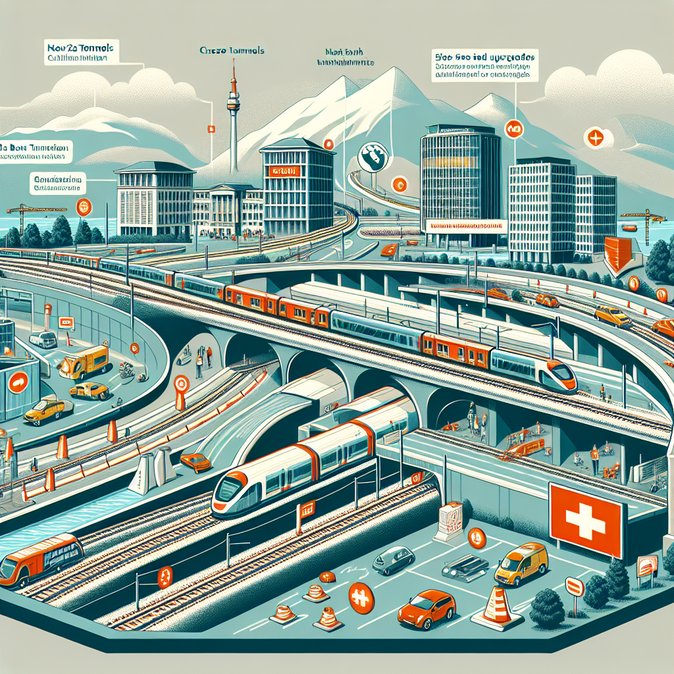
On the rail side the blueprint earmarks at least CHF 10 billion for “priority projects” such as the Zimmerberg Base Tunnel II, a fourth track at Zürich-Stadelhofen, an expanded Basel SBB hub and the first stage of Lucerne’s through-station – all designed to enable 15-minute intervals on the Bern–Zürich axis and half-hourly inter-city links nationwide. Another CHF 7 billion of follow-on schemes, including the Morges–Perroy line upgrade and the second stage of Lucerne’s through-station, are to be reserved for 2031 decisions.
Highway bottlenecks will be tackled by six-lane expansions on the A1 (Aarau-Ost–Birrfeld) and around Geneva (Perly–Bernex), while a revamped Agglomeration Programme will co-finance more than 40 urban mobility projects worth over CHF 500 million. Financing relies on extending the dedicated VAT-surcharge that feeds the Rail Infrastructure Fund and on planned road-toll revenues for electric vehicles from 2030.
![‘Verkehr ’45’ blueprint signals CHF 20 bn rail-and-road expansion to meet Swiss mobility demand]()
International firms planning site visits and executive travel will also need to navigate Switzerland’s entry requirements. VisaHQ’s dedicated Switzerland portal (https://www.visahq.com/switzerland/) streamlines the process by outlining the latest visa categories, document checklists and processing times, enabling mobility managers to secure the right permits while they focus on logistics.
For global-mobility stakeholders the announcement provides long-term visibility on Switzerland’s transport backbone, which underpins commuter flows for cross-border workers and seamless onward connections for international business travellers. Improved punctuality and extra capacity on Bern–Lausanne–Geneva and Basel–Zürich corridors are expected to relieve pressure on short-haul flights and help multinationals meet sustainability targets by shifting trips to rail.
The consultation draft will also spell out project-selection criteria aimed at preventing cost overruns that plagued earlier infrastructure packages. Companies and industry groups – including airport operators and logistics providers – have until late 2026 to lobby for connections that better integrate rail with air-cargo hubs at Zurich and Basel. If approved, groundbreaking on the first tranche could start in 2029, with early service enhancements visible by 2035.
On the rail side the blueprint earmarks at least CHF 10 billion for “priority projects” such as the Zimmerberg Base Tunnel II, a fourth track at Zürich-Stadelhofen, an expanded Basel SBB hub and the first stage of Lucerne’s through-station – all designed to enable 15-minute intervals on the Bern–Zürich axis and half-hourly inter-city links nationwide. Another CHF 7 billion of follow-on schemes, including the Morges–Perroy line upgrade and the second stage of Lucerne’s through-station, are to be reserved for 2031 decisions.
Highway bottlenecks will be tackled by six-lane expansions on the A1 (Aarau-Ost–Birrfeld) and around Geneva (Perly–Bernex), while a revamped Agglomeration Programme will co-finance more than 40 urban mobility projects worth over CHF 500 million. Financing relies on extending the dedicated VAT-surcharge that feeds the Rail Infrastructure Fund and on planned road-toll revenues for electric vehicles from 2030.

International firms planning site visits and executive travel will also need to navigate Switzerland’s entry requirements. VisaHQ’s dedicated Switzerland portal (https://www.visahq.com/switzerland/) streamlines the process by outlining the latest visa categories, document checklists and processing times, enabling mobility managers to secure the right permits while they focus on logistics.
For global-mobility stakeholders the announcement provides long-term visibility on Switzerland’s transport backbone, which underpins commuter flows for cross-border workers and seamless onward connections for international business travellers. Improved punctuality and extra capacity on Bern–Lausanne–Geneva and Basel–Zürich corridors are expected to relieve pressure on short-haul flights and help multinationals meet sustainability targets by shifting trips to rail.
The consultation draft will also spell out project-selection criteria aimed at preventing cost overruns that plagued earlier infrastructure packages. Companies and industry groups – including airport operators and logistics providers – have until late 2026 to lobby for connections that better integrate rail with air-cargo hubs at Zurich and Basel. If approved, groundbreaking on the first tranche could start in 2029, with early service enhancements visible by 2035.