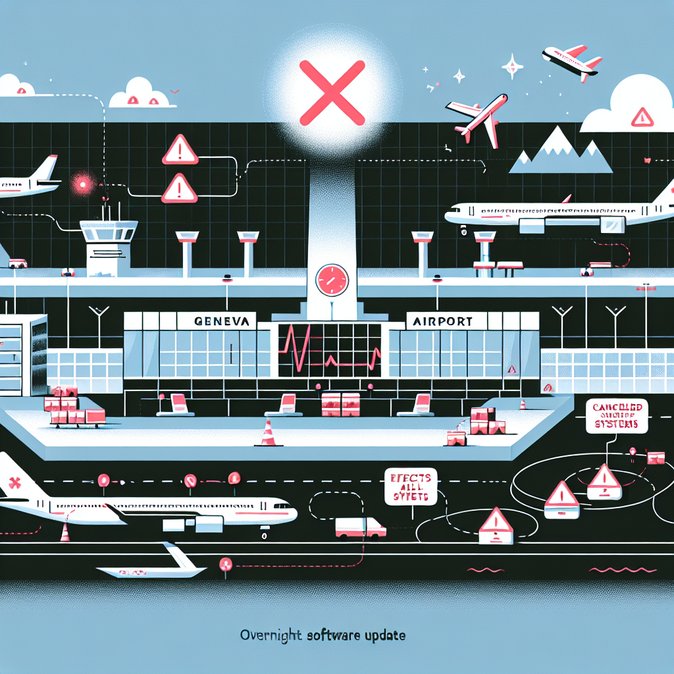
Geneva Airport – Switzerland’s second-busiest international gateway – suffered an unexpected operational stand-still on the morning of 27 January 2026 after a software update crashed one of air-navigation provider Skyguide’s surveillance servers. Between 09:10 and roughly 10:00 local time no aircraft were permitted to depart or land, forcing the diversion of at least nine inbound flights to Basel, Lyon and other alternate airports while dozens of departures remained on the apron.
Skyguide switched immediately to its “degraded-mode” safety procedures, which freeze departures, slow the arrival rate and reroute over-flights around the affected sector. According to airport spokesman Ignace Jeannerat, capacity was restored to about 50 percent within 50 minutes and to 80 percent by 11:00, but knock-on delays lasted all day because the single-runway hub routinely handles more than 400 movements on a weekday. EasyJet – the airport’s largest carrier – advised passengers to expect multi-hour delays, while SWISS re-routed several connecting passengers through Zurich.
Although Skyguide stressed that safety was never compromised, the incident rekindles debate about the resilience of Switzerland’s air-traffic-management infrastructure. Geneva’s runway and control-tower complex are already running close to peak capacity as passenger numbers continue to climb beyond pre-pandemic levels; a previous nationwide outage in 2022 had forced the complete closure of Swiss airspace for several hours. The canton of Geneva is studying the construction of a contingency “digital tower” that could take over essential functions if the main facility fails.
![Skyguide software outage halts take-offs and landings at Geneva Airport]()
Should these operational hiccups prompt itinerary changes that cross additional borders – for example a diversion to Lyon or Basel that requires re-entry into Switzerland – VisaHQ can streamline the requisite transit or Schengen-visa paperwork. Their online platform (https://www.visahq.com/switzerland/) guides travelers through up-to-date requirements, document uploads and courier options, helping ensure compliance even when schedules shift at the last minute.
For business travellers and corporate travel managers the episode is a reminder to build generous connection buffers into itineraries that touch Geneva, especially during the busy winter sports season when slot availability is tight. Travel-risk consultants suggest monitoring Skyguide status alerts and opting, where possible, for rail connections to Zurich or Basel that can provide redundancy when the airport experiences technical or weather-related disruptions.
Longer term, Skyguide has frozen further software updates pending an independent audit and has pledged to accelerate plans for a parallel data-centre architecture that would allow instant fail-over – a project originally scheduled for 2027 but now likely to be fast-tracked. The federal Office of Civil Aviation (FOCA) has also requested a post-incident report that could drive new regulatory requirements for redundancy at the country’s busiest airports.
Skyguide switched immediately to its “degraded-mode” safety procedures, which freeze departures, slow the arrival rate and reroute over-flights around the affected sector. According to airport spokesman Ignace Jeannerat, capacity was restored to about 50 percent within 50 minutes and to 80 percent by 11:00, but knock-on delays lasted all day because the single-runway hub routinely handles more than 400 movements on a weekday. EasyJet – the airport’s largest carrier – advised passengers to expect multi-hour delays, while SWISS re-routed several connecting passengers through Zurich.
Although Skyguide stressed that safety was never compromised, the incident rekindles debate about the resilience of Switzerland’s air-traffic-management infrastructure. Geneva’s runway and control-tower complex are already running close to peak capacity as passenger numbers continue to climb beyond pre-pandemic levels; a previous nationwide outage in 2022 had forced the complete closure of Swiss airspace for several hours. The canton of Geneva is studying the construction of a contingency “digital tower” that could take over essential functions if the main facility fails.

Should these operational hiccups prompt itinerary changes that cross additional borders – for example a diversion to Lyon or Basel that requires re-entry into Switzerland – VisaHQ can streamline the requisite transit or Schengen-visa paperwork. Their online platform (https://www.visahq.com/switzerland/) guides travelers through up-to-date requirements, document uploads and courier options, helping ensure compliance even when schedules shift at the last minute.
For business travellers and corporate travel managers the episode is a reminder to build generous connection buffers into itineraries that touch Geneva, especially during the busy winter sports season when slot availability is tight. Travel-risk consultants suggest monitoring Skyguide status alerts and opting, where possible, for rail connections to Zurich or Basel that can provide redundancy when the airport experiences technical or weather-related disruptions.
Longer term, Skyguide has frozen further software updates pending an independent audit and has pledged to accelerate plans for a parallel data-centre architecture that would allow instant fail-over – a project originally scheduled for 2027 but now likely to be fast-tracked. The federal Office of Civil Aviation (FOCA) has also requested a post-incident report that could drive new regulatory requirements for redundancy at the country’s busiest airports.