India and the European Union used the Delhi summit on 27 January 2026 to move people—not just goods—more freely across their borders. External affairs minister S. Jaishankar and EU trade commissioner Maroš Šefčovič inked a “Comprehensive Framework for Cooperation on Mobility”, the first bloc-level agreement of its kind that India has concluded with any partner.
1. What the pact does
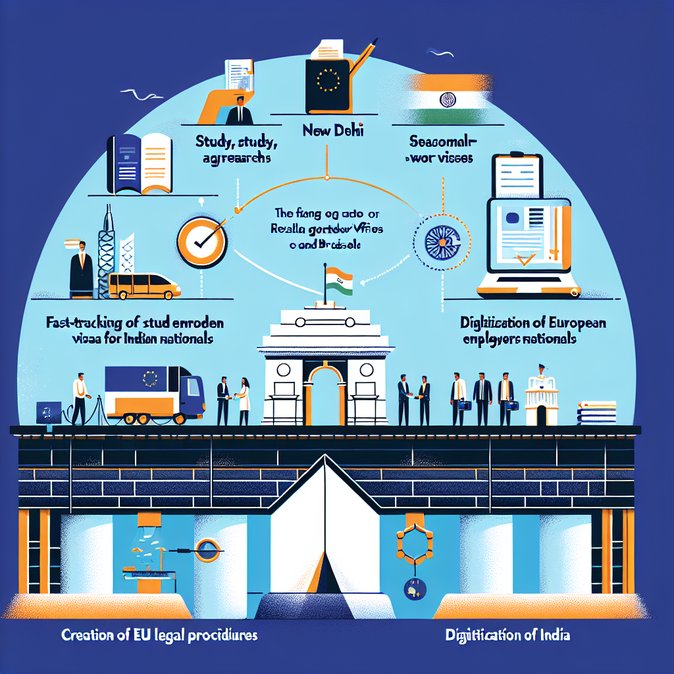
• Creates a legal template that will allow EU member states to issue short-term study, research and seasonal-work permits to Indian nationals for up to 12 months under fast-tracked procedures.
• Establishes an EU “Legal Gateway Office” in New Delhi—a one-stop information hub that will guide Indian talent through visa rules, recognition of qualifications and shortage-occupation lists.
• Commits both sides to digitalise Schengen-visa processing, share data on document fraud and pilot the EU Talent Pool IT platform with Indian IT and engineering graduates.
• Launches an annual Education & Skills Dialogue that will align India’s National Qualifications Framework with the European Qualifications Framework, paving the way for mutual recognition of degrees and apprenticeships.
2. Why business cares
Indian services exporters—from IT to ship-design—have long complained that separate member-state rules create a maze of red tape. A bloc-wide template promises more predictable processing times and clearer pathways for intra-company transferees, researchers and start-up founders. EU firms, for their part, gain a structured channel to tap India’s talent pool without navigating multiple bilateral arrangements.
![India and EU sign landmark Mobility Pact to ease movement of students and skilled professionals]()
For applicants who still find Europe’s evolving visa architecture daunting, VisaHQ can help cut through the complexity. The firm’s India platform (https://www.visahq.com/india/) offers step-by-step Schengen application support, live requirement updates and digital document tools, enabling students, professionals and HR teams to leverage the pact’s fast-track options with confidence.
3. The fine print
The pact is not a “free movement” regime: long-term work and residence permits remain under national competence. Both sides also pledged to co-operate on the return of irregular migrants—an issue that derailed earlier talks with some EU states. Officials said pilot quotas would focus on ICT professionals in 2026 before expanding to health care and green-tech workers.
4. What’s next
The agreement enters into force after the EU publishes implementing guidelines—expected by mid-2026. Companies that anticipate staffing needs in Europe should start mapping skill sets against the EU’s shortage-occupation lists and prepare documentation that meets both Indian and EU digital-visa standards. Universities can leverage new Erasmus Mundus joint master’s grants that set aside funds specifically for Indian scholars.
In short, the Mobility Pact turns the headline-grabbing India-EU trade deal into something that everyday travellers, students and employers will actually feel at passport control—a potential game-changer for India-to-Europe talent flows.
1. What the pact does
• Creates a legal template that will allow EU member states to issue short-term study, research and seasonal-work permits to Indian nationals for up to 12 months under fast-tracked procedures.
• Establishes an EU “Legal Gateway Office” in New Delhi—a one-stop information hub that will guide Indian talent through visa rules, recognition of qualifications and shortage-occupation lists.
• Commits both sides to digitalise Schengen-visa processing, share data on document fraud and pilot the EU Talent Pool IT platform with Indian IT and engineering graduates.
• Launches an annual Education & Skills Dialogue that will align India’s National Qualifications Framework with the European Qualifications Framework, paving the way for mutual recognition of degrees and apprenticeships.
2. Why business cares
Indian services exporters—from IT to ship-design—have long complained that separate member-state rules create a maze of red tape. A bloc-wide template promises more predictable processing times and clearer pathways for intra-company transferees, researchers and start-up founders. EU firms, for their part, gain a structured channel to tap India’s talent pool without navigating multiple bilateral arrangements.

For applicants who still find Europe’s evolving visa architecture daunting, VisaHQ can help cut through the complexity. The firm’s India platform (https://www.visahq.com/india/) offers step-by-step Schengen application support, live requirement updates and digital document tools, enabling students, professionals and HR teams to leverage the pact’s fast-track options with confidence.
3. The fine print
The pact is not a “free movement” regime: long-term work and residence permits remain under national competence. Both sides also pledged to co-operate on the return of irregular migrants—an issue that derailed earlier talks with some EU states. Officials said pilot quotas would focus on ICT professionals in 2026 before expanding to health care and green-tech workers.
4. What’s next
The agreement enters into force after the EU publishes implementing guidelines—expected by mid-2026. Companies that anticipate staffing needs in Europe should start mapping skill sets against the EU’s shortage-occupation lists and prepare documentation that meets both Indian and EU digital-visa standards. Universities can leverage new Erasmus Mundus joint master’s grants that set aside funds specifically for Indian scholars.
In short, the Mobility Pact turns the headline-grabbing India-EU trade deal into something that everyday travellers, students and employers will actually feel at passport control—a potential game-changer for India-to-Europe talent flows.