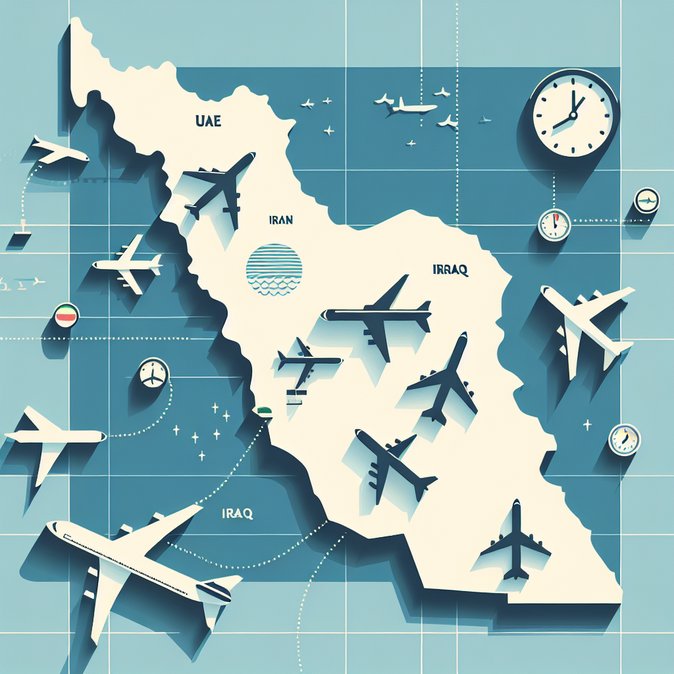
The United Arab Emirates’ Ministry of Foreign Affairs has reiterated that the country will not permit its airspace, land or territorial waters to be used for any hostile military action against Iran. The clarification – issued late on 26 January and carried in local media on the morning of 27 January – comes amid a renewed war of words between Washington and Tehran that has already prompted several European and Asian carriers to re-route around Iranian and Iraqi skies.
Despite the heightened rhetoric, the practical impact on travellers bound for or transiting through the UAE remains limited for now. Dubai International (DXB) and Al-Maktoum International (DWC) report normal operations and Dubai-based airlines Emirates, flydubai and Etihad continue to fly full schedules, albeit on longer southerly or easterly routings that skirt higher-risk flight-information regions. Dubai Airports has advised passengers to allow extra connection time and to monitor flight-status alerts because knock-on delays remain possible when upstream sectors are diverted.
For travellers trying to stay ahead of any sudden regulatory changes, VisaHQ’s UAE portal (https://www.visahq.com/united-arab-emirates/) offers real-time visa updates, streamlined electronic applications and alerts on consular policy shifts—tools that can prove invaluable when itineraries must be adjusted at short notice.
![UAE rules out use of its airspace for attacks on Iran as carriers keep Dubai flights running]()
International airlines are taking a more cautious stance. KLM has suspended select rotations to DXB and TLV, Air France is avoiding Iranian airspace, while Lufthansa Group carriers have switched to daytime-only operations on some regional routes. British Airways briefly paused Bahrain services before reinstating them on 25 January and Finnair is re-routing Dubai flights via Saudi Arabia. Industry analysts say the disparate responses reflect airline-specific appetites for risk, crew lay-over policies and insurance constraints rather than any UAE-specific threat.
For corporate travel managers the message is two-fold: build additional padding into regional itineraries and re-check interline connections that rely on tight minimum-connection times in Dubai or Abu Dhabi. Travel-risk advisers also recommend reviewing aviation-war-risk insurance clauses; most policies activate only if governments issue an official “do-not-fly” advisory, which has not occurred. Firms with essential personnel on mission-critical trips should ensure they have contingency routings via Muscat, Jeddah or Riyadh should airspace dynamics change.
The MoFA statement, while largely symbolic, is seen as an attempt to distance the UAE from any prospective US-Israeli strike scenario and to reassure investors ahead of peak conference season. With the COP30 preparatory meetings and several major trade fairs scheduled in the first quarter, keeping Dubai’s role as an uninterrupted global mobility hub is a strategic priority for the Emirates.
Despite the heightened rhetoric, the practical impact on travellers bound for or transiting through the UAE remains limited for now. Dubai International (DXB) and Al-Maktoum International (DWC) report normal operations and Dubai-based airlines Emirates, flydubai and Etihad continue to fly full schedules, albeit on longer southerly or easterly routings that skirt higher-risk flight-information regions. Dubai Airports has advised passengers to allow extra connection time and to monitor flight-status alerts because knock-on delays remain possible when upstream sectors are diverted.
For travellers trying to stay ahead of any sudden regulatory changes, VisaHQ’s UAE portal (https://www.visahq.com/united-arab-emirates/) offers real-time visa updates, streamlined electronic applications and alerts on consular policy shifts—tools that can prove invaluable when itineraries must be adjusted at short notice.

International airlines are taking a more cautious stance. KLM has suspended select rotations to DXB and TLV, Air France is avoiding Iranian airspace, while Lufthansa Group carriers have switched to daytime-only operations on some regional routes. British Airways briefly paused Bahrain services before reinstating them on 25 January and Finnair is re-routing Dubai flights via Saudi Arabia. Industry analysts say the disparate responses reflect airline-specific appetites for risk, crew lay-over policies and insurance constraints rather than any UAE-specific threat.
For corporate travel managers the message is two-fold: build additional padding into regional itineraries and re-check interline connections that rely on tight minimum-connection times in Dubai or Abu Dhabi. Travel-risk advisers also recommend reviewing aviation-war-risk insurance clauses; most policies activate only if governments issue an official “do-not-fly” advisory, which has not occurred. Firms with essential personnel on mission-critical trips should ensure they have contingency routings via Muscat, Jeddah or Riyadh should airspace dynamics change.
The MoFA statement, while largely symbolic, is seen as an attempt to distance the UAE from any prospective US-Israeli strike scenario and to reassure investors ahead of peak conference season. With the COP30 preparatory meetings and several major trade fairs scheduled in the first quarter, keeping Dubai’s role as an uninterrupted global mobility hub is a strategic priority for the Emirates.