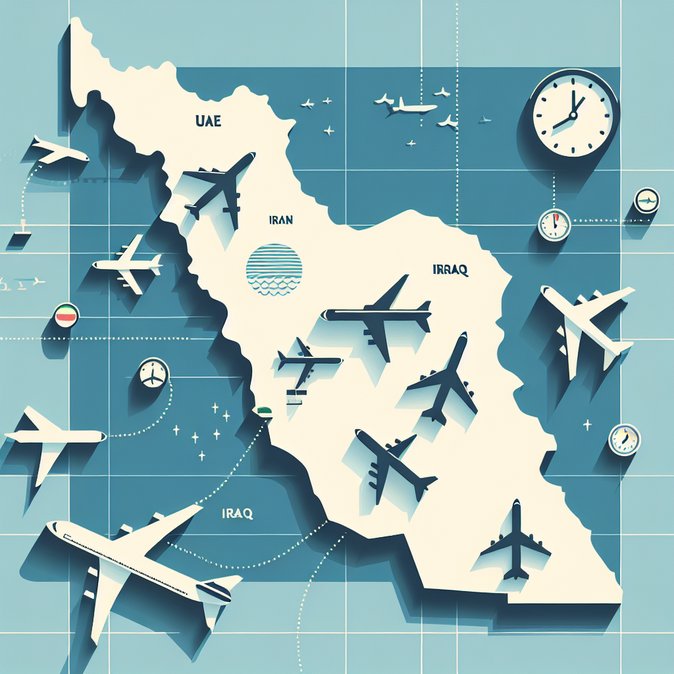
A rolling series of airspace advisories issued on 26 January have forced dozens of international carriers to redraw flight paths over the Middle East, adding up to 90 minutes to some Europe-Asia sectors and raising fresh questions about schedule reliability through the UAE’s megahubs.
While no blanket closure is in force, aviation regulators in Europe and North America now recommend that operators avoid the Tehran and Baghdad Flight Information Regions unless operationally critical. Most western airlines are complying, pushing traffic south over Saudi Arabia or north via the Caucasus. Gulf carriers Emirates, Etihad and Qatar Airways continue to operate but have filed contingency fuel plans and extended block times for select routes to London, Paris, New York and Sydney.
Dubai International remains the world’s busiest international airport and any systemic rerouting reverberates through its tightly banked connections. Flight-data specialists Cirium estimate that 14 % of DXB departures on 26 January left more than 30 minutes behind schedule, double the weekly average, primarily due to inbound aircraft arriving late.
![Airlines lengthen Gulf routings as Middle-East airspace restrictions tighten again]()
Corporate mobility managers should review connection policies that rely on minimum-connection times of under 90 minutes at DXB or AUH and advise travellers to build flexibility into itineraries.
For passengers whose rerouted journeys unexpectedly include a UAE transit or stop-over, staying ahead of visa formalities is just as urgent as watching the flight boards. VisaHQ’s UAE portal (https://www.visahq.com/united-arab-emirates/) lets travellers and travel departments obtain Dubai or Abu Dhabi transit visas online in a matter of hours, and its multi-country dashboard simplifies applications if schedules now span additional nations. Having fast, digital access to the right paperwork removes one more variable when airspace shifts disrupt carefully planned connections.
Air-freight forwarders moving time-critical goods through Emirates SkyCargo’s Dubai hub are also factoring in possible knock-on delays as crew-duty windows tighten.
The current situation illustrates a structural vulnerability: although Dubai’s dual-runway capacity can absorb schedule slippage, the hub’s global-bank model amplifies the impact of upstream airspace disruptions. Stakeholders therefore call for real-time data-sharing between carriers and ground-handlers so that transit passengers – especially those on single PNRs – are re-booked automatically when block times breach certain thresholds.
While no blanket closure is in force, aviation regulators in Europe and North America now recommend that operators avoid the Tehran and Baghdad Flight Information Regions unless operationally critical. Most western airlines are complying, pushing traffic south over Saudi Arabia or north via the Caucasus. Gulf carriers Emirates, Etihad and Qatar Airways continue to operate but have filed contingency fuel plans and extended block times for select routes to London, Paris, New York and Sydney.
Dubai International remains the world’s busiest international airport and any systemic rerouting reverberates through its tightly banked connections. Flight-data specialists Cirium estimate that 14 % of DXB departures on 26 January left more than 30 minutes behind schedule, double the weekly average, primarily due to inbound aircraft arriving late.

Corporate mobility managers should review connection policies that rely on minimum-connection times of under 90 minutes at DXB or AUH and advise travellers to build flexibility into itineraries.
For passengers whose rerouted journeys unexpectedly include a UAE transit or stop-over, staying ahead of visa formalities is just as urgent as watching the flight boards. VisaHQ’s UAE portal (https://www.visahq.com/united-arab-emirates/) lets travellers and travel departments obtain Dubai or Abu Dhabi transit visas online in a matter of hours, and its multi-country dashboard simplifies applications if schedules now span additional nations. Having fast, digital access to the right paperwork removes one more variable when airspace shifts disrupt carefully planned connections.
Air-freight forwarders moving time-critical goods through Emirates SkyCargo’s Dubai hub are also factoring in possible knock-on delays as crew-duty windows tighten.
The current situation illustrates a structural vulnerability: although Dubai’s dual-runway capacity can absorb schedule slippage, the hub’s global-bank model amplifies the impact of upstream airspace disruptions. Stakeholders therefore call for real-time data-sharing between carriers and ground-handlers so that transit passengers – especially those on single PNRs – are re-booked automatically when block times breach certain thresholds.