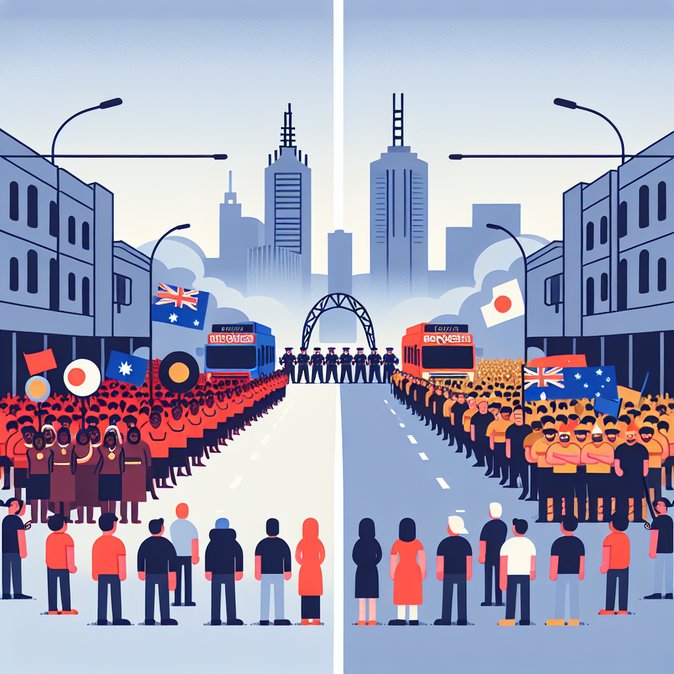
Melbourne’s city centre turned into a flash-point for Australia’s migration debate on 26 January as an estimated 100,000 people converged for competing rallies. The long-standing ‘Invasion Day’ march—led by First Nations elders and refugee-rights groups—called for the national holiday to be replaced with a day of mourning and for stronger protections for asylum seekers. A short distance away, a ‘March for Australia’ protest drew far-right activists and neo-Nazi sympathisers chanting anti-immigration slogans such as “Close the borders” and “Keep Australia Australian.”
Police deployed riot squads and mounted units to maintain a cordon between the groups after online threats raised fears of violence. Two minor scuffles resulted in arrests, but the heavy police presence prevented large-scale clashes. Organisers of multicultural community events in the CBD cancelled afternoon programmes, citing safety concerns for international students and recently arrived skilled migrants living in nearby accommodation.
For global mobility managers the scenes underscore the heightened sensitivity around immigration in the lead-up to the government’s 2026-27 Migration Program cap announcement expected in the May Budget. Advocacy organisations warned that hostile public sentiment could influence forthcoming parliamentary debates on the Skills-In-Demand visa and expanded regional DAMA quotas.
![Australia Day sees duelling ‘Invasion Day’ and anti-immigration rallies in Melbourne CBD]()
At a practical level, organisations can streamline the visa application process and stay abreast of changing entry rules by partnering with VisaHQ, which offers real-time updates and document processing for Australian work and visitor visas. Their dedicated Australia portal (https://www.visahq.com/australia/) allows HR teams and travellers to check requirements, submit paperwork and track approvals, reducing administrative risk in a volatile policy environment.
Employers with assignees arriving this week have been advised to review travel routes from Melbourne Airport and to brief employees on avoiding protest hotspots around Parliament House, Flinders Street Station and the Immigration Museum, which was temporarily closed after being pelted with eggs.
While the rallies concluded by late afternoon, Victorian Police have left a visible presence in the CBD and said further demonstrations are planned over the long weekend. Mobility teams should monitor local media and ensure emergency communication protocols cover civil-unrest scenarios, especially for short-term business visitors unfamiliar with local tensions.
Police deployed riot squads and mounted units to maintain a cordon between the groups after online threats raised fears of violence. Two minor scuffles resulted in arrests, but the heavy police presence prevented large-scale clashes. Organisers of multicultural community events in the CBD cancelled afternoon programmes, citing safety concerns for international students and recently arrived skilled migrants living in nearby accommodation.
For global mobility managers the scenes underscore the heightened sensitivity around immigration in the lead-up to the government’s 2026-27 Migration Program cap announcement expected in the May Budget. Advocacy organisations warned that hostile public sentiment could influence forthcoming parliamentary debates on the Skills-In-Demand visa and expanded regional DAMA quotas.

At a practical level, organisations can streamline the visa application process and stay abreast of changing entry rules by partnering with VisaHQ, which offers real-time updates and document processing for Australian work and visitor visas. Their dedicated Australia portal (https://www.visahq.com/australia/) allows HR teams and travellers to check requirements, submit paperwork and track approvals, reducing administrative risk in a volatile policy environment.
Employers with assignees arriving this week have been advised to review travel routes from Melbourne Airport and to brief employees on avoiding protest hotspots around Parliament House, Flinders Street Station and the Immigration Museum, which was temporarily closed after being pelted with eggs.
While the rallies concluded by late afternoon, Victorian Police have left a visible presence in the CBD and said further demonstrations are planned over the long weekend. Mobility teams should monitor local media and ensure emergency communication protocols cover civil-unrest scenarios, especially for short-term business visitors unfamiliar with local tensions.