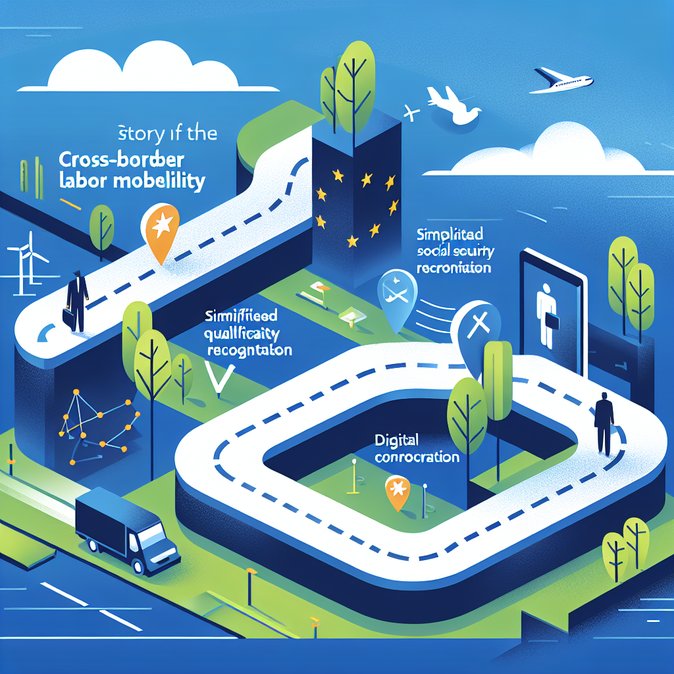
The European Commission’s Border Focal Point Network has opened two public consultations— the Fair Labour Mobility Package and the Skills Portability Initiative—aimed at dismantling obstacles faced by cross-border workers. Announced on 21 January 2026 and updated on 23 January, the consultations invite feedback until 2 February and 27 February respectively. Although the call is EU-wide, it specifically highlights challenges in border regions such as the Ireland–Northern Ireland corridor, where divergent social-security, tax and qualification rules complicate daily commuting for thousands of workers.
The Labour Mobility Package covers recognition of professional qualifications, digital coordination of social-security data, and access to accurate information for mobile workers and employers. The Skills Portability Initiative seeks to standardise how skills are documented and recognised, potentially via EU-wide digital wallets. For employers with operations on both sides of the Irish border, these proposals could simplify hiring and reduce administrative costs associated with posted-worker notifications and tax equalisation.
Irish HR and global-mobility managers should seize the chance to influence the final rules: consultations are open to companies, chambers of commerce, trade unions and individual citizens. Submissions can include case studies on issues such as duplicate PAYE reporting, healthcare coverage gaps, or delays in recognising UK professional licences after Brexit.
![EU launches consultations on cross-border labour mobility – Irish border regions urged to respond]()
Meanwhile, when staff need to cross borders beyond the EU—for example to attend a conference in the United States or visit suppliers in Asia—VisaHQ’s Ireland portal (https://www.visahq.com/ireland/) can shoulder the paperwork, arranging visas, passport renewals and e-visas in a few clicks. Their experts monitor shifting consular and mobility rules so HR teams can stay focused on shaping the new EU framework.
If adopted, the measures could dovetail with Ireland’s plan to introduce a single combined work-and-residence permit, further streamlining mobility for third-country nationals posted to EU sites. However, businesses should also prepare for enhanced enforcement mechanisms, including stricter e-verification of social-security contributions across member states.
The Commission will publish legislative proposals in Q3 2026, aiming for implementation from 2028. Early engagement gives Ireland’s border counties—from Donegal to Louth—a stronger voice in shaping pragmatic, business-friendly solutions.
The Labour Mobility Package covers recognition of professional qualifications, digital coordination of social-security data, and access to accurate information for mobile workers and employers. The Skills Portability Initiative seeks to standardise how skills are documented and recognised, potentially via EU-wide digital wallets. For employers with operations on both sides of the Irish border, these proposals could simplify hiring and reduce administrative costs associated with posted-worker notifications and tax equalisation.
Irish HR and global-mobility managers should seize the chance to influence the final rules: consultations are open to companies, chambers of commerce, trade unions and individual citizens. Submissions can include case studies on issues such as duplicate PAYE reporting, healthcare coverage gaps, or delays in recognising UK professional licences after Brexit.

Meanwhile, when staff need to cross borders beyond the EU—for example to attend a conference in the United States or visit suppliers in Asia—VisaHQ’s Ireland portal (https://www.visahq.com/ireland/) can shoulder the paperwork, arranging visas, passport renewals and e-visas in a few clicks. Their experts monitor shifting consular and mobility rules so HR teams can stay focused on shaping the new EU framework.
If adopted, the measures could dovetail with Ireland’s plan to introduce a single combined work-and-residence permit, further streamlining mobility for third-country nationals posted to EU sites. However, businesses should also prepare for enhanced enforcement mechanisms, including stricter e-verification of social-security contributions across member states.
The Commission will publish legislative proposals in Q3 2026, aiming for implementation from 2028. Early engagement gives Ireland’s border counties—from Donegal to Louth—a stronger voice in shaping pragmatic, business-friendly solutions.