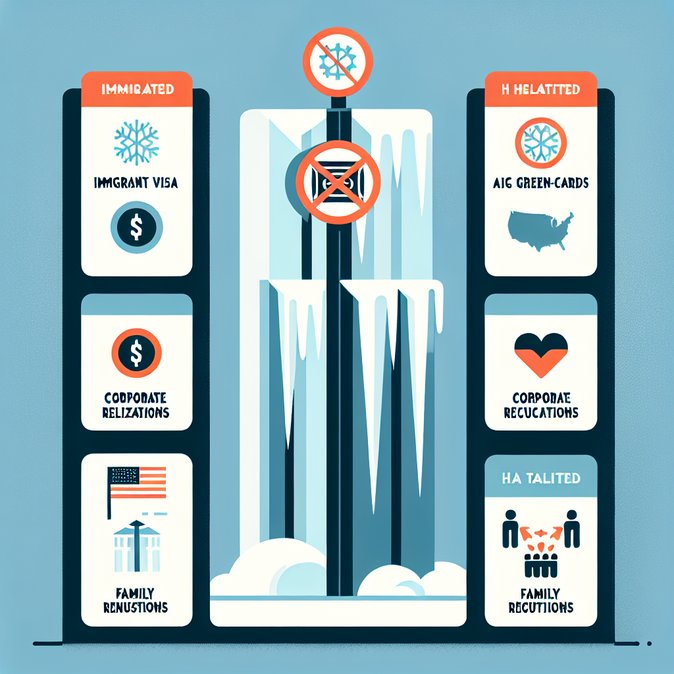
The U.S. Department of State has ordered an immediate, indefinite pause on printing immigrant visas (IVs) for citizens of 75 countries—including Brazil—effective 00:01 ET on 21 January. A cable circulated to all U.S. consulates instructs officers to continue interviews and accept documentation but to withhold visa foils until a “top-to-bottom review” of public-charge screening rules is complete. Tourist (B-1/B-2), student, exchange and temporary work visas are not affected.
Brazil ranked tenth among sources of new U.S. lawful permanent residents in 2023, with more than 28,000 green-card approvals. The sudden freeze therefore hits thousands of family-, employment- and investment-based applicants, as well as corporate mobility programmes that rely on EB-1, EB-2 NIW and EB-5 categories for key talent. Applicants in São Paulo, Rio de Janeiro and Brasília reported attending scheduled interviews this week only to be told their cases are “ready for issuance” but cannot be finalised.
If you are navigating these changes, VisaHQ’s Brazil team (https://www.visahq.com/brazil/) can guide you through alternative visa strategies, documentation checks and time-saving application logistics, helping both companies and individuals keep mobility plans on track while the pause is in effect.
![U.S. Halts Immigrant-Visa Issuance for Brazilians Amid Public-Charge Review]()
Consular officials say the review could last “several weeks to several months,” prompting immigration lawyers to advise Brazilian employers to explore L-1 intracompany transfers, H-1B cap-exempt filings or E-2 treaty-investor structures as interim solutions. Brazilians holding dual nationality with an unaffected country may circumvent the pause by applying with their alternative passport.
The State Department cites the Trump administration’s directive to ensure that incoming immigrants will not become a financial burden on U.S. taxpayers. Critics argue the suspension disproportionately affects middle-income professionals and violates long-standing statutory protections. The Brazilian Foreign Ministry has requested clarification through diplomatic channels but has not, so far, announced retaliatory measures.
Mobility impact: Corporations should prepare for longer lead-times, reassess U.S. assignment start dates and consider remote-work alternatives. HR teams must also manage employee anxiety; some candidates are contemplating job offers in Canada and the EU as fallback options.
Travel-compliance tip: Brazilians with valid immigrant visas issued before 21 January may still enter the United States, but should travel with additional proof of financial self-sufficiency to anticipate heightened inspection at ports of entry.
Brazil ranked tenth among sources of new U.S. lawful permanent residents in 2023, with more than 28,000 green-card approvals. The sudden freeze therefore hits thousands of family-, employment- and investment-based applicants, as well as corporate mobility programmes that rely on EB-1, EB-2 NIW and EB-5 categories for key talent. Applicants in São Paulo, Rio de Janeiro and Brasília reported attending scheduled interviews this week only to be told their cases are “ready for issuance” but cannot be finalised.
If you are navigating these changes, VisaHQ’s Brazil team (https://www.visahq.com/brazil/) can guide you through alternative visa strategies, documentation checks and time-saving application logistics, helping both companies and individuals keep mobility plans on track while the pause is in effect.

Consular officials say the review could last “several weeks to several months,” prompting immigration lawyers to advise Brazilian employers to explore L-1 intracompany transfers, H-1B cap-exempt filings or E-2 treaty-investor structures as interim solutions. Brazilians holding dual nationality with an unaffected country may circumvent the pause by applying with their alternative passport.
The State Department cites the Trump administration’s directive to ensure that incoming immigrants will not become a financial burden on U.S. taxpayers. Critics argue the suspension disproportionately affects middle-income professionals and violates long-standing statutory protections. The Brazilian Foreign Ministry has requested clarification through diplomatic channels but has not, so far, announced retaliatory measures.
Mobility impact: Corporations should prepare for longer lead-times, reassess U.S. assignment start dates and consider remote-work alternatives. HR teams must also manage employee anxiety; some candidates are contemplating job offers in Canada and the EU as fallback options.
Travel-compliance tip: Brazilians with valid immigrant visas issued before 21 January may still enter the United States, but should travel with additional proof of financial self-sufficiency to anticipate heightened inspection at ports of entry.