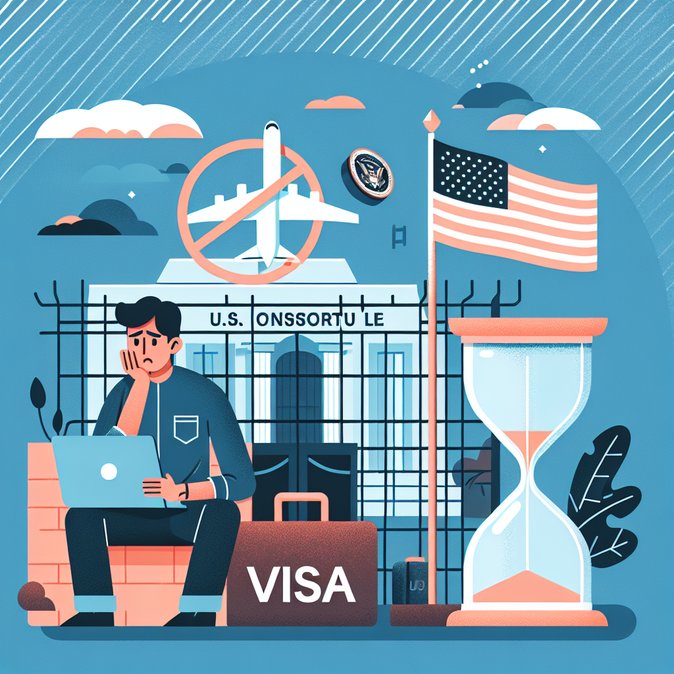
H-1B professionals planning winter travel to India face a new headache: there are virtually no visa-stamping appointments left until 2027. Indian media reported on 22 January 2026 that U.S. consulates in Delhi, Mumbai, Hyderabad, Chennai and Kolkata have rolled appointment calendars forward by as much as 18 months. Applicants who secured December 2025 slots received cancellation notices and automatic reschedules as late as March 2027.
Consular officials have cited a December policy that requires officers to review applicants’ public social-media profiles before adjudication. Because the additional vetting lengthens each interview, daily capacity has been cut almost in half. Immigration lawyers add that officers are also applying “prudential revocation” more aggressively—voiding current visas if they believe an H-1B worker may have violated status—further slowing the queues.
VisaHQ, an experienced visa and passport services provider, can help employers and H-1B travelers manage these shifting rules and shrinking appointment windows. Through its U.S. visa resource hub (https://www.visahq.com/united-states/), the platform offers real-time slot monitoring, document pre-checks, and tailored routing advice, giving companies practical options when consular calendars seem closed.
![H-1B visa stamping backlog in India pushes interview dates into 2027]()
The practical impact is severe for U.S. employers and their Indian talent. H-1B workers normally need a consular stamp to re-enter the United States after international travel. With interview slots essentially unavailable, companies are advising staff not to leave the United States unless absolutely necessary. Employees already in India must decide whether to remain abroad—often separated from family and jobs—or attempt emergency appointments that are rarely granted.
U.S. Customs and Border Protection’s stateside visa-renewal pilot, due to launch in April 2026, will eventually let some H-1B holders renew without leaving the country, but that relief is months away and volume-limited. In the interim, global mobility teams should track travelers in real time, build contingencies for sudden absences, and communicate clearly about the heightened risks of holiday travel.
The Indian backlog also foreshadows global ripple effects. If social-media screening remains mandatory and resources are not added, other high-volume posts—Mexico City, Manila, São Paulo—could see similar slowdowns, complicating worldwide talent rotation.
Consular officials have cited a December policy that requires officers to review applicants’ public social-media profiles before adjudication. Because the additional vetting lengthens each interview, daily capacity has been cut almost in half. Immigration lawyers add that officers are also applying “prudential revocation” more aggressively—voiding current visas if they believe an H-1B worker may have violated status—further slowing the queues.
VisaHQ, an experienced visa and passport services provider, can help employers and H-1B travelers manage these shifting rules and shrinking appointment windows. Through its U.S. visa resource hub (https://www.visahq.com/united-states/), the platform offers real-time slot monitoring, document pre-checks, and tailored routing advice, giving companies practical options when consular calendars seem closed.
The practical impact is severe for U.S. employers and their Indian talent. H-1B workers normally need a consular stamp to re-enter the United States after international travel. With interview slots essentially unavailable, companies are advising staff not to leave the United States unless absolutely necessary. Employees already in India must decide whether to remain abroad—often separated from family and jobs—or attempt emergency appointments that are rarely granted.
U.S. Customs and Border Protection’s stateside visa-renewal pilot, due to launch in April 2026, will eventually let some H-1B holders renew without leaving the country, but that relief is months away and volume-limited. In the interim, global mobility teams should track travelers in real time, build contingencies for sudden absences, and communicate clearly about the heightened risks of holiday travel.
The Indian backlog also foreshadows global ripple effects. If social-media screening remains mandatory and resources are not added, other high-volume posts—Mexico City, Manila, São Paulo—could see similar slowdowns, complicating worldwide talent rotation.