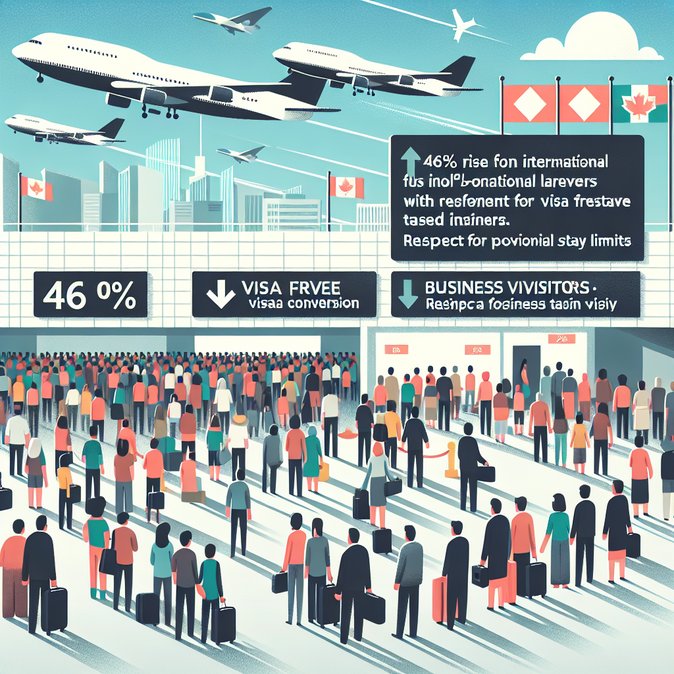
Exactly 30 days after the Hainan Free-Trade-Port (FTP) switched to full customs closure, the island province has published impressive visitor figures. Haikou Border Inspection Corps processed 186,000 foreign nationals between 18 December and 18 January—up 46 % year-on-year. Crucially, 87,000 of them used the province’s 30-day visa-free regime, representing a 64 % jump and accounting for 93 % of all foreign arrivals.
The top five source markets—Russia, Malaysia, Indonesia, South Korea and Kazakhstan—map neatly onto the 92 international routes now serving Hainan, including China’s first seventh-freedom passenger service launched in Sanya late last year. Average immigration clearance time at Haikou Meilan airport has dropped below two minutes thanks to online arrival-card filing, expanded e-gates and group-tour e-visa options.
For organisations navigating the evolving entry rules, visa specialists such as VisaHQ provide a useful safety net. Via its dedicated China page (https://www.visahq.com/china/), the service offers real-time guidance on the 30-day Hainan visa waiver, assistance with switching to national visas, and support for obtaining Z-visas and other work authorisations—helping travel managers stay compliant while keeping trips on schedule.
![Hainan’s closed-port experiment fuels 64 % leap in visa-free foreign visitors]()
Duty-free retail is also booming: analysts at Mintel recorded double-digit sales growth in Haikou’s port-district luxury malls, validating the FTP’s strategy of pairing shopping quotas with beach-holiday packages. Business-migration advisers report a spike in enquiries about the FTP’s fast-track work-permit channel and 15 % individual-income-tax cap designed to attract aerospace and life-sciences talent.
For corporate travel planners, the opportunity is clear but so are the risks. The visa waiver is geographically restricted—travellers must stay within Hainan unless they convert to a national visa at the Public Security Bureau. Airlines are enforcing proof-of-hotel and onward tickets within 30 days. Mobility teams should build those documentary checks into pre-trip workflows and flag that any remunerated activity still requires a Z-visa and work permit.
The early success of Hainan’s ‘closed-port, open-door’ model could encourage other Chinese FTZs to pursue similar customs-tight yet mobility-friendly frameworks, potentially reshaping China’s wider inbound ecosystem.
The top five source markets—Russia, Malaysia, Indonesia, South Korea and Kazakhstan—map neatly onto the 92 international routes now serving Hainan, including China’s first seventh-freedom passenger service launched in Sanya late last year. Average immigration clearance time at Haikou Meilan airport has dropped below two minutes thanks to online arrival-card filing, expanded e-gates and group-tour e-visa options.
For organisations navigating the evolving entry rules, visa specialists such as VisaHQ provide a useful safety net. Via its dedicated China page (https://www.visahq.com/china/), the service offers real-time guidance on the 30-day Hainan visa waiver, assistance with switching to national visas, and support for obtaining Z-visas and other work authorisations—helping travel managers stay compliant while keeping trips on schedule.

Duty-free retail is also booming: analysts at Mintel recorded double-digit sales growth in Haikou’s port-district luxury malls, validating the FTP’s strategy of pairing shopping quotas with beach-holiday packages. Business-migration advisers report a spike in enquiries about the FTP’s fast-track work-permit channel and 15 % individual-income-tax cap designed to attract aerospace and life-sciences talent.
For corporate travel planners, the opportunity is clear but so are the risks. The visa waiver is geographically restricted—travellers must stay within Hainan unless they convert to a national visa at the Public Security Bureau. Airlines are enforcing proof-of-hotel and onward tickets within 30 days. Mobility teams should build those documentary checks into pre-trip workflows and flag that any remunerated activity still requires a Z-visa and work permit.
The early success of Hainan’s ‘closed-port, open-door’ model could encourage other Chinese FTZs to pursue similar customs-tight yet mobility-friendly frameworks, potentially reshaping China’s wider inbound ecosystem.