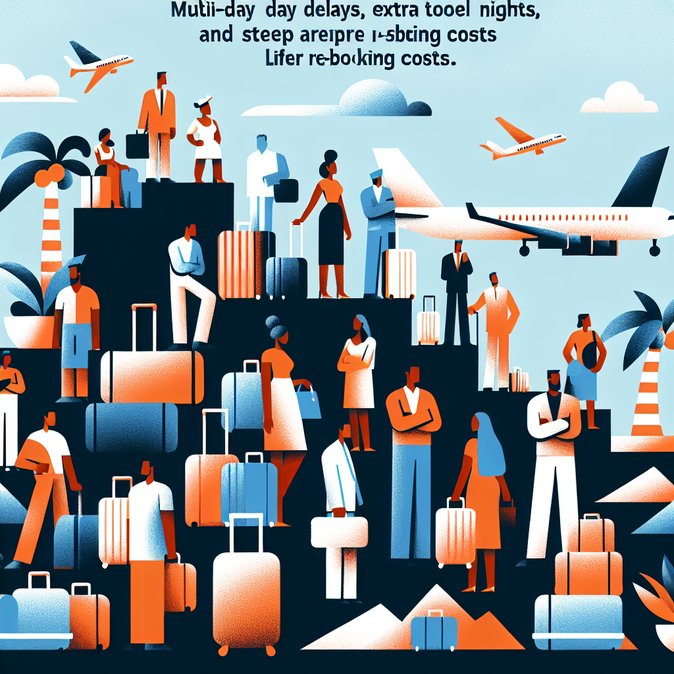
Although the Federal Aviation Administration reopened Caribbean airspace days ago, ripple effects from the 24-hour shutdown following the U.S. raid on Venezuela are still stranding travelers and inflating costs. A January 10 2026 Business Insider report profiles honeymooners, cruise passengers and retired pilots who found their six-day vacations stretching into two-week ordeals—and the same dynamics are hammering corporate road-warriors. (businessinsider.com)
JetBlue, American, Delta and United have added extra sections, yet crewing limits and aircraft repositioning mean seat availability lags demand, particularly at smaller islands such as St. Thomas and St. Lucia. Re-routing via San Juan or Miami often adds 48-72 hours and hundreds of dollars in hotel, per-diem and change-fee expenses that many company travel policies did not anticipate.
Amid the chaos, firms are also discovering last-minute documentation hurdles—especially for staff now forced to reroute through multiple jurisdictions. VisaHQ’s online platform can fast-track any new transit visas, replacement passports, or travel authorizations and sends real-time alerts on entry-rule changes for the United States and dozens of Caribbean territories. Corporate travel managers can start a request in minutes at https://www.visahq.com/united-states/
![Caribbean Chaos Persists a Week After U.S. Airspace Closure—Business Travelers Face Costly Detours]()
Travel-management companies (TMCs) report a spike in “duty of care” calls from U.S. firms with employees attending regional energy and telecom conferences. One multinational estimated an additional $160,000 in accommodation and re-booking costs last week alone. Airlines are waiving some change fees, but refunds remain murky because the closure was government-mandated rather than weather-related.
Risk experts advise corporates to: (1) audit upcoming Caribbean travel through January 20 for potential knock-on disruptions; (2) allow extra connection time in San Juan, Santo Domingo or Miami; and (3) work with insurers to classify the Venezuelan operation as a ‘political event’ to recoup out-of-policy expenses. Meanwhile, the FAA warns that ad-hoc military activity near Venezuelan FIR (Flight Information Region) could trigger renewed restrictions with little notice.
Long-term, analysts say the incident underscores the fragility of Caribbean aviation networks and the need for diversified routings—particularly for firms engaged in offshore energy, financial services and defense contracts across the region.
JetBlue, American, Delta and United have added extra sections, yet crewing limits and aircraft repositioning mean seat availability lags demand, particularly at smaller islands such as St. Thomas and St. Lucia. Re-routing via San Juan or Miami often adds 48-72 hours and hundreds of dollars in hotel, per-diem and change-fee expenses that many company travel policies did not anticipate.
Amid the chaos, firms are also discovering last-minute documentation hurdles—especially for staff now forced to reroute through multiple jurisdictions. VisaHQ’s online platform can fast-track any new transit visas, replacement passports, or travel authorizations and sends real-time alerts on entry-rule changes for the United States and dozens of Caribbean territories. Corporate travel managers can start a request in minutes at https://www.visahq.com/united-states/

Travel-management companies (TMCs) report a spike in “duty of care” calls from U.S. firms with employees attending regional energy and telecom conferences. One multinational estimated an additional $160,000 in accommodation and re-booking costs last week alone. Airlines are waiving some change fees, but refunds remain murky because the closure was government-mandated rather than weather-related.
Risk experts advise corporates to: (1) audit upcoming Caribbean travel through January 20 for potential knock-on disruptions; (2) allow extra connection time in San Juan, Santo Domingo or Miami; and (3) work with insurers to classify the Venezuelan operation as a ‘political event’ to recoup out-of-policy expenses. Meanwhile, the FAA warns that ad-hoc military activity near Venezuelan FIR (Flight Information Region) could trigger renewed restrictions with little notice.
Long-term, analysts say the incident underscores the fragility of Caribbean aviation networks and the need for diversified routings—particularly for firms engaged in offshore energy, financial services and defense contracts across the region.