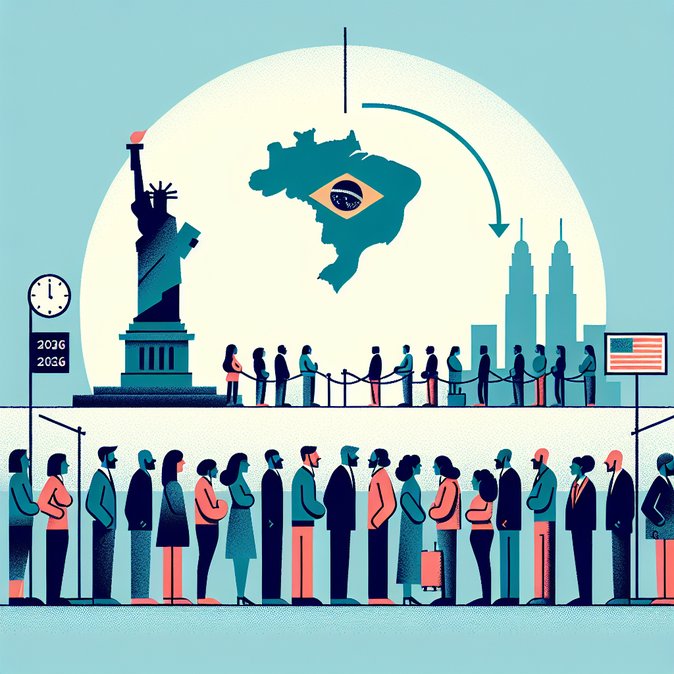
The United States has confirmed that, from 2026, all non-immigrant visa applicants must apply in the country of their nationality or long-term residence—a measure dubbed the “Home Country Rule” within the sweeping One Big Beautiful Act. For Brazilians, the change removes the popular workaround of lodging applications in third-country consulates such as Buenos Aires or Santiago, where interview wait times were often weeks rather than months.
Brazilian business travellers already face average wait times of 250 days for a B-1/B-2 interview in São Paulo and Rio de Janeiro. Consular officials estimate the rule could initially add another 20-30 % to the local queue as “consular shoppers” are funnelled back into Brazil. The U.S. Embassy plans modest staffing increases, but the backlog is unlikely to clear before late-2027 given current demand.
In this tightening landscape, VisaHQ can significantly ease the burden for both individual travellers and corporate mobility teams. The platform’s specialists pre-screen documentation, flag common errors, and monitor appointment availability across all U.S. consulates in Brazil, helping applicants secure the earliest possible interview while reducing the risk of costly rejections. Brazilians can begin the process or chat with an expert at https://www.visahq.com/brazil/
![U.S. ‘Home Country Rule’ set to lengthen visa queues for Brazilians in 2026]()
The policy goal, Washington argues, is consistency and security: concentrating applications allows better data-sharing between homeland-security databases and applicants’ home-country police records. Critics counter that it penalises emerging-market travellers with already limited appointment slots and will hurt bilateral trade, especially the US$ 110 billion goods-and-services corridor between Brazil and the United States.
Corporations should brace for extended lead times when scheduling U.S. travel or short-term assignments. Best practice now involves initiating visa renewals at least one year ahead and exploring in-person interview waiver options for C1/D crew and certain F-1 alumni where available. Global mobility teams are also advised to update risk registers: missed board meetings, delayed product roll-outs and project-start slippage are all foreseeable knock-on effects.
Longer term, digital-first solutions such as remote interviews and artificial-intelligence fraud screening—piloted in smaller posts like Recife—may help reduce queues, but these tools are unlikely to be operational at scale before 2028.
Brazilian business travellers already face average wait times of 250 days for a B-1/B-2 interview in São Paulo and Rio de Janeiro. Consular officials estimate the rule could initially add another 20-30 % to the local queue as “consular shoppers” are funnelled back into Brazil. The U.S. Embassy plans modest staffing increases, but the backlog is unlikely to clear before late-2027 given current demand.
In this tightening landscape, VisaHQ can significantly ease the burden for both individual travellers and corporate mobility teams. The platform’s specialists pre-screen documentation, flag common errors, and monitor appointment availability across all U.S. consulates in Brazil, helping applicants secure the earliest possible interview while reducing the risk of costly rejections. Brazilians can begin the process or chat with an expert at https://www.visahq.com/brazil/

The policy goal, Washington argues, is consistency and security: concentrating applications allows better data-sharing between homeland-security databases and applicants’ home-country police records. Critics counter that it penalises emerging-market travellers with already limited appointment slots and will hurt bilateral trade, especially the US$ 110 billion goods-and-services corridor between Brazil and the United States.
Corporations should brace for extended lead times when scheduling U.S. travel or short-term assignments. Best practice now involves initiating visa renewals at least one year ahead and exploring in-person interview waiver options for C1/D crew and certain F-1 alumni where available. Global mobility teams are also advised to update risk registers: missed board meetings, delayed product roll-outs and project-start slippage are all foreseeable knock-on effects.
Longer term, digital-first solutions such as remote interviews and artificial-intelligence fraud screening—piloted in smaller posts like Recife—may help reduce queues, but these tools are unlikely to be operational at scale before 2028.
More From Brazil
View all
Brazil repatriates record 3,000 citizens from the United States; latest charter with 124 arrivals lands in Belo Horizonte

Canada warns travellers about crime risks and visa delays in Brazil in new January 2026 advisory