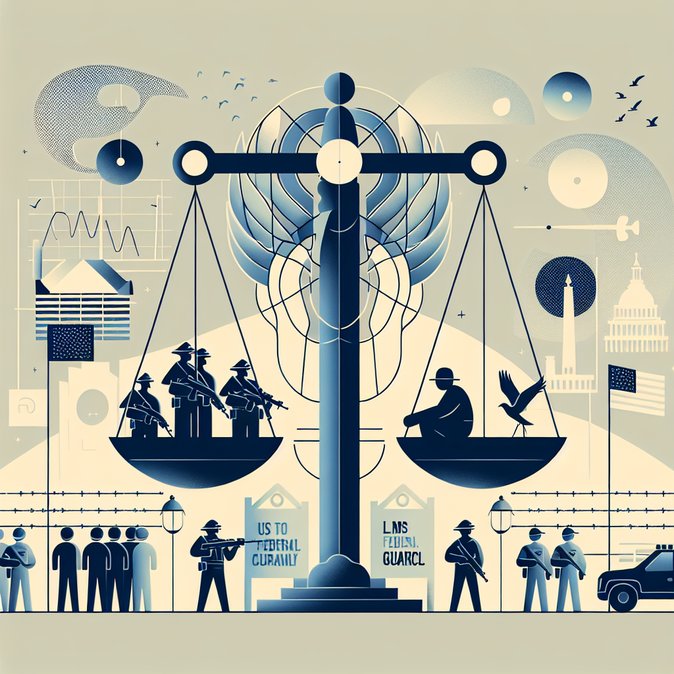
A federal court in San Francisco delivered a major rebuke to the Trump administration on 10 December, ruling that the President exceeded his authority when he federalised California National Guard units to police immigration-related demonstrations in Los Angeles. U.S. District Judge Charles Breyer issued a preliminary injunction directing the government to terminate the deployment and return command of the troops to Governor Gavin Newsom. Although enforcement is stayed for 30 days to allow an appeal, the decision is a significant affirmation of states’ rights over their own militia forces.
The dispute dates back to June 2025, when the White House ordered more than 4,000 California Guard members onto federal duty without the governor’s consent, citing “rebellion” at protests outside Immigration and Customs Enforcement (ICE) offices. The number of federally controlled troops has since dwindled to about 300, but the state pursued the lawsuit, arguing that the Posse Comitatus Act and the Insurrection Act did not justify the deployment. Judge Breyer agreed, writing that the administration’s claim of unchecked authority “would create a national police force the Framers never envisioned.”
For mobility professionals, the ruling has two immediate implications. First, it may constrain future attempts by Washington to use military assets in immigration-enforcement settings, reducing the likelihood of large-scale disruptions at airports, seaports and land-border checkpoints in Democratic-led states. Second, the judgment feeds into a larger trend of state push-back against aggressive federal immigration tactics—an issue companies must monitor when relocating staff or arranging business travel in jurisdictions that view federal crackdowns as overreach.
![Judge orders Trump administration to relinquish control of California National Guard troops used in immigration protests]()
For organisations trying to navigate shifting immigration controls, an experienced visa processing partner can be invaluable. VisaHQ, for instance, offers end-to-end support for U.S. and global travel documents, keeping mobility teams apprised of rule changes and fast-tracking individual applications when volatility is high (https://www.visahq.com/united-states/).
Legal scholars note that the decision sits alongside September orders blocking similar federalisations in Portland and Chicago, suggesting the courts are drawing a bright line against routine military involvement in civil immigration matters. If upheld on appeal, the precedent could limit any future administration’s ability to deploy troops near critical mobility infrastructure, from ports-of-entry to transport hubs, without state approval.
Businesses with operations in Southern California, particularly those that rely on cross-border talent moving via Los Angeles International Airport or the San Ysidro land port, should still expect short-term uncertainty. DHS has not indicated whether ICE or CBP deployments will be scaled back correspondingly, and local unions representing airport workers have warned that any abrupt draw-down could trigger staffing gaps at security perimeters. Mobility teams are advised to coordinate closely with travel-risk providers through the appeal window.
The dispute dates back to June 2025, when the White House ordered more than 4,000 California Guard members onto federal duty without the governor’s consent, citing “rebellion” at protests outside Immigration and Customs Enforcement (ICE) offices. The number of federally controlled troops has since dwindled to about 300, but the state pursued the lawsuit, arguing that the Posse Comitatus Act and the Insurrection Act did not justify the deployment. Judge Breyer agreed, writing that the administration’s claim of unchecked authority “would create a national police force the Framers never envisioned.”
For mobility professionals, the ruling has two immediate implications. First, it may constrain future attempts by Washington to use military assets in immigration-enforcement settings, reducing the likelihood of large-scale disruptions at airports, seaports and land-border checkpoints in Democratic-led states. Second, the judgment feeds into a larger trend of state push-back against aggressive federal immigration tactics—an issue companies must monitor when relocating staff or arranging business travel in jurisdictions that view federal crackdowns as overreach.

For organisations trying to navigate shifting immigration controls, an experienced visa processing partner can be invaluable. VisaHQ, for instance, offers end-to-end support for U.S. and global travel documents, keeping mobility teams apprised of rule changes and fast-tracking individual applications when volatility is high (https://www.visahq.com/united-states/).
Legal scholars note that the decision sits alongside September orders blocking similar federalisations in Portland and Chicago, suggesting the courts are drawing a bright line against routine military involvement in civil immigration matters. If upheld on appeal, the precedent could limit any future administration’s ability to deploy troops near critical mobility infrastructure, from ports-of-entry to transport hubs, without state approval.
Businesses with operations in Southern California, particularly those that rely on cross-border talent moving via Los Angeles International Airport or the San Ysidro land port, should still expect short-term uncertainty. DHS has not indicated whether ICE or CBP deployments will be scaled back correspondingly, and local unions representing airport workers have warned that any abrupt draw-down could trigger staffing gaps at security perimeters. Mobility teams are advised to coordinate closely with travel-risk providers through the appeal window.