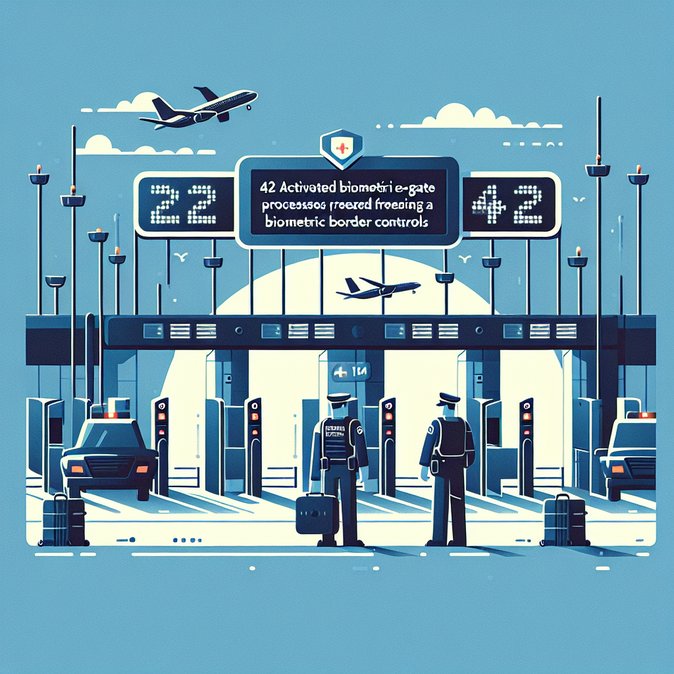
São Paulo/Guarulhos International Airport (GRU) – the country’s main corporate gateway – quietly commissioned 42 next-generation Automated Border-Control e-gates in Terminal 3 in the early hours of 6 December. Supplied by SITA, each lane combines an e-passport reader, facial-recognition camera and fingerprint scanner to clear a traveller in about 10 seconds. Eligible users include Brazilians and holders of ICAO-compliant chip-passports from Mercosur, the EU, United Kingdom, United States, Canada, Australia, Japan and several other jurisdictions. The new lanes replace ageing kiosks installed for the 2014 World Cup and represent the first tranche of a R$ 250 million federal biometric-border programme planned for 2026-27.
Airport operations chief Marcelo Vasconcellos told reporters that the Friday-morning “super-bank” – when as many as 4,000 passengers per hour arrive – moved 40 % faster than the previous week. The Federal Police have redeployed 18 officers from routine document checks to intelligence-led secondary inspections, a productivity gain Brasilia hopes to replicate at Rio-Galeão and Brasília airports.
![São Paulo-Guarulhos Switches On 42 Biometric e-Gates, Cutting Arrival Queues by 40 %]()
Travellers whose nationalities still require visas for Brazil can streamline the paperwork well before departure. Online facilitator VisaHQ, for example, provides an end-to-end application platform, live status tracking and dedicated customer support for Brazilian entry permits and dozens of other travel documents — full details are available at https://www.visahq.com/brazil/ Leveraging such services complements the new e-gates by ensuring documents are correct on arrival, thereby preventing last-minute surprises.
For global-mobility managers there are immediate wins: shorter immigration queues reduce connection-time buffers, improve compliance with duty-of-care standards (many multinationals cap queue time at 45 minutes) and lower the risk of missed meetings downtown. Travellers must, however, ensure booking profiles exactly mirror the data encoded in their e-passports – mismatches remain the main cause of gate rejections. Firms moving time-critical project cargo should note that faster passenger clearance shifts pressure to customs lines; premium pre-clearance services may be worth the extra cost during the holiday peak.
Strategically, the project underlines Brazil’s pivot toward technology-enabled border management. A seamless biometric journey strengthens São Paulo’s bid to become Latin America’s pre-eminent connecting hub – a factor headquarters teams often weigh when deciding where to base mobile talent. Phase 2 will extend the system to Terminals 1 and 2 in February 2026, followed by biometric boarding gates and CT smart-security lanes.
Airport operations chief Marcelo Vasconcellos told reporters that the Friday-morning “super-bank” – when as many as 4,000 passengers per hour arrive – moved 40 % faster than the previous week. The Federal Police have redeployed 18 officers from routine document checks to intelligence-led secondary inspections, a productivity gain Brasilia hopes to replicate at Rio-Galeão and Brasília airports.

Travellers whose nationalities still require visas for Brazil can streamline the paperwork well before departure. Online facilitator VisaHQ, for example, provides an end-to-end application platform, live status tracking and dedicated customer support for Brazilian entry permits and dozens of other travel documents — full details are available at https://www.visahq.com/brazil/ Leveraging such services complements the new e-gates by ensuring documents are correct on arrival, thereby preventing last-minute surprises.
For global-mobility managers there are immediate wins: shorter immigration queues reduce connection-time buffers, improve compliance with duty-of-care standards (many multinationals cap queue time at 45 minutes) and lower the risk of missed meetings downtown. Travellers must, however, ensure booking profiles exactly mirror the data encoded in their e-passports – mismatches remain the main cause of gate rejections. Firms moving time-critical project cargo should note that faster passenger clearance shifts pressure to customs lines; premium pre-clearance services may be worth the extra cost during the holiday peak.
Strategically, the project underlines Brazil’s pivot toward technology-enabled border management. A seamless biometric journey strengthens São Paulo’s bid to become Latin America’s pre-eminent connecting hub – a factor headquarters teams often weigh when deciding where to base mobile talent. Phase 2 will extend the system to Terminals 1 and 2 in February 2026, followed by biometric boarding gates and CT smart-security lanes.