
During President Vladimir Putin’s New Delhi visit on 6 December, India and Russia inked two mobility agreements designed to move skilled and semi-skilled Indian talent into Russia’s acute labour gaps while clamping down on irregular migration.
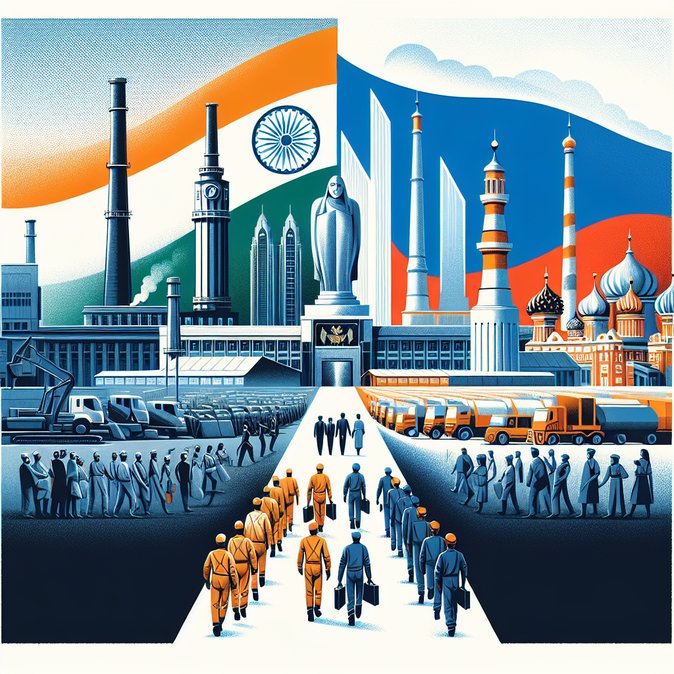
The first memorandum—‘Temporary Labour Activity of Citizens of One State in the Territory of the Other’—creates a government-to-government channel for deploying Indian workers in construction, agriculture, IT-enabled services and light manufacturing. Officials say quotas could reach 70,000 Indians by 2027, with contracts vetted by both labour ministries to guarantee wages, insurance and repatriation rights.
A companion pact on ‘Co-operation in Combating Irregular Migration’ aims to stem the flow of recruiters who have lured Indians—sometimes under false pretences—into Russia’s armed forces and informal jobs. Shared databases, pre-departure orientation, biometric verification and grievance hotlines are part of the toolkit.
![India and Russia sign twin pacts to open legal pathways for 70,000 Indian workers]()
For Indian staffing companies and global firms operating projects in Russia, the accords promise a legally secure alternative to ad-hoc visas. Employers will still need to prove housing and language-training arrangements, and compliance audits will be backed by potential blacklisting for violators.
Navigating the paperwork that underpins these new rules can be daunting; VisaHQ’s India portal (https://www.visahq.com/india/) offers a streamlined solution by handling Russian business and work-visa applications, document translations, and up-to-date compliance advice, helping both employers and workers move quickly while avoiding costly missteps.
Strategically, the deals expand India’s network of labour-mobility corridors (Japan, Germany, Israel, UAE) and give Moscow access to a youthful workforce as domestic demographics tighten. They also signal that even amid geopolitical strain, Delhi is willing to ring-fence economic cooperation while protecting its citizens abroad.
The first memorandum—‘Temporary Labour Activity of Citizens of One State in the Territory of the Other’—creates a government-to-government channel for deploying Indian workers in construction, agriculture, IT-enabled services and light manufacturing. Officials say quotas could reach 70,000 Indians by 2027, with contracts vetted by both labour ministries to guarantee wages, insurance and repatriation rights.
A companion pact on ‘Co-operation in Combating Irregular Migration’ aims to stem the flow of recruiters who have lured Indians—sometimes under false pretences—into Russia’s armed forces and informal jobs. Shared databases, pre-departure orientation, biometric verification and grievance hotlines are part of the toolkit.
For Indian staffing companies and global firms operating projects in Russia, the accords promise a legally secure alternative to ad-hoc visas. Employers will still need to prove housing and language-training arrangements, and compliance audits will be backed by potential blacklisting for violators.
Navigating the paperwork that underpins these new rules can be daunting; VisaHQ’s India portal (https://www.visahq.com/india/) offers a streamlined solution by handling Russian business and work-visa applications, document translations, and up-to-date compliance advice, helping both employers and workers move quickly while avoiding costly missteps.
Strategically, the deals expand India’s network of labour-mobility corridors (Japan, Germany, Israel, UAE) and give Moscow access to a youthful workforce as domestic demographics tighten. They also signal that even amid geopolitical strain, Delhi is willing to ring-fence economic cooperation while protecting its citizens abroad.