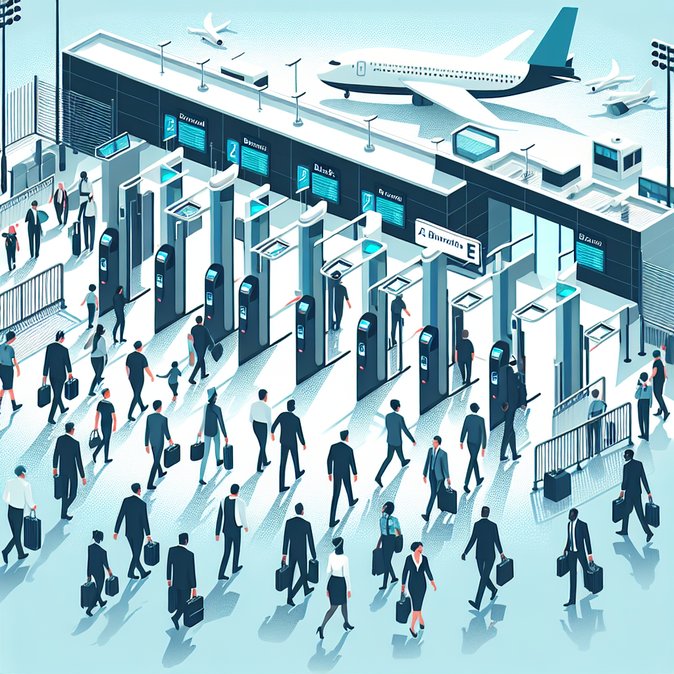
São Paulo/Guarulhos International Airport (GRU) quietly flipped the switch on a new generation of Automated Border-Control e-Gates in the early hours of 6 December, just in time for the holiday rush. Forty-two biometric lanes now line Terminal 3, replacing kiosks installed for the 2014 World Cup. Supplied by airline-IT specialist SITA, each gate combines an e-passport reader, facial-recognition camera and fingerprint scanner in a single 10-second transaction. Eligible travellers—including Brazilians and holders of ICAO-compliant chip passports from Mercosur, the EU, the UK, the United States, Canada, Australia, Japan and others—no longer need a manual passport stamp.
Airport operations director Marcelo Vasconcellos told reporters that Friday-morning arrival banks—the so-called “super-bank” when up to 4,000 passengers per hour descend on passport control—moved 40 % faster than a week earlier. The Federal Police redeployed 18 officers from routine document checks to intelligence-led secondary inspections, an efficiency gain the Ministry of Justice hopes to replicate nationwide. Phase 2 will add 28 lanes to Terminals 1 and 2 in February 2026, followed by biometric boarding gates and CT smart-security lanes.
![Guarulhos Airport Activates 42 Biometric e-Gates, Slashing Immigration Queues by 40 %]()
For travellers who need reassurance that their travel documents are in order before facing GRU’s high-tech gates, VisaHQ offers a quick online check and end-to-end visa procurement service. Corporate mobility teams and individual passengers can visit https://www.visahq.com/brazil/ to confirm passport validity, obtain any required visas and align personal data with e-gate standards—helping to guarantee a friction-free arrival experience.
For global-mobility managers the benefits are immediate. Shorter immigration queues reduce connection-time buffers, support duty-of-care targets (many multinationals stipulate a 45-minute maximum queue) and cut the risk of missed meetings downtown. Travellers should still ensure their booking profiles exactly match the data encoded in their e-passports—mismatches are the main cause of gate rejections. Companies moving time-critical project cargo should note that faster passenger clearance shifts pressure to customs lines; pre-clearance services might be worth the premium during the peak season.
Strategically, the roll-out underscores Brazil’s pivot toward technology-enabled border management. Brasília has budgeted R$ 250 million for biometric solutions in 2026-27, and GRU’s results will likely set a benchmark for Rio-Galeão and Brasília airports. A seamless biometric journey also bolsters São Paulo’s ambition to be Latin America’s pre-eminent connecting hub—an attractive proposition for regional headquarters deciding where to base mobile talent.
Airport operations director Marcelo Vasconcellos told reporters that Friday-morning arrival banks—the so-called “super-bank” when up to 4,000 passengers per hour descend on passport control—moved 40 % faster than a week earlier. The Federal Police redeployed 18 officers from routine document checks to intelligence-led secondary inspections, an efficiency gain the Ministry of Justice hopes to replicate nationwide. Phase 2 will add 28 lanes to Terminals 1 and 2 in February 2026, followed by biometric boarding gates and CT smart-security lanes.

For travellers who need reassurance that their travel documents are in order before facing GRU’s high-tech gates, VisaHQ offers a quick online check and end-to-end visa procurement service. Corporate mobility teams and individual passengers can visit https://www.visahq.com/brazil/ to confirm passport validity, obtain any required visas and align personal data with e-gate standards—helping to guarantee a friction-free arrival experience.
For global-mobility managers the benefits are immediate. Shorter immigration queues reduce connection-time buffers, support duty-of-care targets (many multinationals stipulate a 45-minute maximum queue) and cut the risk of missed meetings downtown. Travellers should still ensure their booking profiles exactly match the data encoded in their e-passports—mismatches are the main cause of gate rejections. Companies moving time-critical project cargo should note that faster passenger clearance shifts pressure to customs lines; pre-clearance services might be worth the premium during the peak season.
Strategically, the roll-out underscores Brazil’s pivot toward technology-enabled border management. Brasília has budgeted R$ 250 million for biometric solutions in 2026-27, and GRU’s results will likely set a benchmark for Rio-Galeão and Brasília airports. A seamless biometric journey also bolsters São Paulo’s ambition to be Latin America’s pre-eminent connecting hub—an attractive proposition for regional headquarters deciding where to base mobile talent.