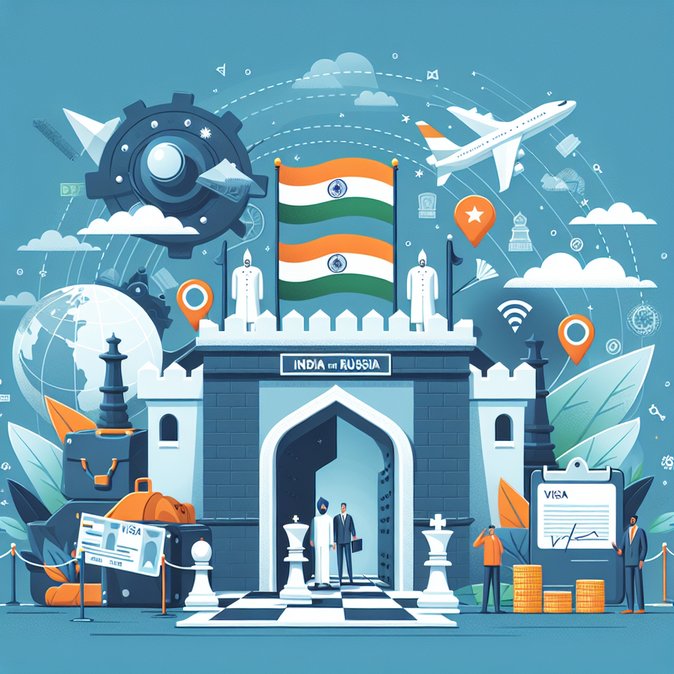
Prime Minister Narendra Modi used President Vladimir Putin’s state visit to unveil a headline-grabbing tourism incentive: Russian nationals will soon be able to apply for a 30-day single-entry e-tourist visa—or a group visa—without paying any fee. Applications will be processed within 30 days on India’s existing e-visa portal, and the facility is expected to go live in early 2026 after system testing.
The announcement sits alongside the India-Russia ‘Vision 2030’ roadmap, which targets US $100 billion in bilateral trade and deeper cooperation in energy, space and polar shipping. Tourism officials say Russian arrivals, which peaked at 297,000 pre-pandemic, could double within two years if charter operators resurrect Goa-Moscow rotations and cultural circuits through the Golden Triangle.
![India to roll out free 30-day e-tourist and group visas for Russian citizens]()
For India’s hospitality sector the timing is propitious: a weak rouble makes long-haul destinations pricier for Russians, while a free visa offsets currency drag. Luxury-train operator IRCTC and medical-tourism providers are already crafting rupee-denominated packages.
Corporate mobility managers should note that the waiver is unilateral; Indians still need visas for Russia, though Moscow is piloting a separate e-visa scheme for business travellers. Airlines may add capacity on Delhi-Moscow and Chennai-Vladivostok routes to catch the new demand.
Analysts caution that backend security vetting remains, and travellers with dual citizenship in sanctioned countries may face longer processing. Nonetheless, the policy underscores New Delhi’s strategy of using visa liberalisation as a soft-power lever in strategic partnerships.
The announcement sits alongside the India-Russia ‘Vision 2030’ roadmap, which targets US $100 billion in bilateral trade and deeper cooperation in energy, space and polar shipping. Tourism officials say Russian arrivals, which peaked at 297,000 pre-pandemic, could double within two years if charter operators resurrect Goa-Moscow rotations and cultural circuits through the Golden Triangle.
For India’s hospitality sector the timing is propitious: a weak rouble makes long-haul destinations pricier for Russians, while a free visa offsets currency drag. Luxury-train operator IRCTC and medical-tourism providers are already crafting rupee-denominated packages.
Corporate mobility managers should note that the waiver is unilateral; Indians still need visas for Russia, though Moscow is piloting a separate e-visa scheme for business travellers. Airlines may add capacity on Delhi-Moscow and Chennai-Vladivostok routes to catch the new demand.
Analysts caution that backend security vetting remains, and travellers with dual citizenship in sanctioned countries may face longer processing. Nonetheless, the policy underscores New Delhi’s strategy of using visa liberalisation as a soft-power lever in strategic partnerships.