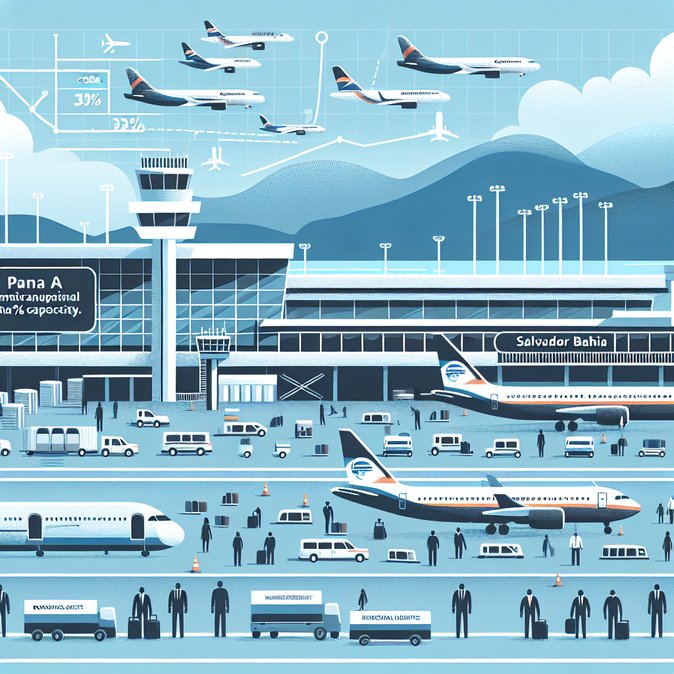
Vinci Airports, operator of Salvador Bahia International, unveiled its high-season timetable on Friday (5 December), forecasting 1.6 million seats between 15 December 2025 and 31 January 2026—up 14 % on last year and the terminal’s highest capacity since the concession began in 2018. Domestic growth (13 %) is led by GOL’s additional Rio and São Paulo frequencies and Azul’s seasonal forays into inland corporate centres such as Ribeirão Preto and Uberlândia.
International supply jumps an even steeper 31 %. The big story is Copa Airlines’ new Panama City service, opening one-stop connectivity to Central America and the Caribbean. Air France upgrades its Paris run to thrice-weekly wide-body flights, while Flybondi lifts Argentina capacity by 74 % across Buenos Aires and Córdoba. Airport commercial director Júlia Orrico expects a single-day record of 36,000 passengers on 2 January and has boosted staffing 20 % to keep immigration desks fully manned.
![Salvador Bahia Airport Adds 14 % More Seats and New Copa Link Ahead of Peak Season]()
For mobility teams, the expansion reduces dependence on the São Paulo–Rio axis, allowing project crews and assignees to land closer to oil-and-gas, renewable-energy and agritech clusters in northeastern Brazil. Travel managers, however, should brace for fare volatility: Amadeus data already shows average prices sitting 18 % above last summer.
Corporate security advisers note that Bahia’s state government has deployed extra military-police patrols inside the terminal and on the airport-city highway, addressing long-standing concerns about seasonal petty crime.
Action points: confirm hotel allotments early, monitor dynamic pricing around holiday peaks and remind travellers that Salvador’s immigration counters now accept e-channels for holders of Mercosur IDs, further trimming arrival times.
International supply jumps an even steeper 31 %. The big story is Copa Airlines’ new Panama City service, opening one-stop connectivity to Central America and the Caribbean. Air France upgrades its Paris run to thrice-weekly wide-body flights, while Flybondi lifts Argentina capacity by 74 % across Buenos Aires and Córdoba. Airport commercial director Júlia Orrico expects a single-day record of 36,000 passengers on 2 January and has boosted staffing 20 % to keep immigration desks fully manned.

For mobility teams, the expansion reduces dependence on the São Paulo–Rio axis, allowing project crews and assignees to land closer to oil-and-gas, renewable-energy and agritech clusters in northeastern Brazil. Travel managers, however, should brace for fare volatility: Amadeus data already shows average prices sitting 18 % above last summer.
Corporate security advisers note that Bahia’s state government has deployed extra military-police patrols inside the terminal and on the airport-city highway, addressing long-standing concerns about seasonal petty crime.
Action points: confirm hotel allotments early, monitor dynamic pricing around holiday peaks and remind travellers that Salvador’s immigration counters now accept e-channels for holders of Mercosur IDs, further trimming arrival times.